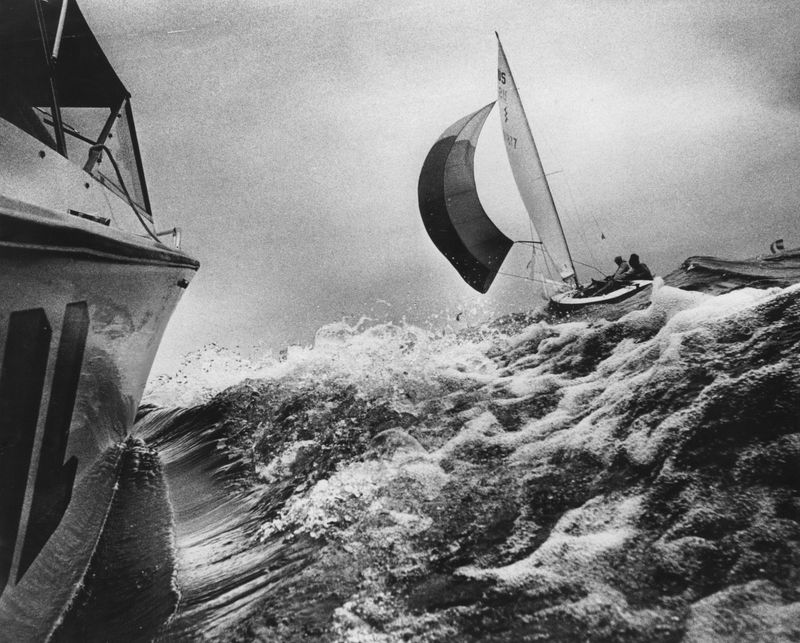
It only takes a quick glance at Lake Michigan this time of year to see that it looks anything but inviting.
The wind cuts in from every direction, waves build without warning and the water churns with a cold, erratic energy.

Waves on the Great Lakes are steeper and packed closer together than on the ocean, making them harder to read and faster to change.
Experts say that volatility can make navigating the Great Lakes even more dangerous than the open ocean.
Paul Christensen, vice president of vessel operations for Interlake Maritime Services — who has sailed on both the ocean and Great Lakes — said that waves on the Great Lakes build up much faster than on the ocean. Christensen compared it to the difference between a swimming pool and a bathtub — it doesn’t take as much energy to get water moving in a smaller space.
Advances in technology and forecasting — particularly since the SS Edmund Fitzgerald went down in 1975 — have made the lakes safer. But, Christensen warned the lakes shouldn’t be underestimated.
Here’s the science behind how and why waves in the Great Lakes can actually be more treacherous than the oceans.
Choppy lake waves versus smooth ocean swells
Weather in the Great Lakes is erratic with the meanest coming in mid-October through November, infamously known as the gales of November.
In the Great Lakes, waves are created by wind from storms nearby. They build up fast and are referred to as locally generated seas, said John Lenters, a climate and lake scientist at the University of Michigan. These seas tend to be small and irregular, causing choppy conditions.
And if a storm is sitting right on top of a vessel, it can be like being inside a hurricane, Lenters said.
Oceans are much more vast, so any vessels are much more likely to be dealing with swells — which are older, leftover waves coming from distant storms, Lenters said. Swells are smoother and much more spread out. The salt in ocean water can help weigh the waves down, although only slightly.
It’s a lot more comfortable to be on a 20-foot swell in the ocean than it is to be on 20-foot seas in Lake Superior, Lenters said.
While swells happen on the Great Lakes, they are rarer. By the time a wave can become a swell it hits a shoreline. Whether waves have time to turn into swells depends on the fetch, or the distance wind travels over open water before it hits a shoreline, which allows waves to build power and momentum.
Ships can ride multiple waves at once in the Great Lakes
Besides being a rougher ride, waves travel much closer together on the Great Lakes than they do in the ocean. In the ocean, waves usually travel more than 10 seconds apart, providing enough distance for large ships to sail in between them, Lenters said.
But in the Great Lakes, Lenters said, typical wave periods can be between two and five seconds — so a large ship can sit on multiple waves at once.
If the bow and stern of a heavy-laden ship are both sitting on a wave crest, the ship’s hull can sag. Likewise, if a wave crest is midship, the hull can bend upwards, draping over the crest, which is referred to as hogging.
The constant bending every few seconds can cause metal fatigue over time, which is why some ships have even been known to snap in half on the Great Lakes. An example includes the SS Daniel J. Morrell, which sank in Lake Huron on Nov. 29, 1966, during a storm.
One of the biggest dangers to mariners is the steepness of waves, Lenters said, especially when an intense storm forms rapidly, creating a flat to rough sea state in a matter of minutes. Steep waves are much more powerful when they break, potentially capsizing boats or damaging ships when they crash into them.
The largest ships that traverse the Great Lakes experience a rougher ride because they are long and skinny, said David Schwab, a retired oceanographer with the National Oceanic and Atmospheric Administration, or NOAA.
Great Lakes waves are different in the fall, spring
In general, the faster the wind blows, the more destructive waves become — but the increase is much more dramatic than you’d expect. For instance, when the wind speed doubles from 20 to 40 miles per hour, the waves don’t get twice as powerful — they will be around 16 times as powerful.
And globally, winds and waves are becoming stronger than ever with climate change.
In the middle of the ocean, the wind is generally travellng in one prevailing direction, Schwab said. However, in the Great Lakes, strong winds can be coming from multiple directions at once, a big contributor to seasickness.
And how predictable — or unpredictable — waves are can vary based on air temperature.
Over the ocean, the air spends a long time in contact with water, and because of this, air and water temperatures become similar, reaching an equilibrium, Schwab said. This creates waves that are much more predictable.
Waves in the Great Lakes are more unpredictable due to the big temperature differences between the land and water, Schwab said.
In the spring, when warm air moves over cold water, the air is smoother and more stable, creating smaller waves. In the fall, when cold air moves over warm water, the air gets bumpy, pushing water harder and creating larger waves.
Freshwater freezes faster than salt water
Freezing temperatures can also be more of a hazard during rough seas on the Great Lakes compared to the ocean, Christensen said.
Freshwater sprayed onto ships from waves and rain freezes faster than salt water does in the ocean. That’s because salt lowers the freezing point of water, meaning it has to be colder for salt water to freeze.
Not only can a ship become coated in ice quickly, Lenters said, but that ice can add significant weight to ships.
Edmund Fitzgerald tragedy led to better wind, wave forecasting
The sinking of the Edmund Fitzgerald in 1975 – the last commercial ship to sink in the Great Lakes – sparked significant steps in improving weather forecasting in the region.
NOAA’s Great Lakes Environmental Research laboratory in Ann Arbor was created the year before the Fizgerald sank. Schwab was among the first scientists helping to better understand wind, waves and quick-building storms in the region.
Since then, a network of buoys have helped gather real-time weather data as well as expanded satellites, radar and computer modeling, which ultimately give those out on the lakes better read time for weather changes.
Caitlin Looby covers the Great Lakes and the environment for the Milwaukee Journal Sentinel. Reach her at clooby@gannett.com and find her on X @caitlooby. All of her work and coverage decisions are overseen solely by Journal Sentinel editors.
Caitlin is an Outrider Fellow whose reporting also receives support from the Brico Fund, Fund for Lake Michigan, Barbara K. Frank, and individual contributions to the Journal Sentinel Community-Funded Journalism Project. The project is administered by Local Media Foundation, tax ID #36‐4427750, a Section 501(c)(3) charitable trust affiliated with Local Media Association.
Learn more about our community-funded journalism and how to make a tax-deductible gift at jsonline.com/support. Checks can be addressed to Local Media Foundation with “JS Community Journalism” in the memo, then mailed to: Local Media Foundation, P.O. Box 85015, Chicago, IL 60689.
This article originally appeared on Milwaukee Journal Sentinel: The Great Lakes can be more dangerous than the ocean. Here’s why.
Reporting by Caitlin Looby, Milwaukee Journal Sentinel / Milwaukee Journal Sentinel
USA TODAY Network via Reuters Connect