Whatever happens this November, Wisconsin is going to end up with one of its most improbable governors ever.
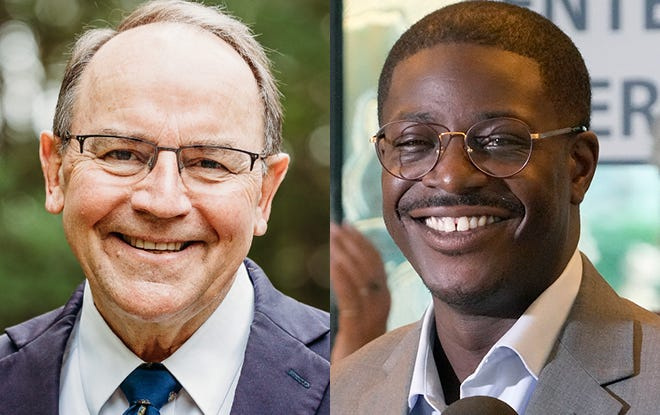
As a result of Tuesday’s primary elections, Republican congressman Tom Tiffany will face Democratic Milwaukee County Executive David Crowley, who pulled off a historically narrow primary victory and a historically big upset over Madison state lawmaker Francesca Hong.

What makes each of these men an unlikely governor?
Let’s start with Crowley, whose bid for governor appeared to be over last month when he dropped out of the race for 10 days and endorsed another candidate (Lt. Gov. Sara Rodriguez) after seemingly going nowhere in this campaign. Then he jumped back in when the Rodriquez campaign abruptly unraveled and rode a very late surge to claim Wisconsin’s closest gubernatorial primary victory in more than 80 years.
Crowley would be the first elected Democrat from Milwaukee to win a governor’s race since the 19th century, Wisconsin’s first Black governor, and – at 40 – one of its youngest.
Then consider Tiffany, a Trump-aligned 68-year-old Republican running in one of the worst mid-term climates for his party in decades, thanks to President Donald Trump’s poor and declining approval ratings.
His election would be just the second victory in the past 10 Wisconsin gubernatorial races for the party of the sitting president, a testament to the well-established penchant of restive voters to punish the powers in Washington. Tiffany is fighting that dynamic in this race.
Tiffany would be one of the oldest candidates elected Wisconsin governor, one of the few from northern Wisconsin, and the first sitting U.S. House member ever elected to lead this state.
Takeaways from Wisconsin’s surprising primary
Here are some takeaways about Tuesday’s big Democratic surprise, followed by some thoughts about the general election matchup in November:
∎ A historic Democratic turnout produced the closest primary for governor since 1942, when the Democratic race was decided by just under one-third of a point (though that primary wasn’t nearly as meaningful, since Democrats were the third most popular party in Wisconsin at the time behind Progressives and Republicans).
This 2026 Democratic primary generated almost 800,000 votes, far more than any previous gubernatorial primary in either party, a byproduct of the huge stakes in this election, the surge in national attention the campaign received in the closing weeks and the historic nature of Hong’s candidacy as a democratic socialist.
∎ Crowley’s big upset after trailing badly in the polls forces everyone to recalibrate for the fall, including Republicans, who were clearly hoping to run again Hong, a state lawmaker from the bluest part of one of America’s bluest cities, whose politics and past statements (about things such as canceling Thanksgiving and defunding police) would have been the target of relentless GOP attacks and news coverage this fall.
∎ As in the recent Michigan U.S. Senate primary, the end result turned out to be a lot less comfortable for the candidate of the left than polls had suggested. Hong easily led in virtually all the public and private polls that were released, prompting huge questions now about polls’ reliability.
Three explanations for the polling “miss” possible. One, the surveys captured the level of Hong’s support, but were largely completed before the final critical political shifts in the race, when Hong’s support flattened, attention to her most controversial statements spiked, and voters who were worried about either her politics or her electability largely consolidated behind Crowley, thanks in part to his support from Gov. Tony Evers (and Milwaukee Cong. Gwen Moore).
Two, Hong’s very liberal support base included people who were more eager to respond to surveys than other voters, thus skewing the results.
And three, primary polls tend to deviate much more from the final result than general election polls, because voters are much more predictable in their choices between two parties than within their own party. Add to that Wisconsin’s open primary system in a state with no party registration; anyone no matter their politics can pick which primary to vote in, making it harder to predict the makeup of the electorate.
When it comes to political narratives, fairly or not, the polling had the effect of turning the story of her campaign from one about the dramatic rise and insurgency of a left-wing Democrat into one about the limits of socialist and progressive appeal in a purple midwestern state.
∎ With the state’s two biggest counties (Milwaukee and Dane) mostly splitting their vote, Crowley’s support in dozens of small rural counties was crucial to his victory, and a sign of the limits of Hong’s appeal in rural Wisconsin.
As expected, Hong carried metro Madison and Crowley carried metro Milwaukee, but the gap between those two powerhouse Democratic counties was more modest than some expected. Hong won most of the counties that were strongest for Bernie Sanders in his 2016 victory over Hillary Clinton in the Wisconsin presidential primary, but won them by a lot less.
∎ The head-snapping Crowley upset that concluded the Democratic contest was simply the last in an outlandish series of unforeseen developments, starting with Hong’s ascension to frontrunner in a crowded field, the failure of other Democrats to gain traction, the implosion of Lt. Gov. Sara Rodriguez’ campaign, Crowley’s re-entry, and the withdrawal of early favorite Mandela Barnes.
Up to the very end, nothing went according to script in this campaign.
Wisconsin’s penchant for persistently close races magnifies every possible tipping point and minor election twist, from candidate missteps to the vagaries of the election system to the role of early voting to the departure and re-entry of individual candidates to their strategy and tactics to the power of political endorsements and the impact of “non-endorsements.”
In one sense, there is a randomness to the outcome of elections this close; in another, you can plausibly argue that any of a long list of factors were decisive.
The unofficial vote margin between Crowley and Hong (around 3,000 votes) was smaller than the number of early votes cast for both Rodriguez and Barnes before their withdrawals, and far smaller than the votes cast for the third and fourth place candidates Kelda Roys and Joel Brennan, who were both subject to speculation about whether they would drop out before Tuesday. Neither did.
One of the crazier twists was that at the end of the vote count, Crowley’s tenuous lead was threatened by the looming release of the city of Milwaukee’s absentee ballots (a déjà vu moment for election watchers now conditioned to the late-night Milwaukee ballot dump).
Were those ballots from his home city going to favor Crowley? Or would they hurt Crowley because many of those votes were cast early and before his late surge in the campaign.
Early voting in primaries can be fraught
Tuesday’s results underscored the fact that unlike in a general election, casting an early vote in a competitive multi-candidate primary can be very fraught, given the potential for the field to change, the horse race to change, and the possibility that the candidate you vote for may be derailed before the election, resulting in a “wasted” vote.
Looking ahead to the general election, the political contrast between Crowley and Tiffany is not quite as extreme as it would have been if Hong had won the primary, but it’s dramatic.
The age difference between these two (28 years) is one of the biggest for Wisconsin governor in a century.
The geographic contrast is as stark as it gets: a Republican from the rural red north representing the most pro-Trump congressional district in Wisconsin in 2024 versus the executive of the state’s biggest county whose hometown, Milwaukee, voted against Trump in 2024 by 56 points. Crowley hails from the most densely populated corner of the state, Tiffany from its least densely populated U.S. House district.
Neither Tiffany nor Crowley was particularly well known statewide going into this race and each will now weather a furious effort by their opponents to define them in the most negative way possible. Money will figure heavily in those efforts.
Had Hong won the primary, she would have been regarded as an underdog against Tiffany by many in the political world. But Crowley’s victory presents a different calculus, and it may make it more challenging for Republicans to overcome a political climate defined by Trump’s unpopularity and the baggage of being the party in power in Washington.
Polling suggests Democratic voters are more energized than Republicans, which could portend a Democratic turnout advantage. Republicans in the Trump era have had little margin for error in Wisconsin. They have lost the majority of major races, and it has been a decade since they won a big election (for governor, U.S. Senate or president) by more than a single point.
At the same time, Democrats are trying to do something they have never done in the state’s 178-year history – hold the governor’s office for more than eight consecutive years, as well as win a rare trifecta by also recapturing the two chambers of the state Legislature.
To do that they will have to overcome any lingering divisions amid the unfolding national tensions between progressives and democratic socialists on the one hand and moderates, pragmatists and more traditional liberals on the other. Though, if there is one thing Democrats are united about it is their intense opposition to Trump, who had a 98% disapproval rating among Wisconsin Democrats in Marquette’s July poll, and has a history of mobilizing Democratic voters here.
The past two elections for governor have been the closest in Wisconsin in more than 60 years, and the three highest mid-term turnouts have come in the past three mid-terms.
That was the rule in Tuesday’s Democratic primary: big turnout and tiny margins. But it is much more reliably the rule in November elections in 50/50 Wisconsin.
This article originally appeared on Milwaukee Journal Sentinel: Takeaways from Wisconsin’s primary, what it means for fall | Gilbert
Reporting by Craig Gilbert, Special to the Journal Sentinel / Milwaukee Journal Sentinel
USA TODAY Network via Reuters Connect
By Craig Gilbert, Special to the Journal Sentinel | USA TODAY Network