A sharp decline in Wisconsin’s largest remaining population of sharp-tailed grouse prompted Department of Natural Resources wildlife managers and an advisory committee to recommend no hunting season be held for the species this year.
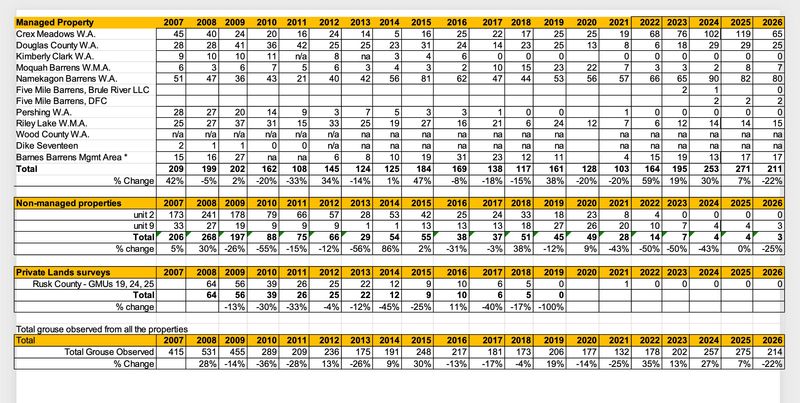
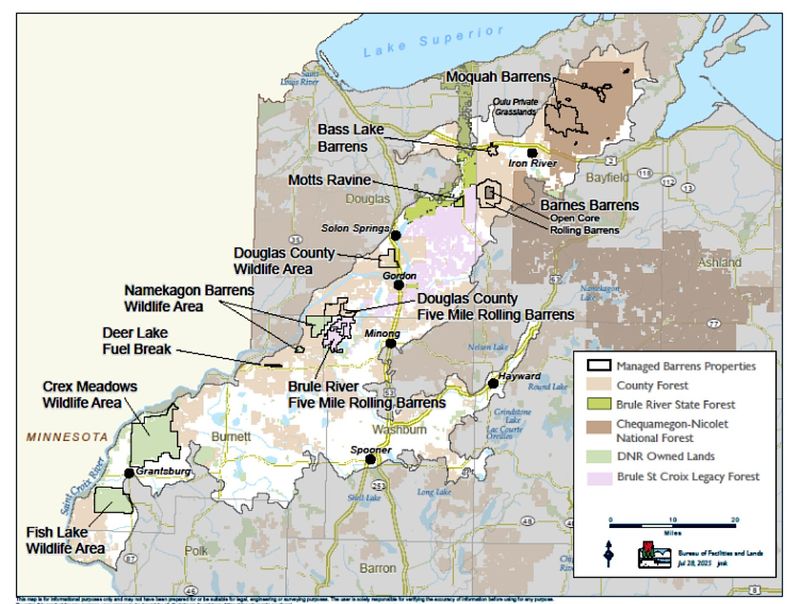
The department conducts lek, or breeding ground, surveys in spring to assess the species’ population. The work is done by counting male grouse as they dance and joust at 12 public properties and a handful of other sites with known or suspected populations of the species.

In 2026 DNR staff and volunteers counted 214 male sharpies in the state, a 22% year-over-year decline.
Importantly, the data showed the largest drop – from 119 birds in 2025 to 65 in 2026, or 45% – at Crex Meadows Wildlife Area near Grantsburg, the property that in recent years has hosted the most sharpies in the state.
In addition, it was the only management area open to sharp-tailed grouse hunting in 2025.
The state’s Sharp-tailed Grouse Advisory Committee met May 18 to review 2026 lek counts and other information related to the species. The advisory committee includes DNR staff and representatives of conservation and other groups. It is led by DNR wildlife supervisor Bob Hanson.
The number of male sharpies declined at all three of the public properties with the most birds, though the drops were smaller at Namekagon Barrens Wildlife Area (year-over-year decline of 2%) and Douglas County Wildlife Area (14%) than Crex.
Only males are counted on the dancing grounds; it is assumed the population contains about an equal number of females.
After reviewing the 2026 lek data, the advisory committee voted unanimously to not hold a sharpie hunting season this year.
The DNR’s wildlife leadership team met May 19 and agreed with the committee’s recommendation, Hanson said.
Although the DNR did not offer a definitive reason for the larger decline at Crex, Hanson said it was most likely related to weather and poorer than normal nesting success in 2025. Sharp-tailed grouse nest on the ground and generally have better chick survival in drier, warmer conditions.
“We know from past data our sharp-tailed grouse populations show quite a bit of variability,” Hanson said. “This year things were clearly on the downside of that.”
Sharp-tailed grouse are native to Wisconsin but have generally declined in number as the grassland and barrens habitat they require has diminished.
The habitat loss is largely attributed to grasslands being converted to agriculture and being overtaken by forests.
Intensive habitat improvement projects on a handful of public properties in northwestern Wisconsin have helped the species sustain itself in the state. Combined with habitat projects and some favorable brood-rearing weather, the state’s sharp-tailed grouse population showed annual increases from 2021 through 2025, according to DNR data.
In spring 2025 the DNR recorded 275 male sharpies in the state, a 7% year-over-year increase and highest since 2010. Last year the DNR recommended and the Natural Resources Board approved a sharp-tailed grouse hunting season, the first since 2018.
Hunters registered a kill of five sharp-tailed grouse in the 2025 Wisconsin hunting season, four males and one female, according to the DNR.
Only 12 permits were issued to state-licensed hunters for the season, the first for the species in the state since 2018. The season ran Oct. 18 to Nov. 9. Twelve permits were also available to Ojibwe tribes but no tribal harvest was reported by the Great Lakes Indian Fish and Wildlife Commission.
In 2025, 790 hunters applied for the 12 available state-licensed sharpie permits. The applications cost $3 each, raising $2,370 for the DNR.
Biologists in North Dakota reported lower sharp-tailed grouse harvest in 2025, likely due to lower chick survival that spring.
In 2025, hunters in North Dakota harvested 55,539 sharp-tailed grouse, a year-over-year decline of 24%, according to the North Dakota Game and Fish Department.
The hunt results followed a 38% drop in summer roadside brood counts of sharpies, according to RJ Gross, North Dakota Game and Fish Department upland game biologist.
“In addition to cool, wet weather in June (2025), which is unfavorable for chick survival, we suspect sharptails may have been impacted by West Nile Virus because they declined from spring surveys to late summer surveys,” Gross said in a statement. “Those declines appeared to have hampered the rebounding population, and the 24% drop in sharptail harvest reflects this.”
No disease effects, whether from highly pathogenic avian influenza, West Nile Virus or other wildlife diseases, were determined in the Wisconsin sharp-tailed grouse populations.
The recommendation for no Wisconsin 2026 sharp-tailed grouse hunting season is subject to additional approvals but is not expected to be changed.
This article originally appeared on Milwaukee Journal Sentinel: No Wisconsin hunt expected for sharp-tailed grouse in ’26 after population decline
Reporting by Paul A. Smith, Milwaukee Journal Sentinel / Milwaukee Journal Sentinel
USA TODAY Network via Reuters Connect