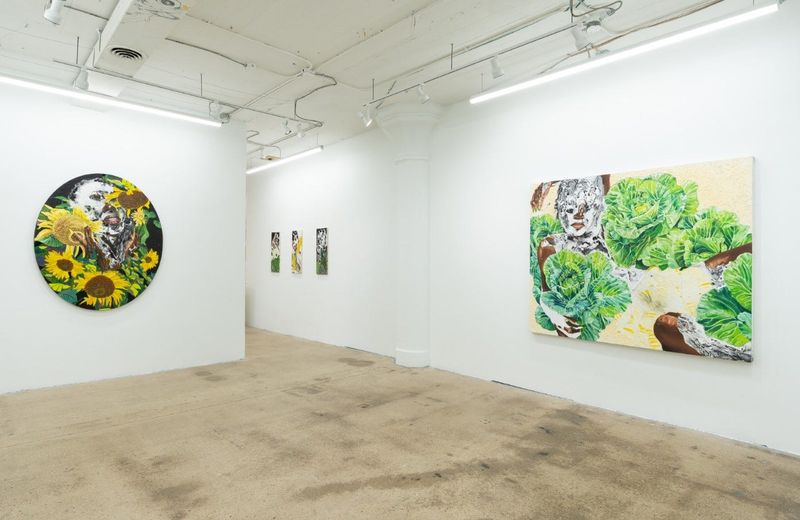
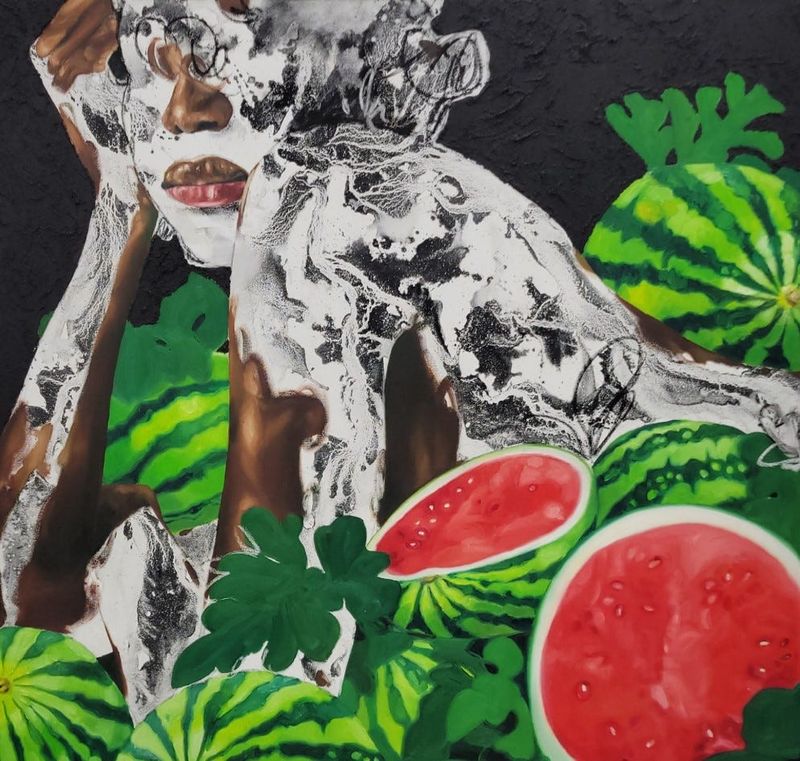
In a richly provincial landscape, where the soil sprouts with crisp cabbage heads, ripened tomatoes and plump watermelon, a world entirely Khari Turner’s own emerges.
Though he resides in Brooklyn, Turner has brought perhaps his most personal show yet to Milwaukee, where he was born and raised.

On view at the Portrait Society Gallery through Aug. 22, “My Grandmother’s Garden” features a survey of Turner’s work over the past two years.
But the centerpiece, which inspired the exhibition’s name, is a reverent exploration of his upbringing tending to his grandmother’s vegetable garden. That body of work, painted across ambitious scales and sharing striking motifs, took Turner six months, according to Portrait Society Gallery owner Debra Brehmer.
“I was dumbfounded by that level of ambition and care,” Brehmer said.
Turner began laying beds and tending rose bushes in his grandmother’s north Milwaukee garden at 11 years old; a skill he remembers as especially formative, shaping both his professional work ethic and his character.
“There’s certain things that you learn that I don’t think you can get anywhere else, especially now,” Turner said, noting how his understanding of delayed gratification, patience and hard work has made him a better artist and man.
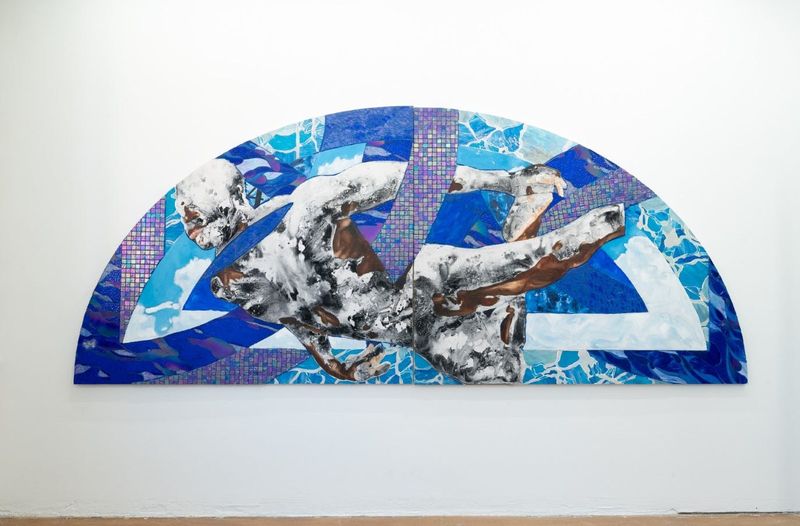
Before his grandparents constructed the garden, they had an in-ground pool put in, fulfilling a long-held dream. Though Turner’s grandmother couldn’t swim, she imparted the importance of the skill onto her grandchildren – teaching them that it was a matter of survival in a coastal city.
Since very early in his practice, Turner has been fascinated by the many meanings water carries – as a historical landmark, a chemical compound, a baptismal symbol, an indestructible resource, and a vital necessity.
When he renders his silhouettes, he mixes a dark ink with water sourced from his travels – places like the Senegalese and Caribbean coasts, or other bodies of water that have deep resonance in African American history – to create a fractal effect signature to his work.
Though this practice started out of pure experimentation, it has become a ritual for Turner to honor and imagine the lives of enslaved Africans who drowned during the Middle Passage. Their bodies and stories have become part of those oceans, Turner said.
Rather than blending, the ink – less dense than the saltwater – trails behind until the water dries. According to Turner, that’s a kind of symbol, too.
“Essentially, I’m thinking, if [that] water could leave a message, what would that message be?” he said.
In Turner’s work, I hear whispers of enslaved mythologies where captured Africans were welcomed by the sea and the sky.
I see flying Africans who jumped ship during the Atlantic Slave Trade, soaring through the skies to find their homeland. I see the underwater world of Drexciya, where the babies of enslaved pregnant women thrown overboard during the Middle Passage learned to breathe underwater and built a thriving civilization in the depths of the sea.
His visual tales sit among these oral historians’, extending their philosophy that the natural world is a baptismal refuge.
He paints his figures on top of the ink and water silhouette, using acrylic paint to depict select features of the face and body – often a nose and a mouth, sometimes a hand or a calf.
“History teaches that there’s things that happened to people, but you don’t know those people. You don’t know exactly what happened to them,” he said. That disconnect between our understanding of history and what actually happened to each individual is why Turner’s silhouettes are disjointed and only tell part of the story.
Turner’s show will be the Portrait Society Gallery’s last exhibition before its move to Walker’s Point, Brehmer said. The gallery, 207 E. Buffalo St. Suite 526, is open noon to 5 p.m. Thursday through Saturday.
To close the show on Aug. 22, Turner will be in conversation with formerly Milwaukee-based artist Tyanna Buie, who is now represented by the Portrait Society Gallery, at Gee’s Clippers barbershop, 2200 N. King Drive. The free talk, sponsored by the Portrait Society Gallery and Bronzeville Center for the Arts, will begin at 6:30.
Anya Sesay covers arts and culture for the Milwaukee Journal Sentinel. Send her story ideas, things to see and people to meet at asesay@usatodayco.com. Follow her on Instagram @anyanic0lette.
Anya’s reporting is supported by the Richard and Ethel Herzfeld Foundation, the Maine-based Rabkin Foundation, and reader contributions to the Journal Sentinel Community-Funded Journalism Project. Journal Sentinel editors maintain full editorial control over all content. To support this work, visit jsonline.com/support. Checks can be addressed to Local Media Foundation (memo: “JS Community Journalism”) and mailed to P.O. Box 85015, Chicago, IL 60689.
The JS Community-Funded Journalism Project is administered by Local Media Foundation, tax ID #36-4427750, a Section 501(c)(3) charitable trust affiliated with Local Media Association.
This article originally appeared on Milwaukee Journal Sentinel: New York’s Khari Turner brings most personal show home to Milwaukee
Reporting by Anya Sesay, Milwaukee Journal Sentinel / Milwaukee Journal Sentinel
USA TODAY Network via Reuters Connect

By Anya Sesay, Milwaukee Journal Sentinel | USA TODAY Network