In December, a number of us sat at a half-empty conference room table. Milwaukee Public Schools and teachers’ union officials refused to attend a meeting to talk about improving educational results in Milwaukee leaving only interested Milwaukee stakeholders and Republican representatives.
Unfortunately, MPS, on the whole, has failed. It is a political hot potato, the “third rail of Milwaukee politics.”

Milwaukee certainly has some unique challenges. MPS serves the highest percentage of students from economically disadvantaged backgrounds, students with disabilities, and English learners. Declining enrollment due to demographic forces, competition with charter and voucher schools, and workforce shortages further complicate matters.
Comparatively, MPS receives more aggregate total revenue than the four next-largest school districts combined and more than the lowest 191 school districts combined. MPS’s per-pupil revenue is the 82nd highest out of 421 school districts in Wisconsin, effectively in the top 20%.
Wisconsin expects better results with money spent
For the educational establishment and their advocates, there is never enough money. For the rest of Wisconsin, we expect better results with the money spent.
We are all painfully aware of the MPS financial reporting fiasco. The scandal cost the previous MPS superintendent his job, cost the state $2.5 million for the audit ordered by the governor, allowed for the passage of a $252 million referendum that adversely impacted over 300 school districts statewide over multiple years, and it took 642 days for MPS to meet the legal requirement.
Compliance is not a strong suit for MPS. Over a decade ago, the Opportunity Schools Partnership Program was created and abandoned. The initial Commissioner, Demond Means, quickly resigned in frustration, saying, “It is now clear to me that as implementation of the law moves forward, the environment is not conducive to collaborative partnerships — something essential for positive things to happen in Milwaukee.” No new commissioner has been appointed since.
Just a couple of years ago, 25 School Resource Officers were mandated by law to be put into MPS schools. It took a private action court case and a courageous judge to enforce the law, and 636 days after enactment, SROs were finally in Milwaukee schools.
In June of 2024, after the most recent MPS referendum, as an independent effort, I began gathering information from stakeholders to explore potential reforms that might be most effective. I arranged meetings with every legislator who would agree to speak, both Democrats and Republicans, other interested parties, and subject matter experts.
I met with folks from the business community, elected city and county officials, and people from education think tanks. Everyone with whom I met was provided an updated working draft document that incorporated a wide range of ideas, including those from the participants. There was no formal legislation proposed, just ideas, conversation starters. It was an open invitation for innovation.
So, how did we get to the half-empty table?
In June 2025, I reached out to Superintendent Cassellius, but she stonewalled.
At the end of August, we finally had a preliminary meeting, after which my office received zero feedback in spite of repeated requests. In November, we invited the superintendent to the December meeting with the speaker of the Assembly, legislators, and other community stakeholders to explore collaboration and possible legislative action. The superintendent declined.
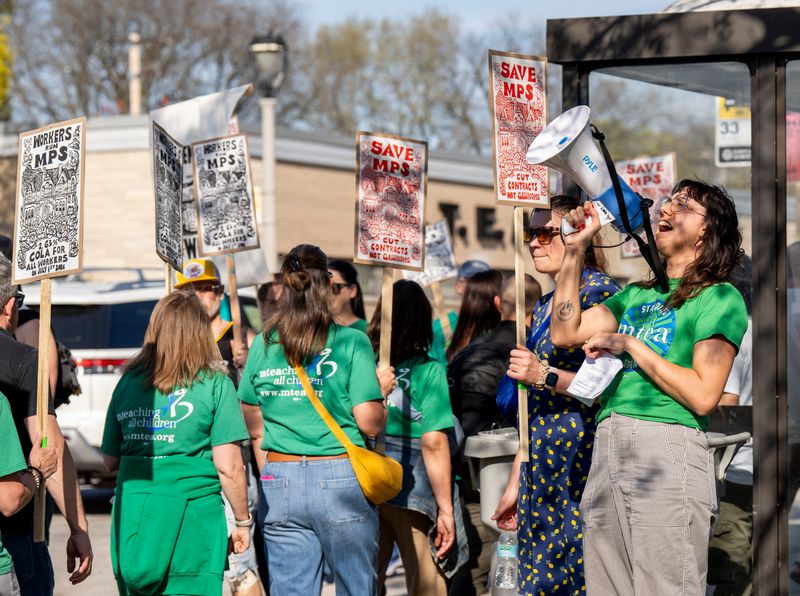
Milwaukee Teachers Education Association’s brazen actions
Even more brazen was the Milwaukee Teachers Education Association. After a July 2025 request to meet, we received a polite reply in August — they would offer possible dates for a meeting. Repeated follow-up was ignored. In November, the MTEA was invited to send a representative to the meeting with the speaker et al. Not only did they decline, but they also sent an email to the invited Democratic legislators, which, given the political clout of the union, could be construed as a threat of retribution if they attended the December 10 meeting.
Thus, the half-empty room, a perfect illustration of the obstruction culture identified in the governor’s audit.
The blatant resistance makes it clear to me that something dramatically different needs to happen. While Cassellius is trying, her efforts alone will not be enough to create the lasting change that we all desire. A turnaround and improvement of MPS will need more than one person’s grit.
MPS’s woes are baked into the culture of the organization. After an initial honeymoon, solo acts, like Cassellius, yield diminishing returns when there is resistance. Without external pressure, we’re dooming Wisconsin’s largest district to endless referendums, eroding public trust, and a complete abandonment of the notion of academic excellence. Workforce be damned. Hope for better futures be dashed. Without state intervention, Cassellius is just the captain on a sinking ship who can only order the crew to bail water.
State Rep. Scott Allen has served in the legislature since 2015, and currently represents the 82nd Assembly District comprised of most of the City of Waukesha and parts of the Village of Waukesha.
This article originally appeared on Milwaukee Journal Sentinel: MPS is doomed to failure without external intervention | Opinion
Reporting by Scott Allen, Special to Milwaukee Journal Sentinel / Milwaukee Journal Sentinel
USA TODAY Network via Reuters Connect