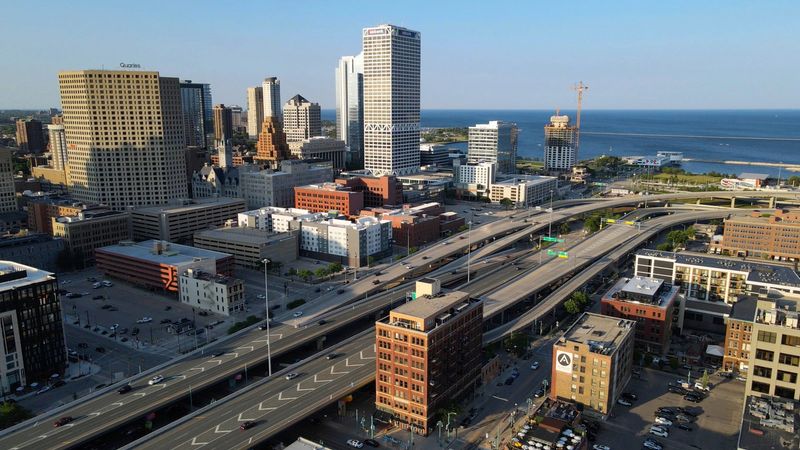
Interstate 794’s possible removal in downtown Milwaukee would create nearly $500 million in potential development opportunities by 2050, according to a new Wisconsin Department of Transportation study.
However, that project also would likely bring more car crashes, including fatal ones, because of increased traffic congestion — mainly on downtown streets.

Meanwhile, changes to I-794, either removing part of it or reconfiguring the freeway, would cost an estimated $675 million to $1.25 billion.
That’s among the new information within WisDOT’s updated study of options for I-794. That update was posted prematurely on the project’s website on April 29 before being removed.
The posting happened before an April 30 project open house running from 4:30 p.m. to 7:30 p.m. at the Milwaukee Marriott Downtown, 625 N. Milwaukee St.
WisDOT is considering four options for repairs to the aging freeway. The department is to choose a plan in 2027, followed by final design work and a possible 2030 construction start if the project obtains federal and state funding.
Options include removing, reconfiguring I-794
One option being studied by WisDOT calls for replacing I-794 between roughly North Sixth Street and the Hoan Bridge’s northern approach, near East Buffalo Street, with an expanded two-way Clybourn Street and extensions of North Cass Street and East St. Paul Avenue.
That would open up 16 acres for development.
Two other options focus on improvements that include reconfiguring on- and off-ramps, and extending Cass Street and St. Paul Avenue – opening up 5 acres for development.
A fourth option would make freeway repairs with no ramp changes.
Some downtown property owners and business operators oppose replacing the freeway with surface streets. They’re concerned that would bring traffic congestion, including in the Historic Third Ward.
A WisDOT analysis, released in November, forecasts more congestion at several downtown intersections if the freeway is removed.
That would be exacerbated by frequent Clybourn Street bridge lifts during the summer boating season. Also, congestion would increase on freeways that connect to I-794.
Congestion brings car crashes, WisDOT says
The latest WisDOT study says keeping an elevated freeway is a key factor in reducing car crashes on surface streets compared with removing the freeway.
Also, freeway removal would bring more difficulties for downtown pedestrians due to longer street crossing distances and increased traffic volumes, the study says.
WisDOT “is tacking on congestion crashes assuming that traffic won’t adapt” to freeway changes, said Larry Witzling, a representative of Rethink 794, a group which supports removing I-794.
“You start by taking down the freeway, then you slow down traffic, then you get more people walking, then you get safer streets,” Witzling, a longtime planner, told the Milwaukee Journal Sentinel.
That updated plans envision Clybourn Street with as many as eight lanes for 14,000 to 26,000 vehicles daily under the freeway removal option.
But Clybourn Street would generally have four thru lanes except for a busier stretch between roughly North Second and North Water streets, said David Pittman, a WisDOT project manager.
Under the freeway reconfiguration options, Clybourn Street would have three to four lanes for 6,900 to 8,400 vehicles daily, WisDOT says.
An eight-lane Clybourn Street would be overkill by WisDOT, said Taylor Korslin, a Rethink 794 representative.
“If you build it for many cars, it will carry many cars,” Korslin said.
Streets can handle increased traffic, says Rethink 794
Freeway removal supporters say I-794 is underused and downtown streets can handle increased traffic. They cite the Park East Freeway’s replacement by development on downtown’s northern edge as well as similar projects in other cities.
Removing I-794 would bring commercial developments that create jobs as well as tax revenue for the City of Milwaukee, Milwaukee Public Schools, and Milwaukee County, according to Rethink 794.
The updated WisDOT study says the freeway removal’s long-term development potential includes 470 to 850 residential units; 330 to 600 hotel rooms, and 300,000 to 500,000 square feet of offices.
That would total an estimated $270 million to $490 million of new development by 2050.
The two options of reconfiguring the freeway carry a development potential of 490 residential units, 340 hotel rooms, and 315,000 square feet of offices – totaling $280 million.
Repairing the freeway without ramp changes would maintain a 2.7-acre development site WisDOT owns at North Lincoln Memorial Drive and East Clybourn Street. That site has remained vacant for several years.
The options of reconfiguring I-794, instead of removing it, would create similarly underwhelming development sites near freeway off-ramps, said Gard Pecor, of Rethink 794.
WisDOT estimates the freeway configuration options would cost an estimated $675 million to $1 billion, and take two to four years to complete.
The freeway removal option has an estimated cost of $850 million to $1.25 billion, and take four to six years.
Hoan Bridge won’t change
Improvements are needed because some freeway sections date to 1974, WisDOT says.
They weren’t touched when part of I-794 was reconstructed from 2013 through 2016 — a $239 million project that included rebuilding the Hoan Bridge’s concrete deck. The bridge is not part of the current improvement plans.
Both the removal option, and the two alternatives involving ramp reconfigurations, call for changes at the Lincoln Memorial Drive/Clybourn Street intersection.
WisDOT’s study found drivers are confused by the intersection’s dual purpose: providing a connection with the Hoan Bridge/I-794 and a surface street connection with the Third Ward.
Another project open house will be from 4:30 to 7:30 p.m. May 5 at St. Francis High School, 4225 S. Lake Drive.
Tom Daykin can be emailed at tdaykin@jrn.com and followed on Instagram, Bluesky, X and Facebook.
This article originally appeared on Milwaukee Journal Sentinel: I-794 removal could bring $500M in development, but more crashes
Reporting by Tom Daykin, Milwaukee Journal Sentinel / Milwaukee Journal Sentinel
USA TODAY Network via Reuters Connect