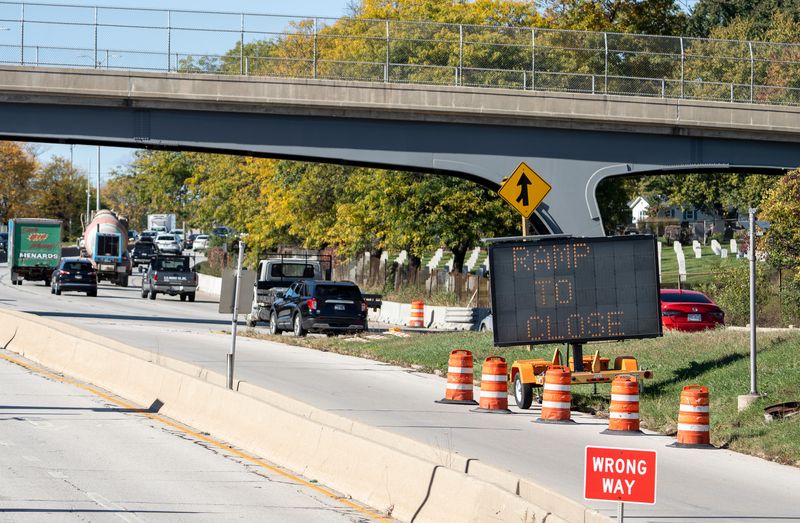
The $1.7 billion Interstate 94 East-West corridor expansion project, which started Nov. 3 and will cover a 3.5-mile stretch of the freeway between 16th and 70th streets on Milwaukee’s west side, is scheduled to take eight years to complete.
The project will reconstruct aging roads, widen the freeway from three to four lanes in each direction, and redesign the Stadium Interchange to a diverging diamond interchange.

Construction is expected to finish in 2033, though some stretches of highway will be completed earlier, according to the Wisconsin Department of Transportation.
The project’s first section is scheduled to last from 2025 to 2028 along the “West Leg” section of I-94, which runs from 70th Street to Zablocki Drive, west of the Stadium Interchange. It’ll include lane closures.
Some construction will also begin this year on St. Paul Avenue and 27th Street intersecting the interstate, east of the Stadium Interchange.
The “East Leg” section running from 35th Street to 17th Street east of the Stadium Interchange is scheduled for construction from 2028 to 2030.
Work on the Stadium Interchange will begin in 2029 and is to finish in 2033.
One family and six businesses had to relocate to make way for the I-94 project, according to WisDOT. The agency gave financial assistance to those it displaced.
Here’s more about the I-94 East-West project:
What are the project’s goals?
WisDOT said the I-94 East-West project is necessary to repair highway infrastructure built in the early 1960s.
“The corridor is nearing the end of its useful life cycle,” the agency said in an overview of the project. “Reconstructing the corridor with the approved plan will ensure that I-94 serves the economy of Southeastern Wisconsin for decades to come.”
Widening the corridor from three to four lanes in each direction will improve safety and reduce congestion, WisDOT and other supporters of the project said.
Critics of the project said the corridor could be reconstructed without adding more lanes. Expanding the highway will result in more pollution and disproportionately hurt people of color living near the highway, they said.
In August 2024, a group of activist organizations, including the Milwaukee Inner-City Congregations Allied for Hope and the Sierra Club, filed a civil rights lawsuit challenging the I-94 lane expansion.
The lawsuit said WisDOT failed to properly analyze potential negative environmental and transit equity impacts the project would have on residents living near the interstate. The department has denied those claims.
What are its most notable changes?
In addition to the expansion from six to eight lanes, the reconstructed highway will turn the Stadium Interchange into a diverging diamond interchange.
A diverging diamond interchange directs vehicles to briefly cross over onto the opposite side of the road, with a pair of traffic signals to control the flow of traffic. WisDOT said this design would save around $80 million in construction costs compared to alternatives.
Though studies have shown diverging diamonds generally improve road safety, the agency projected that the new Stadium Interchange will see a greater number of crashes.
Diverging diamond interchanges primarily increase safety by removing left turns against oncoming traffic on surface streets, but the current Stadium Interchange doesn’t involve surface streets.
Hawley Road interchange will be dramatically different
The project will also rebuild the Hawley Road Interchange as a half-interchange. Access to and from the half-interchange will come only from the west.
The section of Hawley Road near I-94 will include trail improvements for cyclists and pedestrians, including a new access point to the Hank Aaron State Trail near 64th Street and a connection between the Hank Aaron State Trail and Oak Leaf Trail.
Construction on the Hawley Road Interchange will begin this year and is expected to finish in 2028.
How is the project being funded?
Most of the cost of the expansion is covered by the federal government, WisDOT spokesperson Trevor Fannon said.
WisDOT estimates that 58% of total project funding comes from the federal government, 40% from the state and the remaining 2% “from bond and local sources,” Fannon said.
Former Republican Gov. Scott Walker proposed the initial version of the project, but he canceled it in 2017 after the state struggled to pay its share of the cost.
Gov. Tony Evers, a Democrat, revived the project in 2020 with support from the Republican-controlled state Legislature. Earlier this month, Evers approved $121 million for construction on the West Leg section.
What is the status of the lawsuit against the project?
The lawsuit challenging I-94’s expansion is still pending in U.S. District Court.
The plaintiffs said widening I-94 benefits commuters from the suburbs over Black and brown residents living near the interstate, who may not own a car but will be hurt by more pollution and other environmental hazards brought by the project.
Dennis Grzezinski, an attorney representing the plaintiffs, told CBS 58 Oct. 16 the lawsuit doesn’t prevent construction on the West Leg because WisDOT owns land near that section of the project.
This article originally appeared on Milwaukee Journal Sentinel: How long is the I-94 expansion in Milwaukee going to take?
Reporting by Francesca Pica, Milwaukee Journal Sentinel / Milwaukee Journal Sentinel
USA TODAY Network via Reuters Connect