Nature’s Way’s latest local investment takes its tagline “inspired by the power of nature” to a new level, specifically one 500 feet below its Challenger Drive production facility in Green Bay.
By fall 2026, the manufacturer of vitamins, health supplements and related products will not only draw its raw ingredients from nature, but hot and cool air for the I-43 Business Park plant, too. The company has started construction of a new geothermal heating and cooling system that will reduce the plant’s use of natural gas and cut carbon dioxide emissions.

With a price tag of $12 million, the geothermal system is the largest sustainability investment Nature’s Way’s Germany-based parent company Schwabe Group has made this year at any of its global operations, said Christine Greer, senior vice president of supply chain operations for Nature’s Way.
“Our products are powered by nature, so this makes a lot of sense to us,” Greer said.
Here’s a closer look at geothermal energy and what Nature’s Way is doing at one of its three Green Bay production facilities.
What is a geothermal energy?
Geothermal systems use the earth’s natural underground temperature — about 50 degrees in the Green Bay area — as a source of heat when it’s cold and cool air when it’s hot.
Geothermal systems are often used to generate steam for power generation or industrial production. The use of geothermal systems to heat and cool buildings, like Nature’s Way plans to do, has gained traction in residential settings, but less so in industrial or commercial facilities, said Nate Sengstock, a senior project manager for Nature’s Way.
Solar and wind power tend to garner a lot of the attention around renewable energy sources these days. But geothermal systems also provide a steady, efficient, renewable way to heat and cool residences, commercial buildings, schools and production facilities.
The Wisconsin Department of Natural Resources outlines the different types of geothermal systems, but the gist of most of them is to circulate water through a network of pipes buried deep in the earth and use a geothermal pump to either draw warm air or cool air.
What’s that construction at the Nature’s Way plant on Challenger Drive?
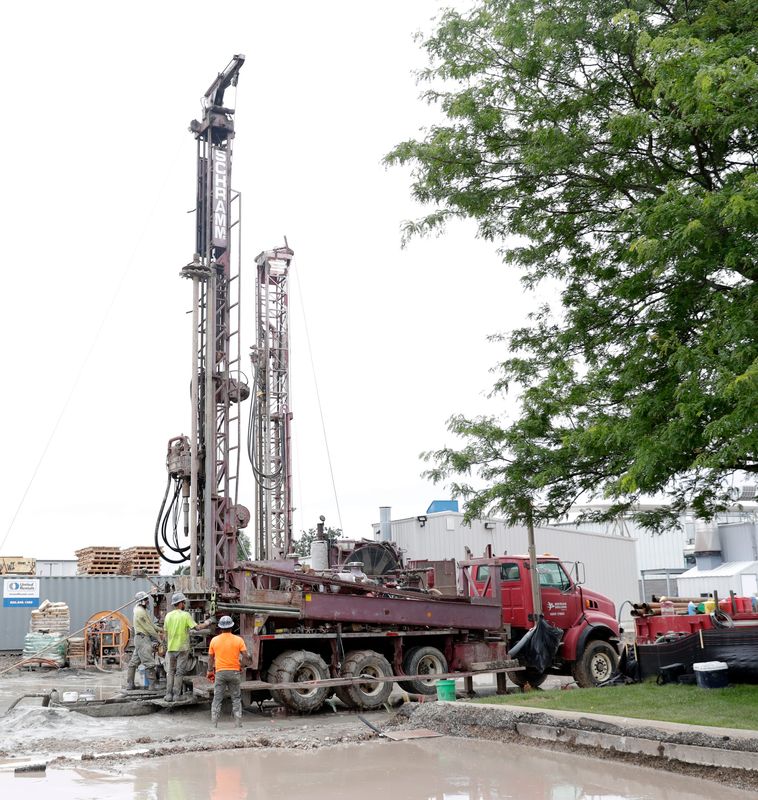
Crews have started to drill the geothermal system’s 280 500-foot-deep wells in the southeast corner of the Nature’s Way parking lot. In the first few days of work, seven wells have been drilled.
The crews will install piping in the wells and heat transfer equipment in the facility. The system will allow Nature’s Way to pump a water-based solution into the pipes to either warm or cool the water, depending on weather conditions. The water would then get pumped to heat transfer equipment to warm or cool the building.
The drilling work will continue through November and will spread to other parts of the factory’s parking lot. The system is expected to come online in fall 2026. Sengstock said the equipment is expected to last 100 years.
What will geothermal energy save Nature’s Way?
Sengstock said the project will reduce the Challenger Drive plant’s reliance on natural gas, which will save energy costs, and cut annual carbon dioxide emissions by about 850 tons, or 20% of the site’s emissions. The new system will replace five air conditioning units and six heating units at the plant.
“We do believe in the power of nature. … This is an initiative that allows us to support nature and our sustainability efforts allow us to walk the walk behind our talk,” Sengstock said.
The company does plan to pursue federal tax credits available for renewable energy investment to help offset some of the project’s cost.
Contact business reporter Jeff Bollier at (920) 431-8387 or jbollier@gannett.com. Follow him on Twitter at @JeffBollier.
This article originally appeared on Green Bay Press-Gazette: How 280 holes in the parking lot will help Nature’s Way cut natural gas use, CO2 emissions
Reporting by Jeff Bollier, Green Bay Press-Gazette / Green Bay Press-Gazette
USA TODAY Network via Reuters Connect