He only traveled a couple hundred feet round-trip in Bay View’s Humboldt Park Wednesday night, Aug. 12, but that was more than enough distance for Robin Greenfield to find his dinner.
Plantains were first, sort of like his hors d’oeuvres. Then came violet, equal to the free bread baskets — be careful not to fill up on it. Acorns and black walnuts made for a delicious appetizer, before basswood as a first plate. Lambsquarters with a side of ground ivy and riverbank grapes were the main course, and sowthistle was dessert.

Greenfield is 305 days into his year of foraging for all his food and medicine. No restaurants, grocery stores or pharmacies. He also refuses to accept food from strangers, and won’t rely on gardens or orchards. By his strict rules, he can only eat things he finds growing naturally from the earth.
“Down to the salt, the oil, the spices, the calories, the fat, the protein, the everything,” he told the Milwaukee Journal Sentinel. “As a practice of living and connecting with this earth.”
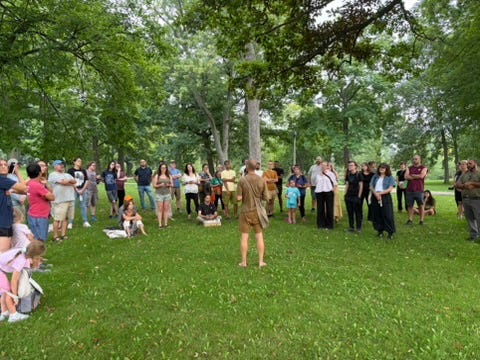
Greenfield has gained some amount of a following as a result of this endeavor. On Aug. 12, around 50 people joined him for two hours in Humboldt Park, his latest stop on a foraging tour that started and will end in Ashland, Wisconsin, where he’s from and has lived since July 2025.
Some found out about the event through Greenfield’s Instagram account, others became fans of his YouTube channel years ago and have closely followed his every step since.
“I really like Robin’s intentional and grounded way of leading,” said 38-year-old Samantha Burgos, who drove down from Shorewood for the walk. “It’s sort of like his moving classroom.”
But, not everyone is OK with Greenfield’s teachings.
After he did a similar walk in April at Gordon Park in Riverwest, Milwaukee County Parks informed him that foraging isn’t allowed in Milwaukee County, in large part due to contaminated soils. Shortly before his return to the city, Andrew Krueger, the special events manager for Milwaukee County Parks, emailed Greenfield informing him his foraging walk violated a local ordinance.
He held it anyway.
“In the past, I have not followed these city ordinances and, as I continue, I will not follow these city ordinances,” Greenfield said after the event. “And I am openly encouraging residents of Milwaukee also to not follow these ordinances.
“But, from a place of deep respect for the earth, for the city and for the plants and animals that we share this home with.”
Greenfield began foraging in 2019 before making it a lifestyle
Greenfield considers himself an activist, social reformer and servant to the earth who 15 years ago decided to break free the confines of consumerism. He goes around the country preaching the importance of reconnecting with the planet in a way you can’t by shopping at grocery stores and buying packaged goods.
He began foraging while living in Orlando in 2019, when he embarked on a mission of growing and finding all of his food. He made the rules stricter for his yearlong challenge.
Greenfield finds his food all over. It could be in a public park or the deeper countryside. He’s found meals in people’s yards, and next to rivers and lakes.
“There’s 20 different foods and medicines within eyesight of here,” he announced before starting his event, which looked in-depth at a select few.
Some of Greenfield’s favorite foods are venison, whitefish, onions, mint, blueberries and cattail pollen. He said he eats about 60 black walnuts every day, which he also uses to dye his clothes. He estimates he has consumed around 25 pounds of acorns this year. He likes to use basswood leaves for tea. Instead of spinach, he cooks lambsquarters, which he says has more sustenance.
He collects riverbank grapes in the summer and freezes them in bags. Then, once it gets cold, he thaws and drinks them — sometimes like a shot, other times like a glass of juice.
While the foraging community is tight-knit today, billions of people throughout history have participated in the ancient practice to sustain themselves. It has deep roots in Black and Indigenous cultures and is experiencing a resurgence as more people seek to remove the barriers between themselves and their food.
There are plenty of Facebook groups, Reddit threads and guides from universities and the Wisconsin Department of Natural Resources that teach Wisconsinites how to effectively forage in a safe way.
Greenfield has a few golden rules. Don’t eat anything you’re not 100% sure is safe. Forage in places you’re familiar with. Look for easy-to-identify plants and learn one at a time.
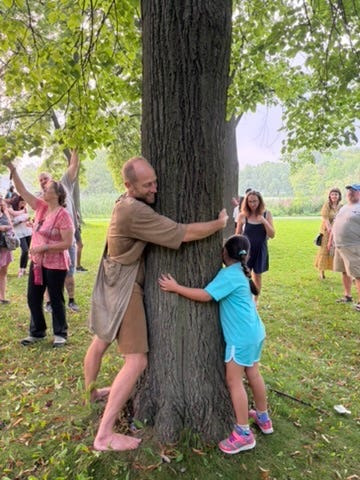
“If you learn one plant per month for the next year, that’s 12 plants,” he said in his closing statement. “It’s life-transforming. If you can walk our your door and have 12 friends that you can harvest as food or medicine, that is very transformational. You can do that with just a few hours per month.
“One plant at a time, you can break free of the systems that no longer serve, and connect with what really serves us,” he continued.
Greenfield wants Milwaukee County to overturn its no-foraging ordinance
Milwaukee County Parks Ordinance 47.08 forbids people from harvesting, collecting, defacing or disturbing any portion of native plants without permission from the government. The ordinance subjects anyone breaking the rule to a $100 fine for each violation, along with all of the restoration costs associated with the damage.
It’s largely in place for safety reasons, because many soils around the county are contaminated due to the area’s industrial history.
“People really can’t assume that, just because this field is green and it has plants growing on it, that it’s always been that way,” James Tarantino, deputy director of Milwaukee County Parks, told the Journal Sentinel April 9.
Greenfield scoffs at the rule.
“Let’s critically think for a second,” he said to the group before the event began. “Me bending down and eating this plant that is going to be mowed, could there possibly be any ecological restoration costs that are needed to be done?
“I can’t imagine so.”
If one were to follow the ordinance code to the letter, Greenfield owed $300 before the event even began: a dandelion, a plantain and a ground ivy. When he yanked a violet out of the ground, plant No. 2 on the tour, he was up to $400. He pulled a handful of basswood leaves from a tree branch, putting his total at $700.
By the end, his bill from the county would have been well over $1,000 – Michelin-star prices. But Greenfield isn’t worried about being fined.
“If they do something like that, I think they know it will be a pain for them,” he said matter-of-factly. A Milwaukee County Parks spokeswoman said she couldn’t immediately respond to a question asking if the county would punish Greenfield, but would when information becomes available.
Instead, Greenfield hopes his foraging expeditions will spur enough community support for places like Milwaukee to end the ordinance, making foraging legal in the county.
“I’m not saying ‘damn the man’ or anything like that,” he said. “Let’s change the ordinances so that they actually serve the people equitably.
“Of course, 147,000 Milwaukee County residents are food insecure, about 15% of the population, and we have some of the most nutritious food on earth, that’s growing right here, freely and abundantly, as part of that solution as well,” he said, closing his introduction.
Then he turned around, bent down and continued breaking the rules until the sun disappeared.
Madeline Heim contributed to reporting on this story.
Jack Albright can be reached at JAlbright@usatodayco.com.
This article originally appeared on Milwaukee Journal Sentinel: Foraging isn’t allowed Milwaukee County. Robin Greenfield doesn’t care
Reporting by Jack Albright, Milwaukee Journal Sentinel / Milwaukee Journal Sentinel
USA TODAY Network via Reuters Connect
By Jack Albright, Milwaukee Journal Sentinel | USA TODAY Network