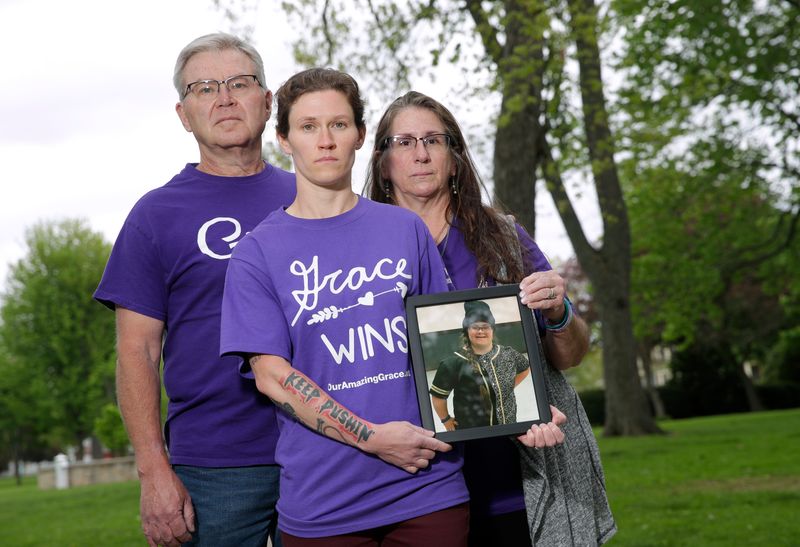
Soon after Cindy and Scott Schara welcomed Grace, their third child, into the world, they recall doctors asking whether they wanted a child with Down syndrome.
But they did, then and always afterward. Grace was the glue, they said, that held the family together.

She had an outgoing, funny personality, and loved drawing, singing, dancing and Elvis Presley.
Thousands of others now know Grace, too — not for those qualities but for the circumstances surrounding her death. For the past three years, most anyone driving along Interstate 41 and other highways in Outagamie and surrounding counties will have seen one of many billboards featuring Grace.
“Have innocent lives been stolen by medical malpractice or murder?”
“Was Grace given a lethal combination of meds at St. Elizabeth’s hospital? Intentional? Who’s next?”
Grace was 19 when she died Oct. 13, 2021, seven days after being admitted to Ascension NE Wisconsin-St. Elizabeth Hospital in Appleton for symptoms of COVID-19.
Scott Schara sued the hospital a year and a half later in a wrongful death case that includes claims of medical negligence, violation of informed consent and battery.
A self-proclaimed “medical murder” expert, Schara believes the government and medical community have worked together to hasten the deaths of thousands of people, particularly the disabled and elderly. He’s spread these views on billboards and a related website, OurAmazingGrace.net,
Now, a jury will decide if Grace died of COVID-19 pneumonia or if staff failed to abide by her parents’ last-minute request to change her “do not resuscitate” status and allowed her to pass away without making any effort to save her.
Jury selection in the case began Monday, June 2, in Outagamie County Circuit Court, with opening statements and testimony expected to begin June 3. The trial is expected to last three weeks.
In the family’s lawsuit, they say Grace was given precedex, lorazepam and morphine without their knowledge or consent, and that it was this trio of drugs — not complications from COVID-19 — that caused Grace’s body to go into respiratory distress.
And, the lawsuit claims, it wasn’t until Grace was in respiratory distress that the family learned a “do not resuscitate” order had been placed on her chart — which directs medical staff not to perform any life-saving measures if a patient experiences cardiac or respiratory arrest.
The hospital argues that injuries or damages sustained by the Schara family may be the result of their own negligence or decision-making, and that Grace’s condition may have been the result of a pre-existing condition or the result of a natural disease progression beyond the control of the hospital staff.
The hospital also argues the federal Public Readiness and Emergency Preparedness Act provided immunity from liability for certain individuals and entities during the COVID-19 pandemic, according to court documents.
Ascension spokesperson Victoria Schmidt said in a statement to the Milwaukee Journal Sentinel that while the hospital is unable to comment on ongoing legal matters, “we have full confidence in the legal proceedings.”
The case is the first to challenge COVID-19 as the cause of death listed on a death certificate.
Family and supporters view it as a chance to hold the medical profession responsible for hospital deaths during the COVID-19 pandemic and beyond. It’s attracted national and local attention, with some Schara family supporters signing up to travel to the courthouse to watch the trial in shifts.
The trial will be live-streamed by Children’s Health Defense, the anti-vaccine nonprofit founded by Robert F. Kennedy Jr., now the nation’s health secretary.
Attorneys for the family believe it is also the first medical battery claim attached to a wrongful death lawsuit to be tried in Wisconsin in the past 50 years.
“Battery involves proving intent,” said Jerome Hierseman, with Milwaukee-based End, Hierseman & Crain, a medical malpractice firm. “And that is tough to prove.”
A wrongful death case can apply to any cause of death, but if that death is due to medical care, there are limitations on who can file such a case and the amount of damages that can be paid out.
The battery claim is an attempt “to kick the case outside the realm of medical malpractice limitations,” Hierseman said.
“I think it is a legal Hail Mary attempt to keep the case alive,” Hierseman said.
If the approach is successful, it could set a precedent that bypasses the state’s medical-malpractice cap for those seeking legal justice when a loved one dies in a medical setting.
“For us, this case isn’t about the money,” Scott Schara said. “We want to open the door for other families to save patients like Grace.”
‘Save our daughter’
Grace learned to communicate using sign language before she began to talk, and started riding horses as a form of speech-language therapy when she was 3.
Not long after, she spoke her first words, “walk on,” a phrase she’d learned in order to instruct her horse to start walking, her mom, Cindy Schara, said.
“She turned into a chatterbox,” Scott Schara said.
Her family says she loved Jesus and was full of faith. She signed her artwork with “God is love.”
Grace referred to her parents as her “earthly mom and dad,” said Jessica Vander Heiden, her older sister.
“She had a strong connection with God. She knew this wasn’t her forever home,” her sister said.
Grace tested positive for COVID-19 on Oct. 1, 2021. The family was supposed to attend a wedding, and Grace had the sniffles. To be on the safe side, they decided to test her.
After Grace’s blood-oxygen saturation levels dropped a few days later, a doctor at an Ascension urgent care clinic recommended Grace be taken to St. Elizabeth’s emergency department for additional oxygen, according to the complaint.
“We just wanted to get her extra oxygen and bring her home,” Cindy Schara said.
In the ER, Grace was given oxygen through her nose or an oxygen mask. Once admitted to the hospital, she was switched to a more intrusive breathing device. Agitated by the noise it made, she pulled at it. According to the complaint, a doctor then placed an order for two sedatives, precedex and lorazepam.
According to the complaint, the sounds of various bedside alarms disrupted Grace’s sleep, and a nurse “trained” Scott Schara to reset the non-essential ones. But other nurses didn’t agree that he should be touching the alarms, and on the morning of Oct. 10, a nurse came into Grace’s room accompanied by an armed guard and told him he had to leave.
He was also told that nurses suspected he had COVID-19, he said, a suspicion confirmed six days later when he was treated for the virus at a Green Bay hospital.
He gave Grace a hug and was then escorted from her hospital room and outside to his truck by an armed guard.
It was the last time he would be with his daughter while she was alive.
“At the time, I still trusted the white coats. I thought the hospital was a safe zone,” Scott Schara said. “Knowing what I know now, I would have never left her alone. I would have taken her with me.”
When Grace’s dad was removed from the hospital, she was left without an advocate or a legal power of attorney, meaning any decisions involving her medical care could not be immediately addressed.
It took a call to Grace’s disability attorney and numerous conversations with hospital attorneys to come to an agreement that allowed Grace to have her sister in her room as her advocate.
The morning of Oct. 13, Grace’s parents had a roughly 45-minute-long phone conversation with her doctor, Dr. Gavin Shokar, now a defendant in the case.
According to the complaint, Shokar told them that “Grace was doing well that day and overnight.” He stated he wanted to get Grace “out of bed to watch TV and to place a feeding tube to improve nutrition.”
Shokar also asked what Scott and Cindy’s intentions were for Grace if there was a severe decline in her condition.
Grace’s parents stated they did not want Grace intubated, which means forcibly inserting a tube into a patient’s airways so they can be placed on a ventilator. There is no way a patient can be placed on a ventilator without intubation.
Shokar then told Grace’s parents that chest compressions might not save her life should Grace go into respiratory or cardiac arrest, according to the complaint.
The family ended the call believing no change was being made to Grace’s care plan. But at 10:56 a.m., around the time the call ended, Shokar entered a “blanket DNR order” on Grace’s chart, according to the complaint.
An investigative report issued in January 2022 conducted by the state Department of Safety and Professional Services found that Shokar “understood he received clear consent from the family to place the patient as a DNR.”
Grace’s parents maintain they did not discuss with any doctor or consent to a “do not resuscitate” order, according to the complaint.
Over the next seven hours, a nurse gave Grace three doses of Ativan and a dose of morphine, according to the complaint.
Less than an hour later after Grace received the morphine, Vander Heiden, Grace’s older sister, was sitting next to her hospital bed when she felt Grace’s temperature dropping.
She asked a nurse to check on Grace. The nurse said the temperature drop was normal and told Vander Heiden to cover Grace with a blanket, the complaint says.
About a half-hour later, Vander Heiden saw on the monitors that Grace’s heart rate was dropping and her breathing was slowing.
She made a FaceTime call to their parents, then ran toward the nurses station.
“We were all begging, screaming, pleading for someone to help save her,” Vander Heiden told the Journal Sentinel.
Staff responded that Grace was coded “do not resuscitate,” the complaint says.
According to the complaint, Grace’s parents were screaming, “She’s not DNR, save our daughter.”
“Not one nurse moved,” Vander Heiden said. “They just stayed stationary.”
In its response to the family’s lawsuit, Ascension said it denies these allegations.
A patient’s code status is “never a static thing,” said Kerri Kliminski, dean of the Madison Area Technical College’s School of Nursing.
“It can be changed by the patient or the patient’s powers of attorney, if they are unable to advocate for themselves, at any time,” Kliminski said.
John Van Cleave, an extracorporeal life support expert who specializes in respiratory care for children, reviewed the civil complaint, which cites Grace’s medical records, and a doctor’s deposition.
He said that if hospital staff did in fact fail to act when Grace’s parents, her powers of attorney, were “in live communication” with them, telling them she was not a DNR and to “save our daughter,” this could be the hospital’s downfall in court.
“There is no excuse for not acting. You can’t say, ‘No, sorry, you already picked. She’s a DNR,’” Van Cleave said.
Grace died around 7:30 p.m., roughly eight and a half hours after the “do not resuscitate” order was entered on her medical chart.
A case with national attention
Scott Schara said his views of the medical profession have changed “one hundred and eighty” degrees since Grace’s death.
Prior to Grace’s death, he said he was like the rest of the population. He “bought into” President Donald Trump’s views on COVID-19. He believed ventilators, for example, were just one tool in the toolbox to fight the virus, or as he refers to COVID-19, “the poison.”
He now refers to the pandemic as the “plandemic,” a way to cull the population, although he admits he doesn’t know who planned the event that left millions dead worldwide.
The government and the health care system, he told the Journal Sentinel, “believe there are too many non-contributing members of society, the elderly, the disabled, who do not deserve medical care.”
He said the “standards of care” — condition-specific treatment plans established by the Centers for Medicare & Medicaid Services and followed by most U.S. hospitals — are not designed to save lives, but to “hasten death.”
He filed his lawsuit April 11, 2023. Beyond seeking damages, the lawsuit seeks to change the cause of death on Grace’s death certificate from “acute respiratory failure with hypoxia as a result of COVID-19 pneumonia” to “drug overdose from precedex, lorazepam, morphine as a result of an illegal do not resuscitate order.”
The suit also seeks a declaratory judgment from the court stating the “do not resuscitate order in question and non-consensual injection of certain drugs” into Grace’s body was in violation of the hospital’s policies and procedures.
Outagamie County Circuit Court Judge Mark McGinnis rejected the hospital’s motion to dismiss the case in 2023, allowing the trial to move forward.
More than 5,000 people have signed up for a newsletter to be kept up to speed on the case, according to Schara’s website. A vast repository of his beliefs about medical murder, the site also sells T-shirts and sweatshirts with phrases like “Grace Wins” as well as more pointed slogans like “unvaccinated lives matter.”
In an effort “fill the court for Grace,” the site contains a sign-up sheet for people to take shifts. As of June 2, more than 50 people per day have signed up to attend the trial Tuesday through Thursday. The site has slots for 150 per day.
Attendees are warned to follow court-ordered guidelines that no cameras, cellphones, computers or recording devices are allowed in the courtroom.
“The judge does not want the public to try to influence the jury. NO shirts, clothing or accessories that promote our side of the case,” the sign-up page reads. “We encourage you to bring signs, but do not bring them into the courthouse. We want to be above reproach in our manners.”
The courtroom seats roughly 30 individuals. The hearing will be livestreamed into an overflow room for the public and the media, where cameras, cellphones, computers and recording devices will be allowed.
The family has stated they will not be doing interviews with the media until the trial’s conclusion.
In earlier interviews, Schara said he fully expects his conspiracy theories will be used to sway the jury.
“All of my theories were developed after Grace died. They are not relevant to her experience in the hospital,” he said. “If they make me look crazy, it takes the focus off the facts of the case.”
Jessica Van Egeren is a health care reporter and assistant breaking news editor with the Milwaukee Journal Sentinel. She can be reached at jvanegeren@gannett.com.
This article originally appeared on Milwaukee Journal Sentinel: COVID, conspiracy theories and a billboard campaign: Grace Schara’s hospital death finally sees trial
Reporting by Jessica Van Egeren, Milwaukee Journal Sentinel / Milwaukee Journal Sentinel
USA TODAY Network via Reuters Connect