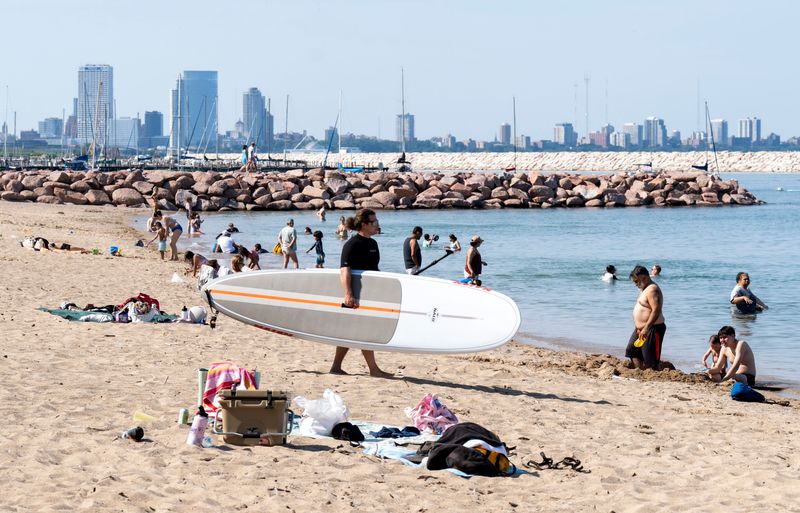
On a late July afternoon, with temperatures pushing 90 degrees, about 100 beachgoers spread across the sand and water at Bay View’s South Shore Beach, undeterred by Lake Michigan’s brisk, mid-60s water.
Parents lingered at the waterline, kids darted in and out of the shallows, more confident swimmers fanned out into deeper water and others settled up the sand with a beach read in hand.

The scene felt ordinary – summer along Lake Michigan – but it marked a quiet turnaround decades in the making.
It’s scene now possible at South Shore Beach, which reopened about a year ago after being moved farther south. Long plagued by elevated E. coli, a fecal bacteria associated with humans and animals, the beach was often closed for swimming and earned a reputation as one of the worst beaches in the country.
Now, it’s turned a corner.
Data shared exclusively with the Milwaukee Journal Sentinel from University of Wisconsin-Milwaukee’s School of Freshwater Sciences show consistently cleaner water, with the new swimming site up to three times more likely to stay below E. coli limits during the 2025 and 2026 swim seasons.
“It’s so gratifying to see something go from beginning to end,” said Sandra McLellan, a professor at UW-Milwaukee School of Freshwater Sciences, who studies bacteria.
While construction on the beach began in late 2024, McLellan was part of a team that started working on the project nearly three decades ago. At the time, many of Milwaukee’s beaches were frequently closing due to high bacteria levels, and she was brought on to figure out where the bacteria were coming from.
The old beach was right next to the South Shore Park boat launch, which happened to be a prime hangout for gulls and other birds.
When it rained, the birds’ droppings washed off the sand and parking lot into the lake, along with oil, trash and other runoff from the paved surfaces. Because the swimming area sat behind a breakwater, there wasn’t much circulation, so anything that went in was trapped.
Between 2020 and 2024, there were 125 days when bacteria levels in the water were high enough to trigger beach advisories at the old beach location, according to DNR data. About 35% of those days were high enough to result in a beach closure.
“It was a bad place for a beach, but they wouldn’t have know that years ago because science hadn’t developed to the point where it is now,” said Melissa Schussman, a research specialist who is one of the scientists in McLellan’s lab that continues to monitor the sites.
The $8 million dollar federally-funded project also included the Wisconsin Department of Natural Resources, Milwaukee County Parks, Baird and Associates, Milwaukee Riverkeeper and the Waterway Restoration Partnership.
This isn’t a problem unique to Milwaukee, McLellan said. It’s an issue across the Great Lakes, especially as growing development makes it harder to keep pollutants out of the water.
The Bay View project has provided a much better understanding of coastal management, she said, and for how to pick smarter spots for beaches from the very beginning.
Lake Michigan beach days shaped by decades of science
The beach was moved about 400 feet south along the lakefront to a spot that monitoring since 2008 showed would likely be cleaner and less of a public health risk. The data collected since then, continue to back that up.
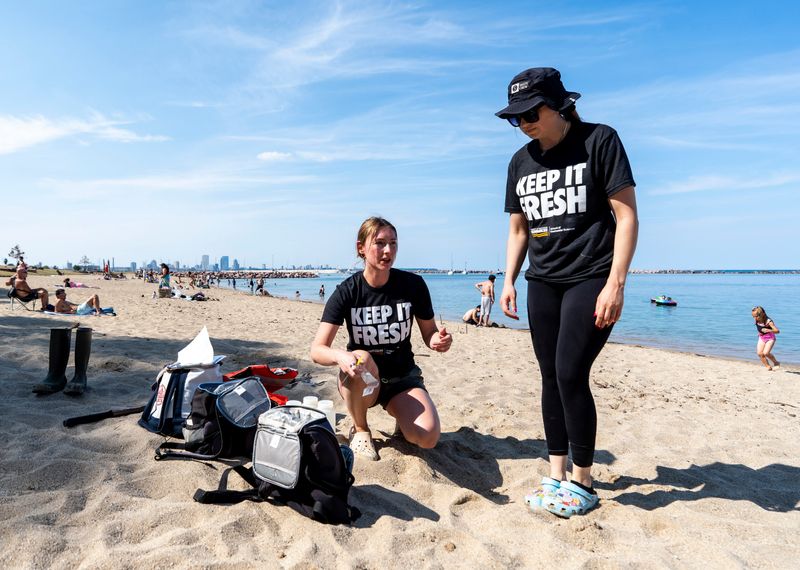
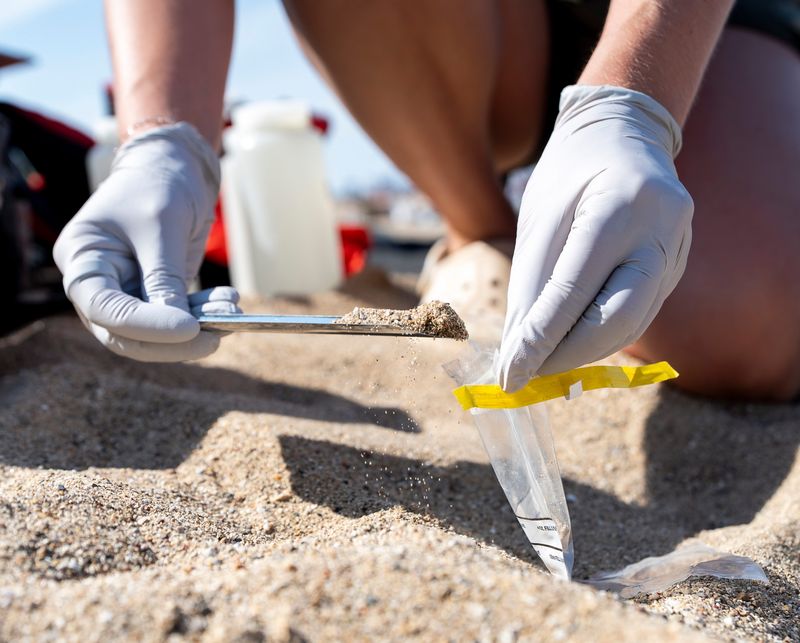
The scientists go out to collect water samples at the old and new beaches the day after it rains to see what’s washing in the water. They collect sand to see what’s in there, too.
Water samples collected in 2025 only exceeded beach action levels − the threshold that can trigger an advisory or closure − at the old beach location, according to data provided to the Journal Sentinel.
So far in 2026, samples at the new site have exceeded those levels far less often: about 13% of the time, compared with 47% at the old beach, the data show.
“This is a great demonstration of science in action,” said Maria Steadmon, a postdoctoral researcher also a part of the research team. “Community concerns were brought up, (scientists) did the research and moved the beach to help the community keep the beach open,” she said.
Steadmon and Schussman collect samples that are mainly for academic research, though the information is shared with city and state officials. Separate testing of Lake Michigan beaches is done by Milwaukee’s Health Department, which is done more often and determines whether beach advisories are issued.
Those advisories appear as yellow or red signs. A yellow advisory means elevated levels of bacteria have been detected, signaling a moderate health risk, while a red advisory means the beach is closed to swimming.
The South Shore Beach redesign adds multiple layers of protection for Lake Michigan, both at the new swimming area and at the former beach site.
A stone wall at the new swimming area stabilizes the shoreline, and prairie grasses help deter birds. Coarser sand also helps filter runoff before it reaches the lake. The former sandy beach has been converted into open space with native vegetation and bioswales that soak up stormwater and cut down on polluted runoff.
Not only can people get out in the water without worrying about getting sick, but more days on the beach are good for mental health, said Natalie Dutack, area of concern program coordinator at Milwaukee County Parks.
A cleaner beach also provides an economic boost, Dutack said, drawing more visitors and helping support local businesses like the South Shore Terrace and Beer Garden.
An effort to restore all Milwaukee’s waterways
The multi-million dollar project is part of the larger effort to clean up the Milwaukee River Estuary, which has been designated as an “area of concern,” or one of the most degraded sites in the Great Lakes region.
Reducing the number of beach closures at South Shore Beach was one step toward getting Milwaukee off that list, Dutack said. The broader goal is for every swimming beach in Milwaukee to be open for at least 90% of the swimming season.
The hallmark of the cleanup effort is removing industrial legacy pollution – largely from polychlorinated biphenyls, or PCBs – from the city’s three rivers and Lake Michigan. The Milwaukee Metropolitan Sewerage District recently finished constructing a new storage facility at Jones. The submerged facility will store 1.9 million cubic yards of PCB-laden sediment.
Habitats spaces are also being restored all over Milwaukee. For instance, a fish passage around Kletzsch Dam in Glendale has opened up 54 miles of river for prized fish like salmon and steelhead to move upstream and spawn. And earlier this year, a fish passage at Estabrook Park in Shorewood replaced a human‑made falls that had blocked many native fish from moving upstream on the Milwaukee River.
Together the passages, open up more than 60 miles of river and tributaries and roughly 2,400 acres of wetland habitat, expanding the stretch of waterways where migratory fish can return to feed, spawn and reproduce.
The new-and-improved South Shore Beach is one piece of that broader effort, but it reflects something larger: how long-term scientific work can drive visible change in a community − and inspire people to protect the Great Lakes.
Gesturing toward children splashing along the waterline, Schussman said, “When they get older, that’s something they’ll want to protect, too.”
Caitlin Looby covers the Great Lakes and the environment for the Milwaukee Journal Sentinel. Contact: clooby@gannett.com. Follow her on X @caitlooby.
Caitlin is an Outrider Fellow and also receives support from the Brico Fund, Fund for Lake Michigan, Barbara K. Frank, and individual contributions to the Journal Sentinel Community-Funded Journalism Project. Journal Sentinel editors maintain full editorial control over all content. To support this work, visit jsonline.com/support. Checks can be addressed to Local Media Foundation (memo: “JS Community Journalism”) and mailed to P.O. Box 85015, Chicago, IL 60689.
The JS Community-Funded Journalism Project is made possible through our partnership with Local Media Foundation, tax ID #36-4427750, a Section 501(c)(3) charitable trust affiliated with Local Media Association, and EnMotive, LLC, a subsidiary of USA TODAY Co., Inc.−the parent company of this publication.
This article originally appeared on Milwaukee Journal Sentinel: Bay View’s South Shore Beach is, in fact, cleaner now | Exclusive
Reporting by Caitlin Looby, Milwaukee Journal Sentinel / Milwaukee Journal Sentinel
USA TODAY Network via Reuters Connect
By Caitlin Looby, Milwaukee Journal Sentinel | USA TODAY Network