Among Wisconsin bird species, it has one of the most distinctive vocalizations.
The human, English translation usually goes: “Who cooks for you, who cooks for you all!”

And while the bird behind the call is found statewide, due to its stealthy flight abilities and mostly nocturnal habits, it is heard far more often than it is seen.
We’re talking about the barred owl, a native raptor that stands about 18 inches tall, has ebony eyes and beautiful, streaked plumage, and is supremely adapted to fly and hunt in forests and wetlands at night.
If you’d like to see one, the Schlitz Audubon Nature Center in Milwaukee has great news for you. And now, nesting time for barred owls, it comes with a virtual 24/7 guarantee.
The center’s raptor program director, Lindsay Focht, and raptor expert, Bill Stout of Ashippun, worked over recent years to install a nest box on a Milwaukee County property frequented by a pair of barred owls.
The nest box was erected in 2022 and the owls, named Betty and Maverick by the researchers, used the wooden bird condo for the first time in 2023, Focht said.
It’s been a hit with the owls and, more recently, the public.
The birds fledged two young in 2023, three in 2024 and two in 2025.
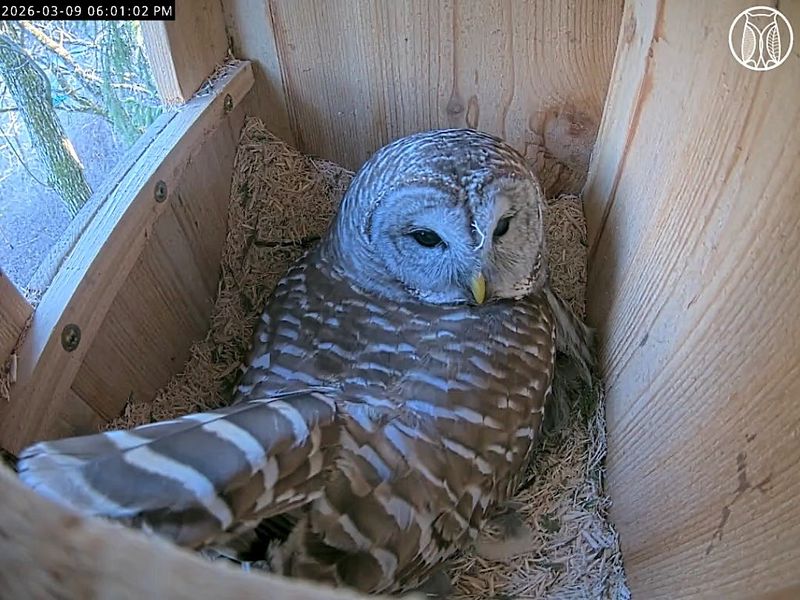
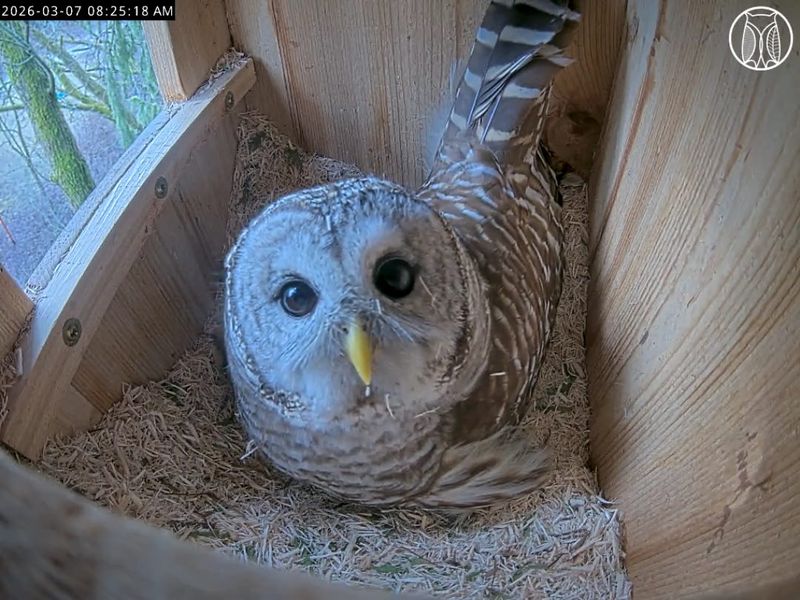
The 2025 nesting season was notable for more than a continuation of the remarkable string of reproductive success: a video camera was placed in the nest box.
Starting last year, the livestream has provided viewers with a eye inside the nest box and an intimate look at barred owl life.
The video plays out uninterrupted and unedited on the nature center’s website.
One moment Betty is sitting still, apparently sleeping on the nest. In another she turns 180 degrees, head down to rotate eggs, before wiggling into position. And in other, rarer scenes, she calls or flies out of the box or looks with dark eyes into the camera.
It’s all pretty cool. Addicting, even.
For the safety of the birds and their offspring, the location of the nest box is private. The webcam, though, is free and open to all.
Focht is accustomed to the public getting excited when they see the education raptors – including hawks, owls and eagles – she and her colleagues and volunteers at the center exhibit. The birds are kept in captivity because for various reasons they cannot be released to the wild.
But Focht said the webcam of the barred owl nest has been embraced as heartily as anything she has experienced in her work with birds.
“From a manager’s perspective, the public’s reaction makes me even more excited,” Focht said.
Barred owls are one of four owl species (including the great horned, Eastern screech and saw-whet) that commonly breed in Wisconsin.
Other owl species are more rare or typically only found in the state in winter, including the barn, boreal, great gray, long-eared, northern hawk, short-eared and snowy.
Barred owls are less abundant and slightly smaller than great horned owls in southeastern Wisconsin. Stout said he’s aware of only three or four pairs of barred owls in Milwaukee County, for example, while there are likely a couple dozen pairs of great horned owls in the area.
It’s not common to see either species in the greater Milwaukee area even though they live among more than 1 million humans.
Barred owls often roost in trees near wetlands and rivers, Focht said. They hunt rodents, fish, amphibians and invertebrates. Their heavily barred plumage provides excellent camouflage and their feathers allow nearly soundless flight, even with a wingspan of 3 to 4 feet.
The nest box has allowed for more than increased viewing of the barred owls. Stout, a federally licensed bird bander who has studied red-tailed hawks, Cooper’s hawks and other raptors, banded the adult barred owls and their offspring each year at the site.
Since relatively little is known about barred owls in urban and suburban environments, Focht and Stout are attempting to fill some gaps in land use and dispersal of the species.
Among the questions they are addressing: Can barred owls adapt to human activities? How will their presence affect other raptor species’ land use in the area? What habitats and territory sizes are preferred during breeding and non-breeding seasons?
This year marks the fourth nesting season for Betty (named for Betty White, the late actress and wildlife advocate) and Maverick (for his more brazen behaviors).
So far it’s bringing good news, too.
On March 4, Betty laid an egg. On March 7, she laid another.
Since then she’s been brooding the eggs almost constantly. Maverick is doing most of the provisioning this time of year, bringing food to or just outside the nest box.
Barred owls typically lay one to three eggs. The eggs typically hatch in 30 days.
Thanks to the data provided by the webcam, the Focht and Stout are expecting the owlets to hatch April 6 to 8.
The public is invited to watch.
Focht said the webcam technology provides a modern means of educating people about and connecting them to wildlife. In the end she feels it can really help people care more and take action on conservation issues.
“Once we got into this phase of the research and added this technology, we realized this was something we could easily share with the public and let them share in the excitement,” Focht said. “We’ll see what the rest of the season holds. I’m as excited as anyone.”
This article originally appeared on Milwaukee Journal Sentinel: A barred owl named Betty is a nest box star and wildlife ambassador | Paul A. Smith
Reporting by Paul A. Smith, Milwaukee Journal Sentinel / Milwaukee Journal Sentinel
USA TODAY Network via Reuters Connect