

By Andrew Chung
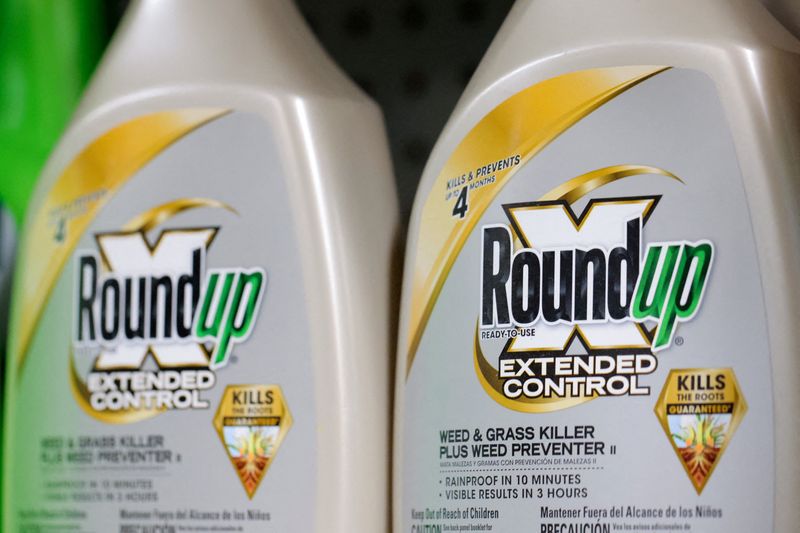
WASHINGTON, June 25 (Reuters) – The U.S. Supreme Court reined in thousands of lawsuits pursued in state courts accusing Bayer of failing to warn users that the active ingredient in its Roundup weedkiller causes cancer, handing a major legal victory on Thursday to the German company.

The justices in a 7-2 decision overturned a jury verdict in Missouri awarding $1.25 million to a man named John Durnell who said he was diagnosed with non-Hodgkin’s lymphoma after years of exposure to glyphosate in Roundup. The Supreme Court agreed with Bayer that a U.S. law that governs pesticides precludes failure-to-warn claims that are brought under state law from moving forward in court.
President Donald Trump’s administration backed Bayer in the case.
Bayer acquired Roundup as part of its $63 billion purchase of agrochemical company Monsanto in 2018. More than 100,000 plaintiffs have filed cases in U.S. state and federal courts alleging a cancer link, and the German drugmaking and crop science company had said that the lawsuits could threaten its ability to supply the herbicide to farmers.
The torrent of litigation already prompted Bayer to remove glyphosate from its consumer version of Roundup. Bayer said before the Supreme Court ruled that a decision in its favor could largely end the Roundup litigation.
The Supreme Court heard arguments in the case in April.
“The U.S. Supreme Court decision is good for science, farmers, and industries that depend on regulatory clarity for innovation. It should help significantly contain the Roundup litigation after nearly a decade of legal battles. The ruling should result in the dismissal of current warning-based claims and bar future failure-to-warn claims,” company spokesperson Tino Andresen said in a statement.
The company emphasized throughout the litigation that the U.S. Environmental Protection Agency repeatedly found that glyphosate does not cause cancer and approved its product labels without a warning.
Facing billions of dollars in potential liability, Bayer announced in February a proposed $7.25 billion settlement to resolve tens of thousands of current and future lawsuits. The settlement would not affect claims that stem from pending appeals or that fall outside the deal, according to the company. Those amount to nearly $1 billion, it said.
The sprawling dispute centers on a U.S. law called the Federal Insecticide, Fungicide and Rodenticide Act, or FIFRA, that governs the sale and labeling of pesticides and bars states from imposing differing or additional requirements.
The measure prohibits pesticides that are “misbranded” with labels that lack an adequate warning to protect health and the environment.
Bayer has argued that Durnell’s claims are preempted by this law. The EPA has repeatedly approved labels without such a cancer warning, demonstrating that these products are not misbranded, the company said, adding that labels cannot be substantially changed without the agency’s approval.
Durnell’s lawyers said that despite the EPA’s registration of Roundup, the label may still be challenged as misbranded. They also said Durnell’s claims are not preempted because Missouri state law that requires products to adequately warn of dangers imposes the same requirements as FIFRA’s prohibition on misbranding.
Durnell sued Monsanto in Missouri state court in 2019, claiming it failed to warn users of the dangers associated with Roundup and glyphosate.
He was diagnosed with a rare and often aggressive form of non-Hodgkin lymphoma, a cancer that starts in the white blood cells, and attributed the disease to his exposure to Roundup starting in 1996. For about 20 years he was the “spray guy” for a neighborhood association in St. Louis, killing weeds at local parks without protective equipment, according to court papers.
A jury sided with Durnell in 2023, and in 2025 a state appeals court upheld that verdict.
Some activists with the “Make America Healthy Again” movement that backs Trump’s Health Secretary Robert F. Kennedy Jr have criticized the Trump administration’s support for Bayer. Also backing Bayer in the case were a number of crop farming and agricultural industry groups. Several environmental, farm worker and public health groups backed Durnell.
(Reporting by Andrew Chung; Editing by Will Dunham)
By Andrew Chung | Reuters | © Copyright Thomson Reuters 2026.
