This story was supported by the Pulitzer Center. It is part of a project on reverse migration by Arizona Republic reporter Daniel Gonzalez and El Paso Times visual journalist Omar Ornelas.
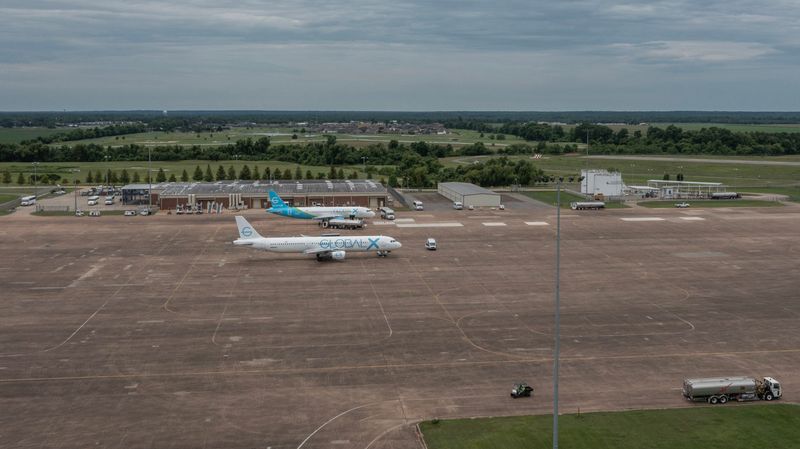
TAPACHULA, Mexico — At 1:20 p.m. on Aug. 20, an Airbus 320 passenger jet landed at the Tapachula International Airport.

Instead of the typical commercial travelers who arrive daily at this sweltering tropical city in Mexico’s southern tip, the plane carried a unique kind of passenger: people who had just been deported from the United States.
Among the deportees were middle-aged men and women who had not set foot in Mexico since they left as young children just 7 or 8 years old.
Some arrived in long-sleeved fluorescent shirts stained with sweat — the same work shirts they wore the day they were arrested by Immigration and Customs Enforcement in the United States.
Most still had family in the United States.
One, 40-year-old hairstylist Patricia Reyes, left behind three U.S. citizen children, two of them serving in the U.S. military. She said she was deported after a domestic violence dispute turned into an immigration case.
“I have two daughters in the Marines, yet they deported me,” Reyes said as she rushed to flag down a taxi moments after walking out of a reception center for recently arrived deportees, known as returnees in Mexico. “I mean, they don’t even care about that.”
Some said they were caught at the U.S. southern border on their first day in the United States.
Many said they had lived in the United States for years, and in some cases, decades and described deep roots in America.
Some said they were held in detention centers for months before their deportation and were moved multiple times to detention centers in multiple states before their removal from the United States.
Some spoke English better than Spanish. Others said they had no place to go in Mexico or relatives to call and recognized that a life of uncertainty lay ahead.
Adjusting to life in a country he had not seen since he was a child was “going to be a surprise, I can tell you that much,” Erik Ruelas, a 33-year-old returnee, said in English.
Ruelas said he had lived in the United States for the past 25 years, most recently in Alabama, where he worked at a Mexican restaurant. He was turned over to ICE while on probation for a DUI, he said.
“It’s going to be an experience.”
Returnees experience ‘extreme anxiety,’ mental trauma from ordeal
For years, this city of 350,000 in Chiapas, Mexico’s poorest state, was flooded with migrants from around the world headed for the United States after crossing into Mexico from Guatemala.
Now, Tapachula is experiencing a reverse migration, as the United States sends planeload after planeload of deportees to the southern part of Mexico while the flow of migrants headed north has dried up.
The U.S. deportation flights to southern Mexico are unprecedented, migration experts say. They started in Tapachula in February with one flight per week. By August, they had increased to once a day, but in September they dropped down to twice a week, according to groups in Tapachula that assist migrants.
The flights to southern Mexico are part of the Trump administration’s aggressive mass deportation campaign. The growing strategy is intended to make it more difficult for deportees to return to the United States by flying them as far from the U.S. border as possible, according to migration experts.
The United States in 2025 has so far conducted 238 removal flights to Mexico. Of those, about 87% were to cities in southern Mexico, including 89 flights to Tapachula, and 119 to Villahermosa, in the state of Tabasco, according to ICE Flight Monitor, which tracks U.S. removal flight data on behalf of Human Rights First, an advocacy group. The other U.S. removal flights were sent to an airport near Mexico City.
The number of people deported to Mexico on U.S. removal flights increased nearly 50% from January through July 2025 compared with the same period in 2024, Mexican government data shows. Eighty-five percent of the people deported to Mexico on U.S. removal flights were flown to southern Mexico, Tapachula and Villahermosa, in the state of Tabasco, the data shows.
Of the nearly 60,000 immigrants in U.S. immigration detention on Sept. 21, 71.5% had no criminal records, according to Transactional Records Access Clearinghouse analysis of government data.
The U.S. deportation flights to southern Mexico, some 2,000 miles from the border, are adding to the stress and trauma of the growing number of people deported to Mexico under the Trump administration’s mass deportation campaign, migration experts say.
“There are people who are basically gringos at this point, and they’re undergoing a real big shock,” said Adam Isacson, director for defense oversight at the Washington Office on Latin America, a research and advocacy group. He visited Tapachula in July as part of a trip to Honduras, Guatemala and Mexico to determine how recently deported people are faring.
Some deportees, researchers have found, are experiencing “extreme anxiety” and other mental health problems “from the shock and mistreatment they’d just gone through,” Isacson said.
Most people deported to Tapachula are not from southern Mexico, said Ivana Saldivar, who heads the Tapachula office of the United Nations’ International Organization for Migration.
In addition to the shock of having to reintegrate into life in Mexico, deportees must first figure out how to travel to their home states, often in northern parts of Mexico, many hundreds of miles from Tapachula, Saldivar said. Many often arrive without Mexican identification or money, adding to the challenges, she said.
“We know that the profile of Mexican returnees is that they have been in the U.S. anywhere from one day to 30 years,” Saldivar said. “They may face difficulties to reintegrate in the country because some of them don’t even speak Spanish properly or they don’t have any family remaining in the country, or any attachment to the country or to the cities where they were born.”
From an airplane, to a bus, to a reception center
The buses loaded with deportees arrived at the soccer stadium’s parking lot as a late afternoon thunderstorm rolled in.
The flight originated in Alexandria, Louisiana, home to the largest deportation hub in the United States, then made a stop in Atlanta, and continued south to Tapachula, according to ICE Flight Monitor, which tracks ICE flight data on behalf of Human Rights First, an advocacy group.
It was operated by GlobalX, a charter airline, according to ICE Flight Monitor. The U.S. Department of Homeland Security contracts with CSI Aviation, which subcontracts with GlobalX and other airlines, that carry out removal flights, according to ICE Flight Monitor.
At the airport in Tapachula, the deportees boarded white passenger buses that took them to the parking lot of the city’s Olympic soccer stadium. Mexican officials waited in tents to help process the scores of deportees who now arrive daily on deportation flights from the United States to this city in the southern tip of Mexico.
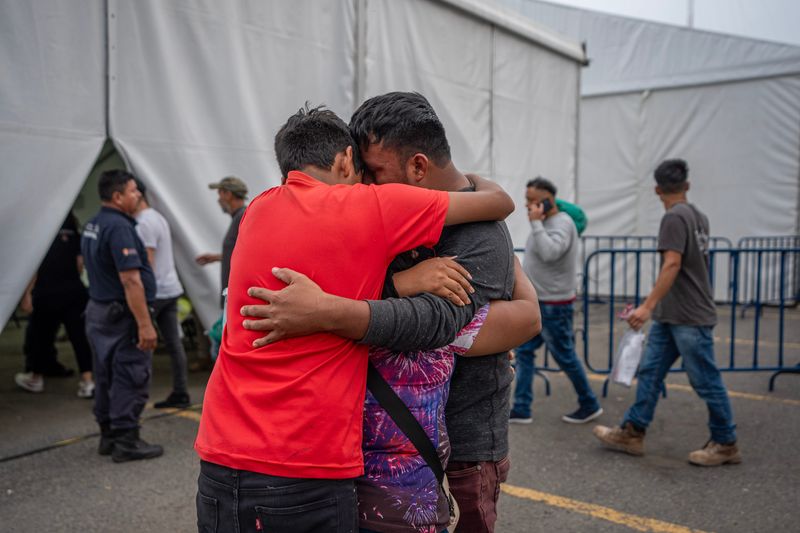
The reception center, a collection of white military-style tents, sat in front of the main gates of the soccer stadium. Local police guarded the center along with members of Mexico’s national guard. They stood in the beds of pickup trucks wielding heavy machine guns, while vendors who had set up shop in the parking lot sold shaved ice, cigarettes and sodas to deportees as they exited the reception center.
At the reception center, Mexican officials helped deportees locate birth certificates and other documents they would need to reintegrate in Mexico under a program run by the Mexican government called “Mexico Te Abraza,” Saldivar said. The title means “Mexico embraces you.” Deportees also are handed debit cards preloaded with 2,000 pesos, Saldivar said. That is equivalent to about $108.
At the reception center, deportees undergo health screenings and receive vaccines. They are offered a meal and the chance to shower, according to Mexican officials.
Deportees reunite with relatives, recall journey
In the soccer stadium’s parking lot, relatives greeted some deportees.
Adi Velazquez, 32, wrapped her arms around her brother, Luciano Velazquez, 30, after he climbed off one of the buses arriving from the airport. Luciano lived in North Carolina for five years before he was deported, Adi Velazquez said.
She was joined in a group hug by her brother, Christian, 13, and her niece, Gabriela Velazquez, 22, as Luciano wiped away tears. They drove off together in a blue Ford pickup.
The majority of the deportees, however, walked out of the reception center and climbed back onto the same buses that brought them from the airport. The buses were headed to Mexico City as part of a program funded by the Mexican government to help deportees travel back to their home states.
Originally from the state of San Luis Potosi, in central Mexico, Marvin Robledo Rodriguez, 43, said he had lived in the United States for 35 years, most recently in Plainville, New Jersey, before he was deported.
Now, the construction manager found himself in southern Mexico.
Asked whether anything seemed familiar, Robledo Rodriguez had a three-word answer.
“Not at all,” he said in English, adding, “My Spanish is a little crude.”
Robledo Rodriguez said he was arrested after getting into a fight in New Jersey. The charges against him were dropped after surveillance cameras showed others started the fight, he said.
“The judge dropped my case, but then I was walking away from jail and ICE was right there,” Robledo Rodriguez said.
Would he stay in Mexico?
“I don’t know,” Robledo Rodriguez said. “I got two boys (in the United States). Seven and 11.”
Deportees face uncertain future back in Mexico
As dusk arrived, Wilson Delvalle, 36, walked out of the main tent and searched for a taxi to take him to a hotel in Tapachula.
Delvalle said he lived illegally in the United States since 2022. Police called ICE after he was stopped in Stiltsville, North Carolina, in April for driving with tinted windows, he said.
Before being deported, Delvalle said he worked for a contractor maintaining conveyor belts at warehouses for Walmart, UPS and Amazon and left behind a son living with his mother in Arkansas.
Delvalle said he spent a month in Alligator Alcatraz, the troubled detention center built by Florida to hold federal immigration detainees.
He described frigid conditions there, despite the tent site’s location in the subtropical mosquito-infested Everglades.
“They were bad,” Delvalle said. “Inside it was too cold. A lot of air-conditioning.”
Facility employees did not seem to know what they were doing, he said.
“All the staff seemed like they were from Walmart or something like that,” Delvalle said. “They did not do their job very well. If they take you to the clinic, they forget you. They just leave you alone while they go get someone else. It was totally crazy.”
After Alligator Alcatraz, Delvalle said he was transferred across the country to multiple facilities. He spent a month at a detention center in Aurora, Colorado, where he said conditions were good, and was then transferred to detention centers in Denver; Eloy, Arizona; and finally Alexandria, Louisiana; before his deportation flight to Tapachula.
Nicolas Perez, 35, was working as a roofer for 3.5 years in Spartanburg, South Carolina, when he was turned over to ICE after police stopped him for going through a yellow light and arrested him for driving without a license, he said.
He spent eight days at the Stewart Detention Center in Georgia before being transferred to a detention center in Pennsylvania and then back to the Stewart Detention Center, where meals consisted of “two pieces of bread and a piece of ham. That’s it.” The center was so overcrowded “people are sleeping on the floor, there are no more beds.”
Good, hardworking people are being deported under Trump’s mass deportation campaign, not just people causing problems, Perez said.
“And he’s separating a lot of families,” Perez said. “It’s sad because they only go there to work.”
Perez met Delvalle on the deportation flight to Mexico. It turned out they both were from the same place in Mexico, Frontera Comalapa, a rural area in Chiapas, about a four-hour drive from Tapachula.
As night fell, they decided to share a taxi to a hotel in Tapachula and wait for relatives to drive them to Frontera Comalapa the next day.
Perez said he was excited to see his wife and two daughters, ages 12 and 4. When he left for the United States, the youngest was only a few months old.
As the bus pulled into the reception center, Perez said he started thinking about his family, looking out the window at the lush, green jungle landscape.
“I’m happy to be back in my country,” Perez said. “I’m never going to go back.”
El Paso Times visual journalist Omar Ornelas and Arizona Republic reporter Daniel Gonzalez spent 12 days in Mexico and Panama in August reporting how the Trump administration’s immigration and border policies are affecting migrant patterns. Both had spent years chronicling immigrants’ movements north. In a dramatic shift, this time they captured people heading south, often back to their home countries.
This article originally appeared on El Paso Times: Under new strategy, US flies deportees to southern tip of Mexico
Reporting by Daniel Gonzalez, The Arizona Republic / El Paso Times
USA TODAY Network via Reuters Connect