President Donald Trump’s push for $9 billion in spending cuts, which would slice into funding for public broadcasting stations and the United States’ foreign aid efforts, was signed into law on Thursday, July 25.
The bill crossed the Congressional finish line last week when the House approved the measure in a 216-213 party line vote on July 18.

Around $1 billion will be taken from public broadcasting, including PBS and NPR, as well as their local affiliates.
Will it impact local stations in Texas?
Local PBS and NPR affiliates in Texas are likely to be hit hardest by the recent funding cuts. Unlike their national counterparts, many rely heavily on federal grants to stay afloat.
Stations such as Marfa Public Radio in West Texas and KEDT in Corpus Christi receive between 30% and 50% of their annual budgets from the Corporation for Public Broadcasting (CPB). Even larger outlets, such as KUT in Austin, KERA in Dallas, and KUHF in Houston, depend on CPB funding for 7% to 18% of their operating budgets — a significant loss for stations already working with lean resources.
Cuts at this scale wouldn’t just shrink programming; they could result in layoffs, fewer local news reports, and, in some areas, complete station closures. In parts of Texas, these outlets are the only non-commercial, locally focused media serving rural and underserved regions.
Marfa Public Radio executive director Anne Pitts Marozas wrote a letter to listeners after Congress advanced the resolution, saying one-third of the station’s budget had been wiped out. A campaign on the station’s website said Marfa Public Radio must raise $463,000 by Oct. 1 to close the gap.
“The public radio network was envisioned a system where radio and TV stations could prioritize education and culture over commerce,” Pitts Marozas wrote. “It was meant to ensure that rural and remote communities, like ours, would not be left behind. It was created for us. And now we must carry that mission forward.”
“We know that small, rural stations like ours will take the hardest hits. But we are prepared to be thoughtful and responsive in this moment. We are not just going to survive — we are going to evolve,” she added.
Similarly, KERA in Dallas-Fort Worth is expected to lose approximately $2.7 million due to budget cuts, according to The Dallas Morning News.
The impact extends to higher education as well. At least 11 public broadcasting stations in Texas are affiliated with universities, where they double as student newsrooms and hands-on training hubs for future journalists. Stations like KUT at UT-Austin, KTTZ at Texas Tech and KAMU at Texas A&M face threats to both staffing and student opportunities — potentially reducing opportunities for internships and on-campus jobs, on-air experience and career pathways within the industry.
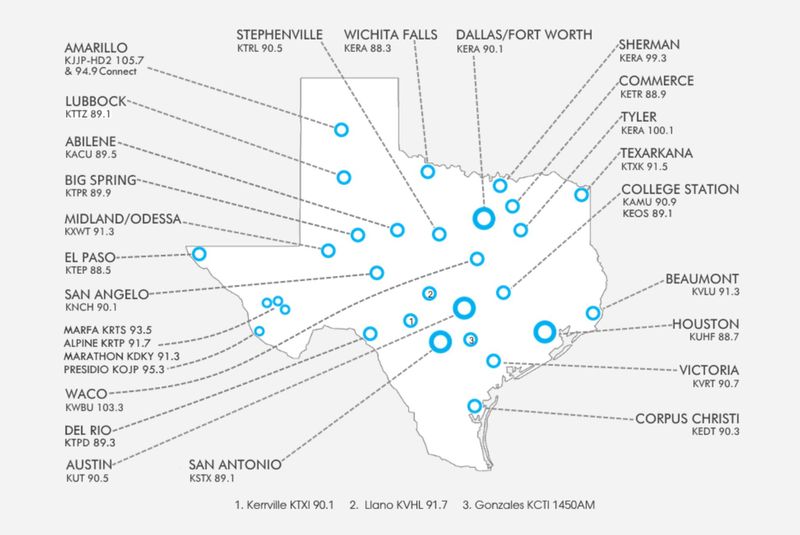
Map: NPR locations in Texas
Texas is home to several of the nation’s most prominent NPR member stations, including KERA in Dallas–Fort Worth and KUHF in Houston. KERA serves more than 3 million people monthly across its radio, television and digital platforms. It regularly ranks among the top 10 stations in the Dallas market and is widely considered one of the top 20 NPR affiliates in the country.
KUHF, part of Houston Public Media, reaches a similarly large audience — with more than 2.7 million monthly users across radio, streaming, podcasts and TV. While its on-air ratings place it in the top 15–20 FM stations locally, its combined digital and broadcast reach ranks it among the most influential public media organizations in Texas.
Austin’s KUT is another major player. Although it is more difficult to pin down exact figures, KUT regularly appears among the top five stations in the Austin market and is recognized nationally for its award-winning reporting and high audience loyalty.
It’s harder to determine how many listeners for each local station. However, there are likely around 10 million listeners across Texas.
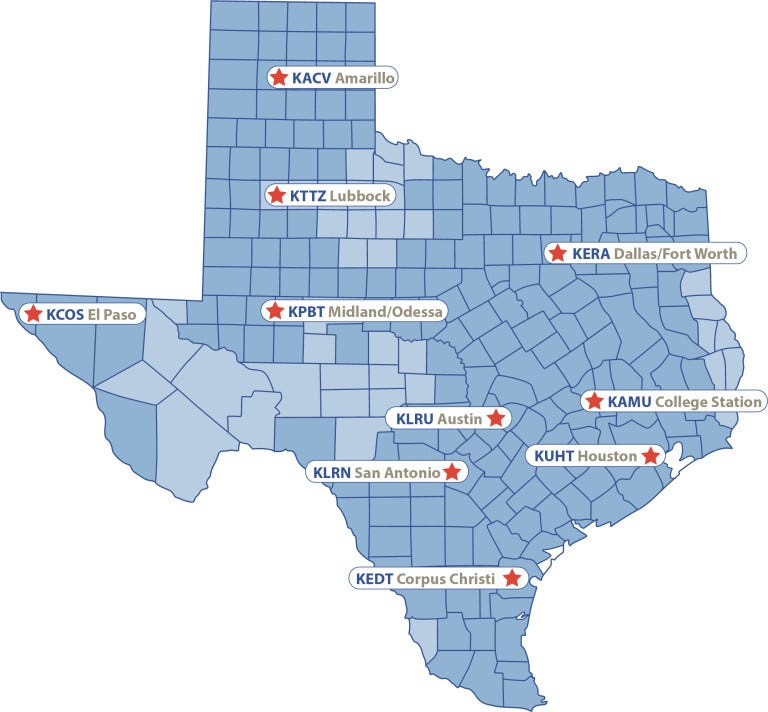
Map: PBS locations in Texas
This article originally appeared on Austin American-Statesman: Trump signs bill to defund public broadcast. How many NPR, PBS stations does Texas have?
Reporting by Brandi D. Addison, Austin American-Statesman / Austin American-Statesman
USA TODAY Network via Reuters Connect