

A friend recently sent a photograph of an organism he encountered, and we discussed what the creature could be.
It turned out our initial identification was correct; however, exactly how this organism’s group fits into the kingdom of life is still debated, and, even after at least two centuries of scientific study, surprisingly little is known concerning these organisms’ specific life histories.

In the early 1800’s, Swedish mycologist Elias Magnus described several species and classified them as fungi within a class he named Gastromycetes.
Another researcher classified the group into suborder Myxogasteres; whereas, a later German researcher, Heinrich Link, coined the group name Myxomycetes/Myxomycota which, translated from Greek, means “slime fungus.” We presently refer to these organisms as slime molds.
Using modern molecular techniques and detailed laboratory experiments and observations, current researchers placed slime molds into kingdom Protozoa — more closely associated with amoebas and other protists. However, protozoans are a polyphyletic group. That means they contain organisms grouped together that don’t share a common ancestor.
Therefore, slime molds present researchers with many unresolved mysteries and questions.
A fascinating characteristic of the myxomycetes, or true slime molds, is a lifecycle stage known as the plasmodium involving a large, macroscopic, single-celled body with a tremendous number of nuclei.
How they hunt
The slime mold’s plasmodial stage is mobile and slowly oozes over surfaces via cytoplasmic streaming and pseudopod-like extensions in search of bacteria, fungal spores, yeasts, detritus and other nutrients to surround and engulf — similar to a huge amoeba!
The most common plasmodia encountered in nature are known as phaneroplasmodia which, translated from Greek, means visible plasmodium. Many mobile slime molds are covered by a slime sheath. The organism sheds a portion of its sheath material during movement and leaves visible slime trails.
A colorful bunch
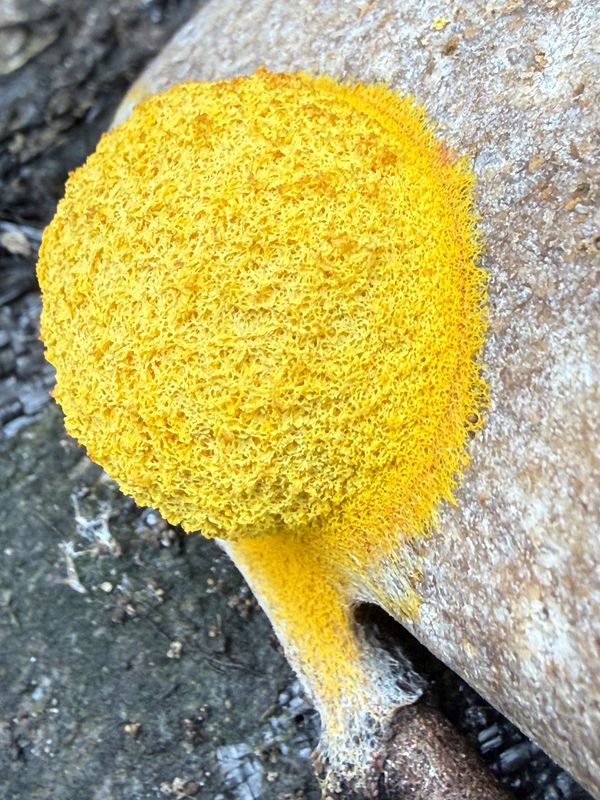
Plasmodia colors, sizes and shapes vary. Slime molds can form fan-shaped, globular, and rather amorphous body forms ranging from white to red, orange, yellow or other colors. Slime molds were grouped with fungi because part of the slime mold lifecycle involves development of fruiting bodies, sporangia and spores.
However, germinating fungal spores release hyphal cells, whereas, germinating slime mold spores release motile flagellated and amoeboid (myxamoeba) cells usually referred to as amoeboflagellate cells.
Shape-shifters
These cells can reversibly alternate their form between an amoeba-like or flagellated cellular state depending upon presence or absence of water. If water is abundant within the immediate environment, more flagellated cells — also referred to as swarm cells — are produced. But myxamoeba cells predominate in drier environments.
If conditions become unfavorable, myxamoeba cells may form resistant, dormant structures called microcysts and await better environmental conditions. Eventually, two compatible amoeboid cells fuse together producing a zygote that undergoes numerous nuclear divisions and growth without forming separate cells.
This process ultimately results in development of the syncytial, plasmodial life stage. Plasmodia can transform into an environmentally resistant, resting form known as a sclerotium. But, if conditions are favorable, the plasmodial slime mold will grow and develop into an aethalium that produces fruiting bodies containing unicellular, haploid spores of the next generation.
They do get around
Although lifecycles may be complicated, these developmental adaptations enabled plasmodial slime molds/myxomycetes to become cosmopolitan colonizers found upon every continent — even extremely cold Antarctica!
Slime molds occur in all terrestrial habitats including desert, tundra, forest, grassland and tropical ecosystems as-well-as a few freshwater habitats. Nutritional requirements are not well documented, but many species are found in specific microhabitats including tree bark, leaf litter and woodland debris, various soils and even animal dung.
Slime molds likely obtain sufficient moisture, bacteria and other food and nutrients from these associations. Insects, such as beetles and flies, are known to feed upon plasmodia and their spores and pupate within the aethalium stage. Emerging adult insects effectively spread slime mold spores to new locations.
About dog vomit slime mold
The bright yellow slime mold my friend encountered was the cosmopolitan Fuligo septica. It is unflatteringly called dog vomit slime mold; scrambled eggs slime; witches’ butter; and flowers of tan.
Although widespread, this slime mold is most commonly reported in mesic eastern and southern portions of our region. Fuligo septica forms some of the largest known aethalia measuring 2–20 centimeters or greater in diameter.
It is usually found on decaying wood, forest floor litter and soils and sometimes on living plants, especially after periods of substantial rainfall. There is some speculation that the yellow pigments of dog vomit slime mold may convert sunlight to useable energy.
These yellow pigments are known to chelate heavy metals such as zinc, thus, rendering these toxic compounds harmless to F. septica and conferring this slime mold a potential role in bioremediation strategies.
An alien invasion?
Although harmless within its environment, a sudden and unusual outbreak of dog vomit slime mold plasmodia and aethalia caused a brief panic within the Garland community in 1973 as residents discovered the slime mold in yards and on telephone poles and other areas.
Firefighters attempted to remove the slime molds by hosing them down which only resulted in proliferation and growth of the witches’ butter into perceived alien-like “blobs.” Panic was dispelled when researchers identified the “alien” organisms as F. septica slime mold and informed residents that the slime mold actually improved their soils and environment!
How slime molds are used
Researchers utilize slime molds to study cell division and differentiation, RNA processing, toxicology and oncology. Engineers have used the organism’s movement patterns to model efficient traffic patterns and flow for urban settings.
Indigenous peoples of Mexico and Central America consumed young scrambled eggs slime and identified the dish as “caca de luna.” (I’ll forego translation!). But I advise caution because F. septica can accumulate and concentrate heavy metals present in its surroundings.
As discussed, much remains to be learned regarding slime molds and their habits, but perhaps, when encountering a mobile, plasmodial “blob,” you won’t panic at the sight of these fascinating and mysterious creatures!
This article originally appeared on Abilene Reporter-News: It’s ‘The Blob,’ or is it? | Opinion
Reporting by Jim Goetze, Abilene Reporter-News / Abilene Reporter-News
USA TODAY Network via Reuters Connect
By Jim Goetze, Abilene Reporter-News | USA TODAY Network
