Editor’s note: This is the second part of an exploration of how farming practices have changed over the decades, driven by horses and then engines. The first part is here.
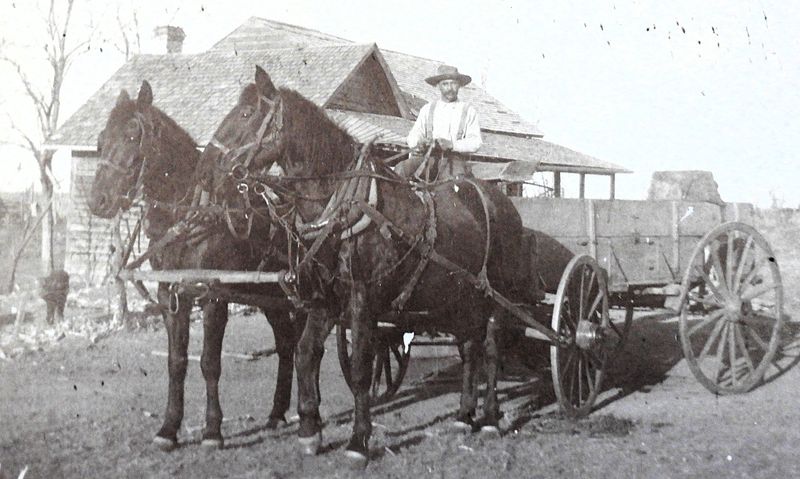
We’ve previously discussed horsepower and use of horses for farm work and tillage during the later 19th and early 20th century. Farm production was dependent upon animal-powered implements and centered around relatively small family farms with a portion of the crops produced as feed for the draft animals.

As the 20th century advanced, technological breakthroughs forever changed agribusiness and farming practices throughout North America. Let us enhance the previous discussion by focusing upon shifts toward completely mechanized agriculture and its accompanying cultural changes.
‘Road locomotives’
We discussed the railroad’s impact upon farming pursuits throughout our region. It seems logical that someone would develop a type of steam-powered, wood- or coal-fired self-propelled machine capable of independent movement upon land.
Just such inventions occurred as early as the 1860s with development of “road locomotives” that became widely used in logging and timber industries. The J.I. Case company produced several types and sizes of road locomotives.
By the early 1900s, the most popular steam-powered tractors ranged from approximately 15–40 horsepower with the largest Case 150 model boasting approximately 170 brake horse power — which is engine power measured before drivetrain losses.
This amount of horsepower seems small today because larger riding lawnmowers are often 20-30 horsepower; however, compared to horses, the road locomotives were huge advances. The Case 150 model could pull a 30-bottom plow at slow speed; a feat almost impossible to imagine for teams of horses. However, this massive road locomotive or tractor also weighed a staggering 75,000 pounds.
Fueling old-timey tractors
There is an ebb and flow involved in many technological developments, and agricultural engineering is no exception. It may surprise you that the first gas-powered tractors were produced during the era of wood and coal-fired road locomotives.
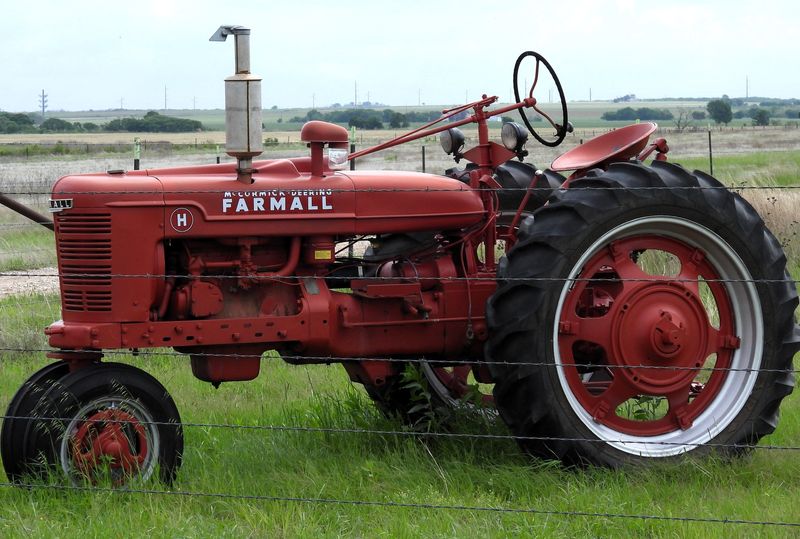
An Iowa inventor named John Froelich engineered a gas-powered tractor in 1892. However, at that time kerosene was more readily available, and most tractor manufacturers switched to kerosene-fueled engines. Examples include early Fordson and Farmall tractors.
However, improvements in gasoline refining, availability, storage and price stimulated a switch back to gasoline-fueled machines by the 1930s and 1940s.
Crawler tractors
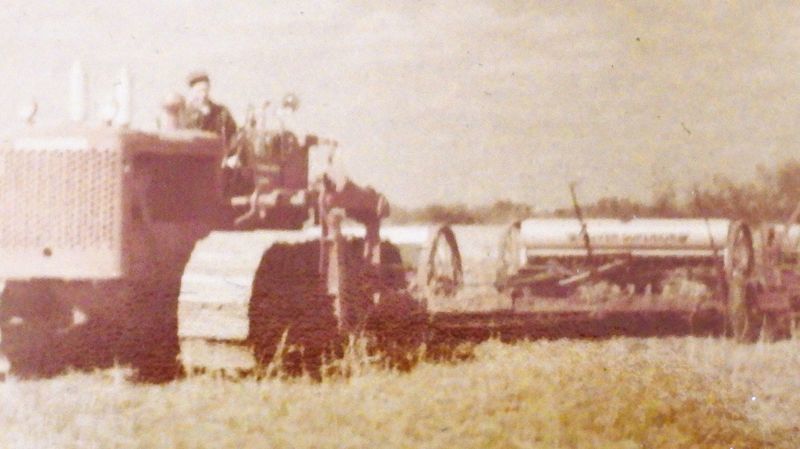
Concurrent with the transition back to gasoline-powered tractors and machinery, manufacturing companies such as Caterpillar began pioneering work upon diesel engines for large, track-type, crawler tractors and machinery. Caterpillar tractors moved upon large, steel tracks instead of the steel wheels of smaller, gasoline tractors.
Similar to most kerosene tractors, early diesel engines were initially started with gasoline and then switched to diesel fuel as the engine heated up. Crawler tractors, or bulldozers, became popular for farming operations by the middle 1940s because of the crawler’s increased traction, horsepower and ability to pull larger implements compared to most gasoline tractors.
The popularity of diesel-powered machinery increased, and diesel finally became the dominant fuel of agricultural, industrial and transportation equipment of all kinds by the 1960s.
However, a significant disadvantage incidentally occurred when states, counties and municipalities began paving roads. If fields were separated by paved roads, the crawler or track-type tractors had to be driven along unpaved roadside ditches, across other fields or pasturelands or transported by truck and trailer.
Otherwise, the tractors’ metal tracks would literally tear up the road pavement! Rubber tires on conventional, wheeled tractors solved this issue, but many years passed before rubber tracks were developed for crawler tractors.
Four-wheel drive steers onto tractor scene
Consequently, manufacturers began developing practical, four-wheel-drive tractors and machinery in the 1950s and 1960s to substitute for traction loss and increase drawbar horsepower — which is the power of a tractor to pull a load as measured at the tractor’s hitch point.
One of the first, large, four-wheel drive tractors was produced by the International Harvester company in 1961–1965. This tractor was the IH 4300. It delivered improved traction and, at the time, the greatest drawbar horsepower at 200 of any mass-produced farm tractor.
As sometimes happens with new technology, this particular tractor was ahead of its time, and less than 50 were manufactured. However, by the 1970s, the popularity, demand and manufacture of four-wheel drive farm tractors increased dramatically as larger farming operations and mass production of cash crops such as wheat, corn, sunflowers and soybeans became the dominant trend of farmers across the Rolling Plains and Great Plains.
Companies such as J.I. Case, International Harvester, John Deere, Steiger, Versatile and others began engineering and manufacturing even larger tractors.
The debut of combines in farming
Harvesting machinery underwent a technological and mechanical revolution to accompany increasing acreage devoted to cash crops and larger tractors, tillage implements and planting equipment. Combine evolution involved integration of previous, horse-drawn, reaping, threshing and winnowing equipment into a single machine.
Hiram Moore produced the first integrated combine in 1836, but this impractical machine required a team of 30 or more horses to pull and power it. Steam-powered tractors assumed the pulling duties for combines by the 1890s, and, by the 1920’s, tractor-pulled combines gained popularity.
The pull-type combine trend continued well into the 1940s, but a change was coming.
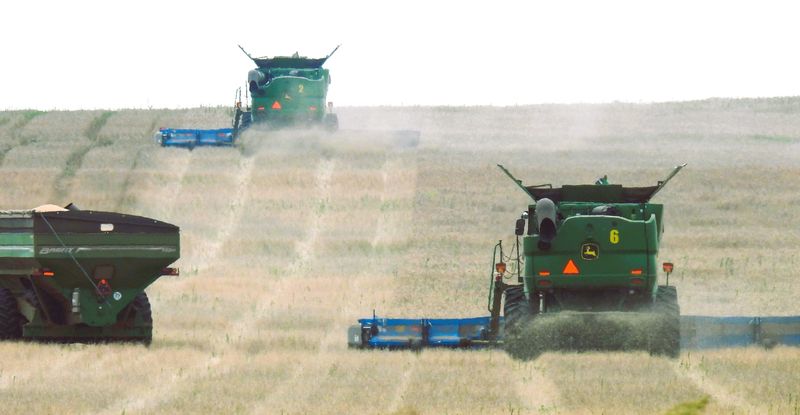
In 1938, the Canadian-based, Massey-Harris Company engineered the first, efficient, self-propelled combine, and other agricultural manufacturing companies soon followed suite. Similar to farm tractors, over time the size and capacity of combines dramatically increased.
For example, a 1940s, pull-type, Cockshutt combine had an average cutting bar width of 10 feet and grain bin capacity of 40 bushels. But a modern combine may have a cutting bar/header width exceeding 40 feet and a grain bin capacity greater than 500 bushels!
Nostalgia and modernity
Horse farming is still practiced in a few North American communities; however, mechanical advances have rendered horse-based agriculture obsolete or almost purely nostalgic.
Wooden barns were replaced by metal grain bins, other storage facilities and fuel tanks. Horse stables were replaced by large shop buildings where the farmer’s mechanized equipment is repaired and housed.
Farming culture has definitely changed, but we can still appreciate the elegance of antique equipment and powerful draft animals while at the same time marveling at innumerable advances in modern agriculture that help provide food and fiber products worldwide.
Jim Goetze is a retired professor of biology and former chairperson of the Natural Sciences Department of Laredo College with an avid interest in all aspects of the natural world. He can be contacted at gonorthtxnature@gmail.com.
This article originally appeared on Abilene Reporter-News: Horses to ‘road locomotives,’ how farming changed forever | Opinion
Reporting by Jim Goetze, Abilene Reporter-News / Abilene Reporter-News
USA TODAY Network via Reuters Connect