Have you seen “Moulin Rouge! The Musical”?

Before Thursday night at Bass Concert Hall, I had not.
A dereliction of duty, given the rave reviews for the 2018 Broadway reimagining of the 2001 Baz Luhrmann movie musical; its 10 shiny Tony Awards; and the show’s ongoing romps in New York City and on the road worldwide.
I figured that the groundbreaking original movie had delivered the last word: The eye-smacking sets, lights and costumes; the snippets of pop, opera and show tunes; the conventionally tragic love story; the whiplash camera work and whooshing sound work; and the charming glamour of the young stars who played the doomed romantic couple.
I was wrong. The stage musical far outranks the movie original, as you can judge for yourself through May 25 at Bass Concert Hall.
Allow me to share nine reasons why:
The stage ‘Moulin Rouge’ tells the story better
Set in turn-of-the-last-century Paris, the story, borrowed unabashedly from various operas, novels, movies and other sources, is set in an underworld of artists, demimondes and show folk, who mix with the other classes in nightclubs such as the famous Moulin Rouge, where the scandalous, high-powered can-can dance was popularized.
In the movie, the characters appear as little more than cartoonish lovers, clowns, villains, pimps and harlots. At the center of the plot are Christian, an aspiring composer with new bohemian friends, and Satine, a classy courtesan who has risen to cabaret stardom at the Moulin Rouge, which itself is in financial trouble under its impresario, Zidler.
Complications ensue.
The stage play by Josh Logan deepens the characters and their motivations, while adding wit to the movie’s slapstick humor, without impeding the the irresistible scenes of nonstop nightclub mania, truly some of the best depictions of that carnivalesque life that one could imagine.
Pop parade of songs plays out better onstage
Australian director, producer and writer Lurhmann is rightly credited with expanding the range of “jukebox musicals,” which employ existing songs rather than new ones. Not in service to reality, or even just biography, as seen in “Jersey Boys” or “Beautiful: The Carole King Musical,” both given recent, solid-gold stagings at Zach Theater.
But rather, Lurhmann mines all manner of music to generate a cascade of micro-moods.
If a single song can’t propel the right emotional forward motion, maybe a dozen will do so, in the form of a riotous medley. By my count, the “Elephant Love Medley” that closes the first act in the stage musical samples no fewer than 20 songs.
While Lurhmann set a melancholy tone for the movie original with John Leguizamo’s haunting rendition of “Nature Boy,” he swiftly moved into breathless fragments of rearranged tunes that just about everyone in the audience recognizes.
As clever as this technique seemed on the screen, it’s even more effective onstage, in part because the audience is primed to listen carefully and respond appropriately to each musical nugget. It’s a shared experience rather than a semi-solitary one.
Perhaps too much so at times, but more about that later.
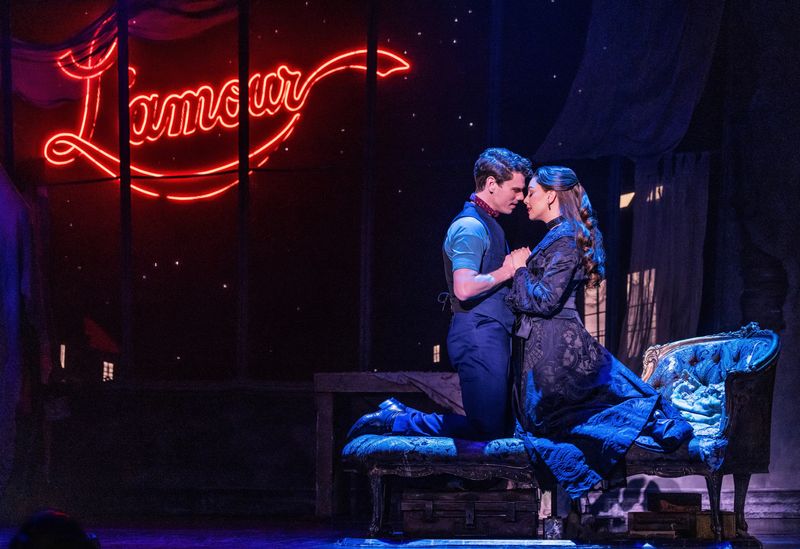
Adele’s “Rolling in the Deep” is among the winning new songs in the stage version, but I’m also relieved that the creators kept the heartbreaking “Come What May,” written for Luhrmann’s “Romeo + Juliet,” but introduced in the movie, “Moulin Rouge!”
Thank Justin Levine, credited in this show with “music supervision, co-orchestrator, arrangements and additional lyrics,” and his team for all that.
The dancing is real and extraordinary
In the movie, the dancers are viewed from every imaginable angle. Their movements are often slurred or sped up to increase the kinetic feeling. Even the relatively repetitive can-can becomes a rollercoaster ride. (Similar techniques enlivened, but sometimes cheapened, the dancing in the otherwise fine film adaptation of “Chicago.”)
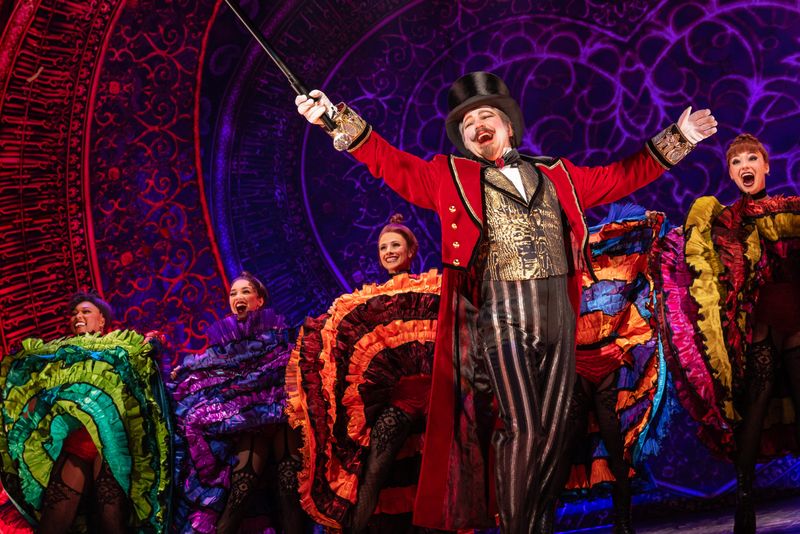
Onstage, the dancers do not hide behind the camera. They are real and extraordinary. Everybody dances, even the performers who play the more sedentary roles of wealthy nightclub patrons. Thank extraordinarily creative dance-maker Sonya Tayeh for that.
Two dancing roles that have been expanded or reinvented, Nini and Santiago, are played by two performers who stood out from the talented crowd: Kaitlin Mesh and understudy Mateus Barbosa da Silva. Give your full attention to their sexy, tango-inspired pairings.
The stars humanize, extend their roles
Nicole Kidman and Ewan McGregor charmed their way through the movie “Moulin Rouge!” Without their glowing, open-eyed performances, often shown in extremely tight close-ups, the film might have floated off like the green fairy from the absinthe bottle. For Kidman, it was an especially satisfying breakthrough that showed her growing range as few movie roles had done before.
Neither, however, impressed as singers. Their thin, breathy voices suited much of the material on a surface level, but Lurhmann depended on their sweetness or sharpness to sell their songs.
Not so for Jay Armstrong Johnson and understudy Jerica Exum as Christian and Satine. They fleshed out their romantic roles physically and vocally. While McEwan’s Christian appeared mostly passive, Johnson takes control of the role — and the whole show — from the opening lines. And while Kidman emphasized Satine’s fragility, Exum plays up her strengths and surprising empathy.
Both performers come with fantastic voices which can handle the numerous musical challenges presented by the jukebox score.
Other cast members are joined by a strong ensemble
What is true for the stars is true for the supporting cast of this “Moulin Rouge” tour.
I didn’t think anyone could top the movie performance by veteran Jim Broadbent as Zigler, the wily showman and sexual procurer in the movie. Robert Petkoff, aided by some rewritten scenes, proved that one can fill a Broadway-scale house with this character, especially in the staged rehearsals for the melodrama-within-a-melodrama that replaces the cliched take on Bollywood in “Spectacular Spectacular” from the film.
Jahi Kearse and Andrew Brewer shade and broaden the roles of Toulouse-Lautrec and the Duke of Monroth. Brewer, particularly, redefines the bullying aristocrat, played in the movie as a simpering sadist, but a more robust, complicated man onstage.
The ensemble does a tremendous job of shaping their background roles to become both particular and general as the scenes require.
The scenery overwhelms the senses
Before the stage musical premiered in 2018, just about everyone must have wondered: How the heck will director Alex Timbers and his design team match the universe of saturated colors and patterns from Luhrman’s endlessly ornate movie set?
Scenic designer Derek McLane achieved the seemingly impossible by using 19th-century theatrical techniques: Curtains, drapes, cutaways, drops, flats and sliding scenery, all decorated with intense patterns and hues, often nested in a way that added layered depth to the concert hall’s already vast stage.
Stray thought: How many stages — along with backstages, side-stages, flies and other spaces — around the country can handle that much concentrated scenery?
The lighting does the work of the camera
How does one duplicate, or even echo, the crazy camera work from the original movie? This stage show’s artistic team doesn’t even try.
Yet if one element comes closest to providing those animated effects it is Justin Townsend’s lighting. The designer leaves no tool in his toolbox: back lights, foot lights, spotlights, neon lights, pin spotlights, running lights, searchlights, laser-like lights, blinding flashes, lights embedded magically in bottles and cups.
They complement Catherine Zuber’s extravagant Monmartre district costumes, which inventively modernize the styles left behind in visual evidence from the period.
In musicals, you don’t want to leave the theater “humming the sets, lights or costumes,” but the scale and variety of visual effects is overwhelming.
The best elements of the movie are retained
In general, I like the movie. I recently rewatched it with a musical theater buddy and we agreed that it more than held up after almost 25 years. This go round, it didn’t feel the least bit revolutionary. In fact, the passage of time has made its conventional elements all the more evident.
The stage version, thank goodness, keeps and amplifies the romance, the danger, the songs, the dancing, the maximalist scenery, costumes and lighting, etc. That’s no small thing.
The audience is on board before the show even starts
This show attracts ardent followers. Along with the usual variety of theatergoing attire, audience members arrived in costumes inspired by “Moulin Rouge.” Inside the theater, they listened intently to every twist and turn, and responded with glee and cheers to almost every familiar tune.
That got out of hand in the second act as the story darkens and the songs beg a more serious response. Too many times, spectators around us giggled or guffawed when the matter onstage was meant to be tragic.
No matter. It’s delightful that they are so engaged. It’s gratifying to share a show with fans who so adamantly adore musical theater.
Not often do musicals earn all the too common exclamation point in the title, but I’m ready to shout it out loud to anyone who will listen: “Moulin Rouge!”
‘Moulin Rouge! The Musical’
When: Various times through May 25
Where: Bass Concert Hall on the University of Texas campus
Info: austin.broadway.com, texasperformingarts.org
This article originally appeared on Austin American-Statesman: Far better than the movie: 9 reasons to see ‘Moulin Rouge! The Musical’ in Austin
Reporting by Michael Barnes, Austin American-Statesman / Austin American-Statesman
USA TODAY Network via Reuters Connect