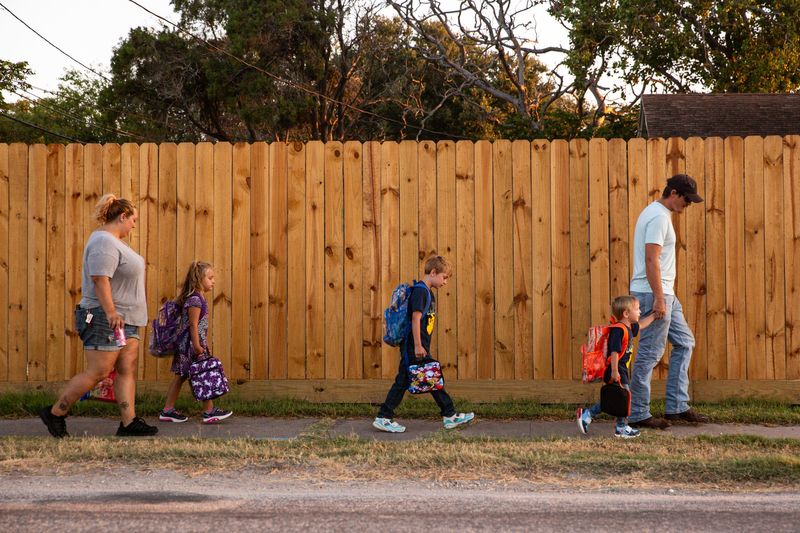
Last year, Corpus Christi ISD students made progress in math. But attendance remains a persistent problem for the district.
These are some of the key points highlighted in the Corpus Christi Independent School District’s Texas Academic Performance Report for the 2024-25 school year, a detailed collection of the state’s best data on academic performance, graduation outcomes and demographics.

Texas school boards are required to discuss and share TAPR reports annually. Corpus Christi ISD’s Board of Trustees began this discussion on Feb. 16 during a workshop meeting. The board will hold a public hearing on the report during a school board meeting on Feb. 23.
Full state reports are available for every school district and campus in Texas online at tea.texas.gov. Additionally, once it’s approved by the school board, each district typically posts its version of the report online and makes printed copies available upon request.
Here are some of the key points for understanding how Corpus Christi ISD performed in 2024-25:
Are Corpus Christi ISD students going to school?
As many as 1 in 5 Corpus Christi ISD is “chronically absent.” This means they miss at least 10% of the instructional days in a school year or 10 or more days in a semester.
Though Corpus Christi ISD is on track to continue dropping the chronic absenteeism rate, the district has historically seen higher rates of chronic absenteeism than the state or Coastal Bend region.
In 2022-23, the district’s rate was 30.5%, compared to a state average of 20.3%. In 2023-24, 29.3% of Corpus Christi ISD students were counted as chronically absent.
That data from two years ago is the most recent official data and is included in the district’s annual report for 2024-25. However, during the school board meeting Feb. 16, district officials shared internal data for the current school year.
As of earlier in February, 22.7% of Corpus Christi ISD students have missed 10% or more of the current school year.
To explain this improvement, district officials cited constant attendance monitoring and early communication, as well as stricter implementation of academic consequences for chronically absent students.
Sandra Clement, Corpus Christi ISD deputy superintendent of curriculum and instruction, said that district policy outlines that students with too many absences should be denied credit for the course. But this hasn’t been strictly enforced.
This fall, the district mandated stricter enforcement. Schools do offer attendance recovery plans for students who meet requirements, but students have to act within the same six weeks as their absence.
“We’re tightening that up with clear expectations,” Clement said.
As of last week, the district’s attendance rate was just under 93%. This means that on any given school day, an average of about 7% of CCISD students aren’t in class.
That amounts to thousands of students across the district, or, at the classroom level, about one or two students from a class with 20 students.
Corpus Christi ISD has a high student mobility rate, which means that many students are enrolled on a campus for less than 83% of the school year. That’s the equivalent of missing six or more weeks of instruction from the school where they spent most of the year.
The district’s student mobility rate was 22.1% in 2023-24, the most recent data included in the annual report. The state student mobility rate was 16.4% that year.
Sonia Zyla, CCISD chief officer of accountability and student support services, said that though this also includes students who come in and out of Corpus Christi ISD, about 18% of the student population are students who are moving within the school district.
This is why consistent curriculum implementation across Corpus Christi ISD is important, Clement said.
Economically disadvantaged and special education students are particularly mobile.
The mobility rate is higher for Hispanic students in CCISD than it is for White or Black students.
How did CCISD students perform academically in 2024-25?
In reading, Corpus Christi ISD students showed mixed results in state standardized tests. Compared to the previous year, CCISD spring 2025 reading results showed growth for third, fourth, seventh and eighth grades.
But Corpus Christi ISD showed even larger gains in math, particularly in sixth, seventh and eighth grades.
During the school board presentation, staff highlighted third and fourth grade results.
In fourth grade, 65% of students showed annual growth in reading and math. The previous year, 2024, only 54% of CCISD fourth graders showed annual growth in math.
The percentage of students who didn’t meet grade level in 2024 but improved to “approaches grade level” in 2025 in fourth grade rose from 32% to 38% in math.
“Overall, these results indicate positive momentum in early literacy and math,” Zyla said.
The district’s high school graduation rate is higher than the state or regional average. This includes particularly high graduation rates at Branch, Collegiate and Veterans Memorial high schools, but rates were lower at King, Miller and Moody high schools. Carroll and Ray high schools fall in the middle. This is based on class of 2024 data.
But even if nearly all students graduate across Corpus Christi ISD, not all graduate ready for college or a career after high school.
Just under 60% of Corpus Christi ISD graduates from class of 2024 finished “college-ready.” This includes nearly all Branch and Collegiate high school students, most Veterans Memorial High School graduates and less than half of Miller High School graduates.
The district’s rate of college-ready graduates was lower than the state and regional rates for the class of 2024.
But for career or military ready graduates, Corpus Christi ISD outpaced the state and region. This includes nearly 94% of Branch Academy graduates, but only 35.4% of Ray High School graduates.
“Especially in our area … kids know early on where the work is needed,” Superintendent Roland Hernandez said. “If they’re in those specific programs, they’re jumping straight into those jobs.”
Enrollment and poverty levels
Corpus Christi ISD’s official enrollment count for last year was 33,047. Since then, the district has lost students. This year’s enrollment was just short of 32,100.
In 2024-25, the grade with the fewest students was kindergarten, with only 2,170. The largest grade was ninth grade, with 2,666.
A larger percentage of students in Corpus Christi ISD are economically disadvantaged and at-risk than the state average. The district has a lower percentage of emergent bilingual students.
The average class size at the elementary level ranged between 19 and 20 students for kindergarten through fifth grade. The average class size was 23 for sixth grade. Generally, at the elementary school level, the district average is in the line with the state average class size for each grade, except for sixth grade.
At the secondary level, average class sizes ranged from 21 students for foreign language courses to 25 students for social studies classes. Corpus Christi ISD middle and high school class sizes are larger than the state average by as many as five students in the case of social studies.
This article originally appeared on Corpus Christi Caller Times: Corpus Christi ISD data reveals how schools performed in 2024-25
Reporting by Olivia Garrett, Corpus Christi Caller Times / Corpus Christi Caller Times
USA TODAY Network via Reuters Connect