During the public comments session of the Amarillo City Council meeting May 12, the topic of new cameras being installed around the city — intended only for safety, according to Amarillo Police Department Chief Thomas Hover — was a target again for those who view it as a surveillance tool.
Caroline Stowell started the discussion by saying she wanted to speak about the purchase of cameras for Amarillo, which was on the agenda. The agenda item’s proposal was to add 18 traffic cameras at several intersections throughout the city for the next 10 years.

“I strongly oppose the proposed expansion of the Verkada Camera Systems because I believe it raises serious force offending concerns and creates a dangerous level of government mass surveillance in our city,” she said. “According to the agenda, this proposal would install 18 strategically placed cameras across the city, purportedly for proactive policing. Now, you claim that the goal is to monitor activity and identify suspicious behavior.”
“But that is precisely why my neighbors and I are concerned — that it tracks the movement of citizens. This expansion in already implemented surveillance network is much more than just a few security cameras protecting a couple of intersections,” she said.
Stowell continued to say that it was a citywide surveillance network designed to continuously monitor and catalogue the movements of ordinary Amarilloans like herself. She said she was deeply concerned that such systems could reveal where they work, worship, and more, all without a warrant.
“The Fourth Amendment protects Americans from unreasonable searches and government intrusion,” she said. “Most supporters may argue that this activity in public is not private, and courts have recognized that prolonged digital surveillance of citizens goes way beyond a reasonable expectation of privacy.”
Stowell also went into the issue of data collection and accountability, which Chief Hover spoke to later.
“All this system, through Verkada, is a cloud-based system designed for long-term data storage under a 10-year agreement, and we deserve answers and guardrails about who can access this footage, how long it’s stored and whether it will be shared outside of Amarillo,” she said.
Stowell said a lot can and has been done in the name of public safety, but constitutional rights also mattered to them.
“And Amarillo should not normalize mass surveillance simply because technology makes it easier,” she said.
Madison Boyle also protested against the Verkada systems of cameras. “First of all, I have found it abhorrent that your constituents have to come up here and appeal to your best judgement and beg to be represented. We elected you, members of city council, to represent us, but it looks like you all have preemptively decided to sell us out to private corporations before you even take the stand,” she said.
She claimed that Verkada and other A.I. cameras treat every driver and pedestrian as a subject of investigation, absent of any suspicion. “Mass collection of data precedes any crime, which inverts the Fourth Amendment’s premise that most government intrusion requires cause,” Boyle continued.
She claimed that there was a huge difference in being observed by neighbors, and having all your movements tracked, catalogued and stored indiscriminately.
“This is the difference between being seen and surveilled,” she said. Boyle claimed that people would not be able to live in Amarillo in 20 years and were tired of being pushed out by their own representatives.
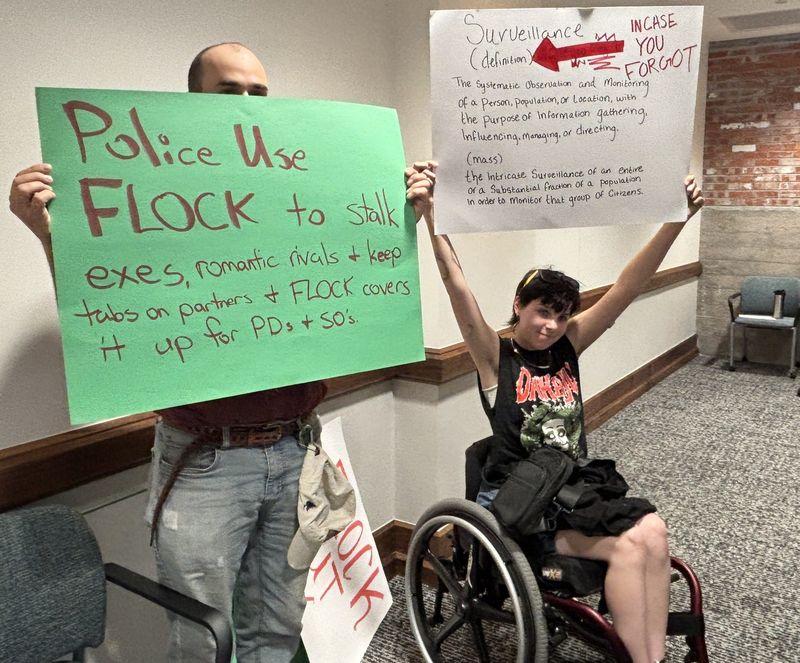
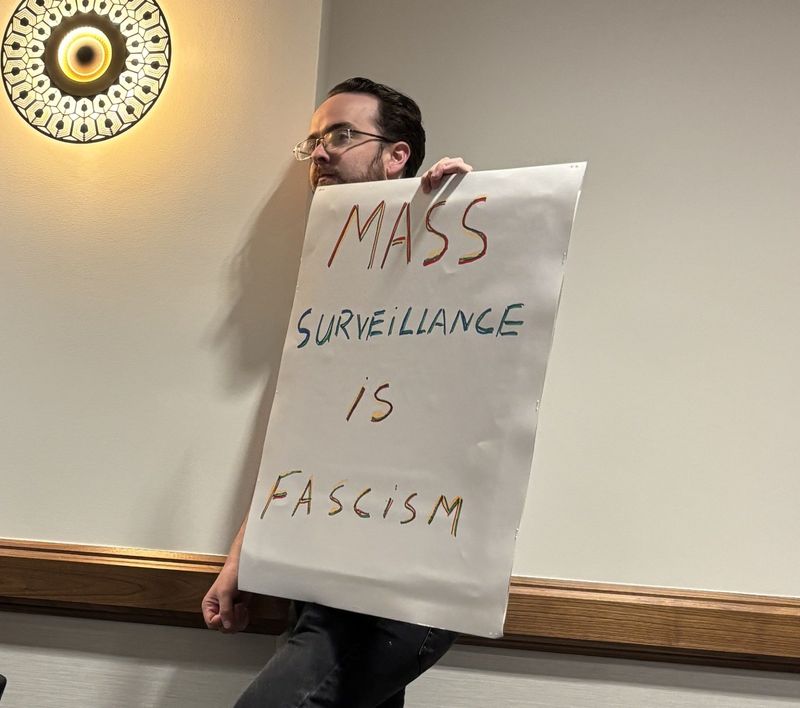
Many of those in attendance silently protested the cameras by holding handmade signs up during the duration of the council meeting.
Joe West said that the Supreme Court has said that people have a reasonable expectation of privacy in the whole of their public movements, but when the government collects information without suspicions, it violates the Fourth Amendment.
“Police officers are stalking ex-lovers, current partners and romantic rivals using FLOCK safety cameras, and it’s only being found out after something happens,” he said. “FLOCK safety executives got caught spying on children’s gymnastics and swimming lessons.”
Chief of police explains FLOCK system retention, help in emegencies
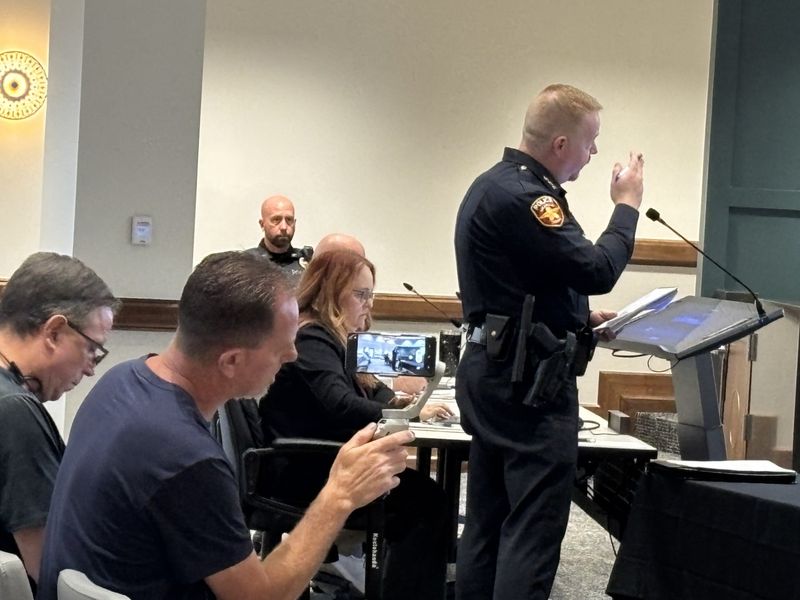
“I can’t tell you when the current FLOCK system was put in place, but I can tell you how we’re using it now, and specifically what this item is and what it’s not,” Chief Hover said.
“They are simply traffic cameras,” he said. “They’re going up in intersections. Some of them are actually replacing older aged equipment, but they’re traffic cameras, not ALPR, which is an automatic license plate reader.”
Hover told the council and attendees that it was nothing different than a regular camera that they see in front of them today. “As far as the retention (of the footage), it is only going to be retained for seven days, and then it gets injected into our video management system and then drops off,” he explained.
“There’s also an auto trail. Anytime an officer looks at that camera, for a specific reason, they have to put in the reason why they are searching, and then when they collect the data, how long they look at the camera and, for the auto trail, they put in a case report number or traffic stop number or if it’s being used in response to an event that has already occurred,” Hover said.
He emphasized that the cameras were not being used as surveillance of citizens.
“It’s simply just used after a call for services occur,” he said. “The ten-year contract is simply to have (in place) when this piece of equipment breaks or fails, so they can come in and fix it.”
Hover reiterated that the cameras are not being shared outside of their local partners, law enforcement in Potter and Randall County, and they are not a federal thing anyone else has access to, other than their actual system.
“The whole idea behind these cameras is to actually improve public trust,” he said. “The idea behind them is to provide specific details after a specific car or bicycle offense that occurs.”
“When seconds matter, especially when you’re talking about violent crime or a traffic collision, sometimes people don’t necessarily know exactly where they’re at,” Hover said. “The use of these cameras can pinpoint exactly where they are, so we can get the help and resources to help.”
This article originally appeared on Amarillo Globe-News: Controversy over surveillance, cameras continues at council meeting
Reporting by Nell Williams, Amarillo Globe-News / Amarillo Globe-News
USA TODAY Network via Reuters Connect