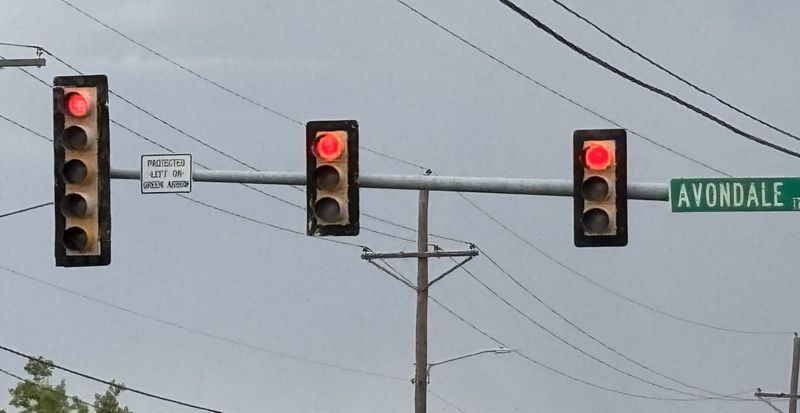
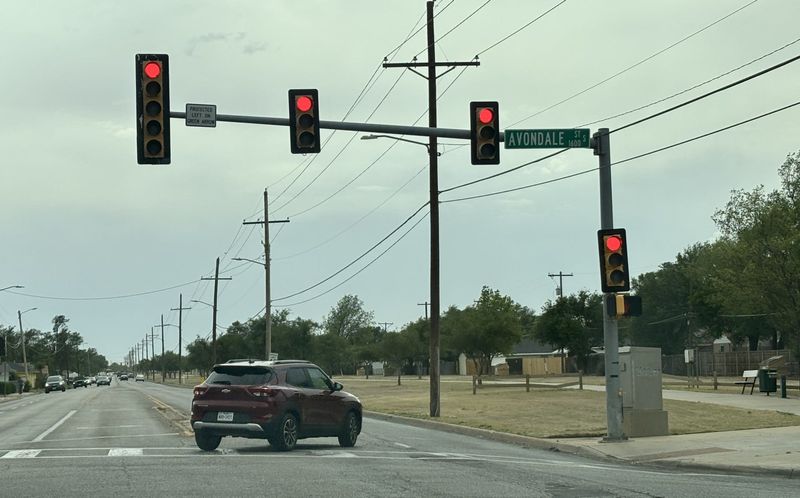
A study on traffic signal timing at various city intersections was presented during Tuedsay’s regular meeting of the Amarillo City Council.
In the lengthy agenda May 12, the presentation shared results from a study done by a third party to see whether Amarillo intersections had the correct timings on red, yellow and green lights, or if they needed to be changed for safety reasons.

Due to the growing number of accidents and deadly crashes at certain intersections, the study was deemed warranted by the City Council and City Traffic Engineering Department, with a cost of around $10,000 to $15,000.
“As you recall, on April 14, the City Council requested an evaluation of signal timing at intersections with fatal accidents in the last six months,” Alan Harder, the city’s public works director, told the council. “We actually took that all the way back to January of 2025, to make sure we got a very comprehensive look at all intersections with fatal accidents.”
He said there were some new council members since they last presented traffic accident data in March 2025, as well as an overview of signal timing and how it works. In April 2025, they hired a third-party traffic consultant to specifically evaluate the yellow change and red clearance intervals at 45th and Soncy, at the council’s request.
“The results were that they actually recommended that we reduce the amount of time we have there,” Harder said. “We didn’t take that action, but kept it the way it was that way we would be consistent with all other intersections across the city of Amarillo.”
He then preceded to go through a review of traffic fatalities and discussed the findings and the request to adding time to the currently allotted amount for each traffic signal.
Evaluating intersections for timing, finding contributing factors
From January 2025 to the present, there have been six fatal crashes at signalized intersections in Amarillo, which resulted in eight fatalities, Harder reported. Three of those were motorcyclists, and five of those were passengers in automobiles.
The findings showed that there were several contributing factors in the crashes. In three of those, speed was identified as a contributing factor and in one, alcohol was a factor. In two of the fatal crashes, drivers disregarded a stoplight, and three resulted from drivers failing to yield while turning left.
“Really, to break down the six fatal crashes, three of those were a vehicle turning left in front of oncoming traffic and being struck. One of them was a single vehicle incident in which the driver attempted to make a left turn, left the roadway and actually struck a pole outside the roadway,” Harder said.
Two of the crashes where were drivers ran red lights and struck other vehicles.
He pointed out that the intersection at Western and Mesa wasn’t included in the six fatal crashes mentioned. It had been brought specifically before city council as a concern for signal timing potentially causing a fatal accident. However, the fatal accident that occured there wasn’t in the actual intersection.
In some more telling numbers of accidents, Harden shared: 0.28 was the blood alcohol content of one of the drivers in an incident, 15 was the number of seconds that one vehicle entered an intersection after they had gotten a red light, 80 mph was the speed one vehicle was going, and at least 110 mph was the speed a vehicle was going in a 30 mph zone before entering an intersection.
He said after running calculations, they found that all six intersections of the deadly crashes studied in Amarillo, as well as Western and Mesa, meet the current requirements for traffic signals and are operating as intended.
As for adding more time to red light intervals, after checking with traffic engineers and reviewing guidelines, not just overwhelmingly, but across the board, they found the answer is no, Harden said. The extra time encourages more running of red lights and impacts efficiency, because it lowers the overall amount of time that vehicles get to go through intersections.
How is the timing determined
Harder said the criteria they use for traffic signals is determined by state and federal guidelines. “All discussions about traffic control devices have to start at the Texas Manual on Uniform Traffic Control Devices which establishes uniform criteria for the use of traffic-controlled devices and ensures consistency for motors,” he said.
He said that the manual was adopted as state law in November 2025, based on the Federal Highway Administration’s similar document. “The intent is to ensure the safe transition in signals from green to yellow to red to let drivers know that they’re about to receive a red signal,” he said. “The duration for that is calculated to provide enough time for a vehicle to come to a stop before they get to an intersection or to safely get through an intersection before they have a red light.”
He said that the recommendations had started in the 1940s when they first started seeing equations being used to do calculations and they really didn’t change until the early 2000s.
“It is simply the amount of time it takes a vehicle to travel from one side of the intersection to the other, and is still used by the City of Amarillo today.”
At one point, due to increased traffic volume, it was determined that older red light calcuation guidelines were over-conservative. “What those documents suggested was actually subtracting one second from the calculated red clearance interval,” he said. He said they even recommended using a vehicle speed that’s seven miles over the speed limit to calculate the red clearance calculation.
However, Amarillo has kept the same timing and not lowered any of these intervals to the reduced timing, which was reflected in the results of the study of 45th and Soncy.
“When I get that green light in front of me, it takes time for me to perceive that that light has changed,” he said, noting it takes at least one second for people to recognize a light has changed to green and they can take their foot off the brake, onto the accelerator, and move into the intersection.
Resident speaks on recent crashes
Mike Fisher, who regularly attends and speaks during public comments at council meetings, spoke about how he has been pursuing the traffic situation, particularly fatal accidents that he believes can be avoided.
As far as a rollover crash that occurred in front of Lowe’s last Thursday, May 8, Fisher contended that the light at Lowe’s had a 140-foot clearance north and south, which means that there was that much time to get out of harm’s way.
“It’s 140 feet from the stoplight to where your bumper is out of the way,” he said. “That would mean at a 45 mph speed limit, you would need 2.1 seconds to clear that intersection without being hit, if you barely went into that intersection when the light turned red.”
“I timed that light, and it’s 1.3 seconds — so .8 seconds, so you’re only about halfway through that intersection,” he added.
He also mentioned Plains and 10th. He said he posted a video of on his website of the intersection after a rollover accident happened there, and he claimed the light’s sensor was defective. “They implemented this automated system in 2018 that … would make our city so efficient and so effective,” he said. Fisher said for traffic heading westbound, anytime anyone goes into that intersection in any direction, it trips the signal, and then the arrow to turn south turns green and the eastbound light turns green — every single time, while traffic on the main road is stopped.
At this point, Fisher had run out of his allotted time during public comments, and the microphone was cut off. A short argument ensued when another community member spoke up, and Mayor Cole Stanley asked for a recess.
Afterwards, Stanley spoke to Fisher and told him he meant no disrespect to him, but they needed a system in order to run an efficient meeting. He later asked Fisher if he would be willing to be part of a subcommittee to further delve into the issue of traffic signals and intersections and causes of accidents.
This article originally appeared on Amarillo Globe-News: City releases study on traffic lights at dangerous intersections
Reporting by Nell Williams, Amarillo Globe-News / Amarillo Globe-News
USA TODAY Network via Reuters Connect