Editor’s Note: Jack Becker is the editor of Caprock Chronicles and is a Librarian Emeritus from Texas Tech University. He can be reached at jack.becker@ttu.edu. Today’s article is the first of a five-part series by frequent contributor Chuck Lanehart, Lubbock attorney and award-winning history writer. These articles were originally published by The History Press in Chuck’s book, “Evolution of the Texas Plains,” in 2023, reprinted here with permission.
I worked as a teenage grunt roustabout in the Texas Panhandle during the summers of 1969-1971. These are my memories of the oil patch.

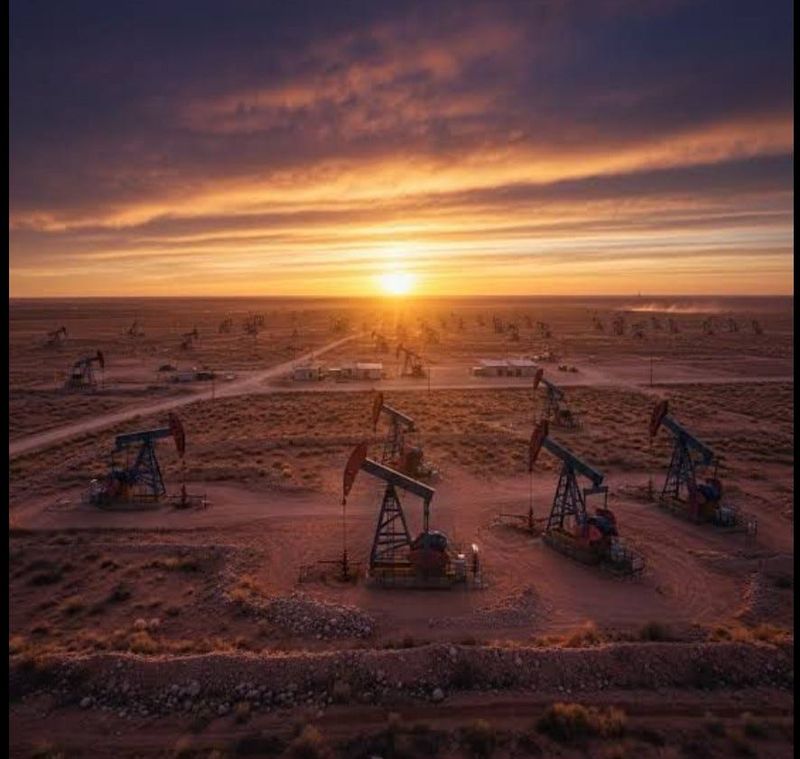
It was early June of 1969, I was 16 years old, and it was my first day as a roustabout. I found myself in the middle of a remote Texas Panhandle oilfield.
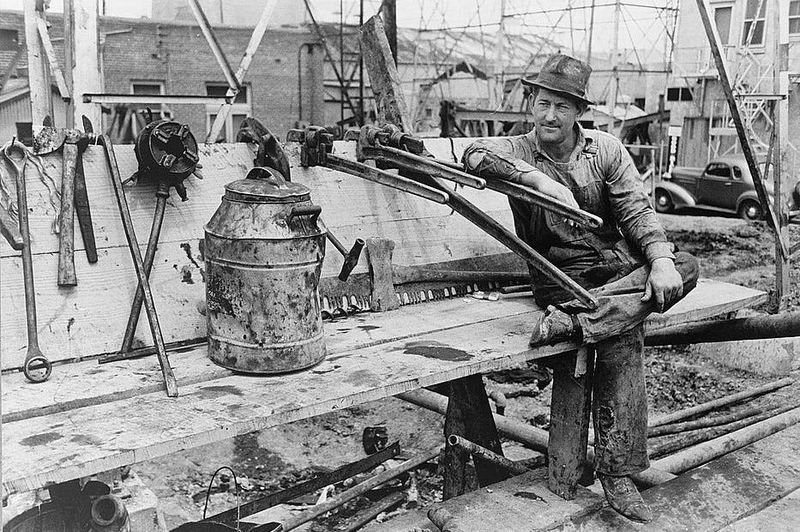
I wore heavy cotton gloves, jeans, a blue cotton work shirt, a silver hard hat and steel-toed boots. I was handed my first oilfield tool, a four-foot-long steel pipe wrench. A pipe wrench is an adjustable tool featuring two serrated, hardened-steel jaws designed to grip, turn, or hold threaded pipes.
Someone told me how to use the 35-pound monster. Before me was a shallow trench, from which an iron pipeline had been excavated. The three-inch pipe had been buried in the ground for more than 30 years, and it must be “broken out.”
I was ordered to stand on one side of the pipe and clasp my wrench on the joint connecting the two pipes. My buddy Gene Thompson—it was also his first day as a roustabout—stood on the other side of the pipe and fastened his wrench on the adjoining pipe. The threads of the joint had not been disturbed for decades, and they would not give up their adhesion without a fight.
We aggressively pushed down on the wrenches with our arms.
When that failed, we jumped on our tools—bouncing up and down—with little effect. Someone gave us “cheaters,” pipes that slid over the handles and extended beyond the length of our wrenches a couple of feet, giving us more leverage.
The cheaters and some sort of lubricant our bosses applied to the joint finally did the trick. Our 15-foot length of iron pipe was suddenly liberated!
The effort had taken a good 20 minutes, but the pipeline was several hundred feet long, so Gene and I had a long day still ahead of us. Did I mention the temperature was above 100 degrees?
By the end of the day, I was convinced manual labor was not in my long-term future.
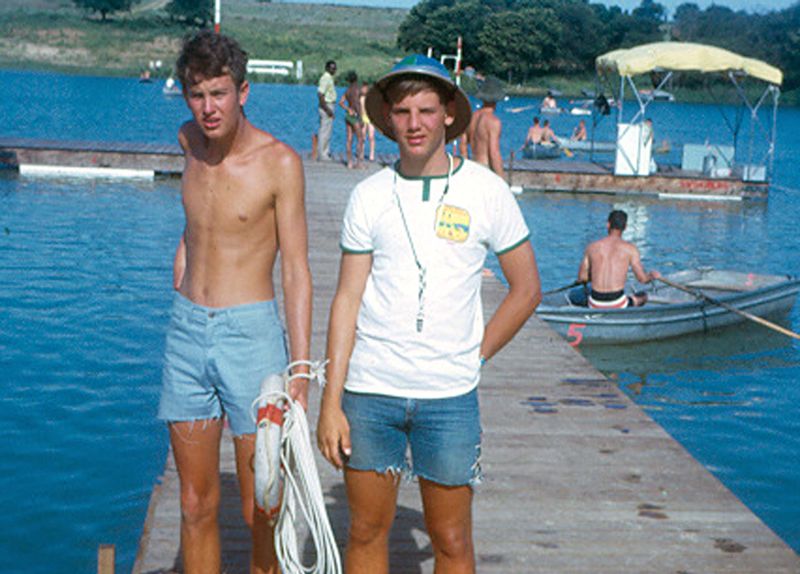
The previous summer, Gene and I both worked as Boy Scout camp counselors, earning $8 a week, including room and board.
A better-paying job was in order, and the best jobs for kids my age in the Texas Panhandle were in the oil field. My father was a geologist, and he got me a job with a colleague named Collinsworth who ran an oilfield service crew for Cree Drilling Company, an independent oil company based in Pampa, Gray County.
The job paid $1.75 per hour for a 40-hour week! We worked five days each week, and Saturdays until noon, which entitled us to $2.62 per hour, “time-and-a-half wages.”
It was a wonderful opportunity to make big money, which I would soon squander on a bit of bootleg beer, 35-cent gasoline and elusive teenage girls, saving a bit for cheap college tuition.
So, what is a roustabout?
A roustabout may be defined as “a worker who maintains all things in the oil field” who “typically performs various jobs requiring little training.”
The word roustabout derives from English terms describing “common deck hand, wharf worker,” or perhaps “rough, shaggy,” or perhaps “a restless, roaming person.”
In 1969, I was certainly untrained, rough and shaggy, I was also restless, and I would love to have roamed to California to witness the remnants of the Hippie Movement or to travel east for the Woodstock Music and Arts Festival (3 Days of Peace & Music).
But that summer I was destined to become a roustabout, the equivalent of a common deck hand. It turned out my job was a notch below the humble roustabout. Real roustabouts called me a “grunt.” In order to become a real roustabout, I was expected to “make a hand.”
An hour or so before my introduction to the pipe wrench, my first morning on the job was memorable. It took me just a few minutes to drive 3.5 miles south from my modest Pampa home to the Cree Drilling Company barn on West Wilks Street.
The barn was the staging place for our roustabout crew, where we met to gather our gear, pile into our pickups, and venture into the oilfield for the day.
The barn was a magical place, a place I did not want to leave. Several big, beautiful oilfield service trucks occupied the space, and I thought they must be brand-new.
They were all at least ten years old, but they bore fresh paint and were well-maintained. I wanted to drive one, but that indulgence was never allowed.
Every kind of exotic tool was displayed here and there, but something even more interesting covered the walls: girlie calendars and foldouts! By today’s standards, the pictures were tame, but for a 16-year-old boy in 1969, I thought I was peeking at heaven.
Part Two of this series will be published at a later date.
This article originally appeared on Lubbock Avalanche-Journal: Caprock Chronicles’ confessions of a roustabout in Texas oil patch
Reporting by By Chuck Lanehart, special for the Avalanche-Journal / Lubbock Avalanche-Journal
USA TODAY Network via Reuters Connect