By Joseph Ax
May 7 (Reuters) – Tennessee Republicans on Thursday approved a new congressional map dismantling a majority-Black U.S. House district centered on Memphis, as several other Southern states seek to leverage last week’s U.S. Supreme Court decision that severely weakened the landmark Voting Rights Act.

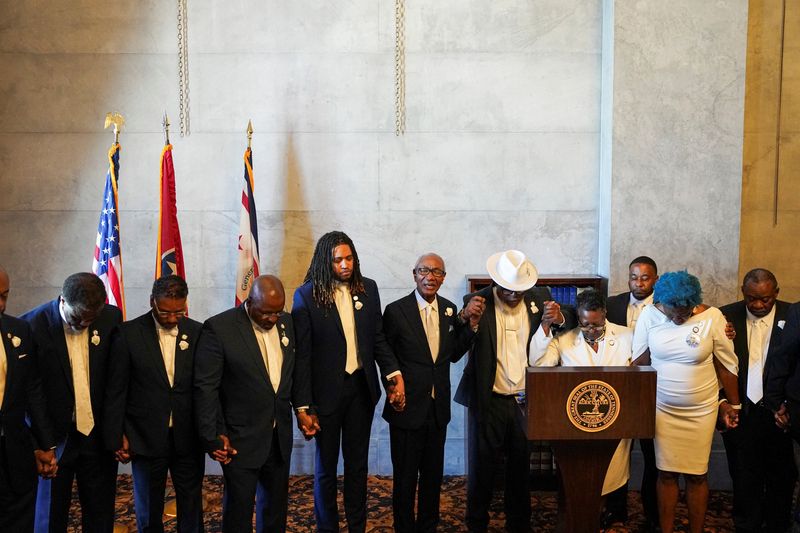
The move, greeted by loud protests at the state capitol, is likely to flip the Democratic-held seat in November’s midterm elections, when Republicans’ razor-thin majority in the U.S. House of Representatives will be at stake.
The new map splits Shelby County, the home of Memphis, a majority-Black city that played a critical role in the civil rights movement, into three separate Republican-leaning districts. The new lines could oust Democratic U.S. Representative Steve Cohen, who has represented Memphis since 2007. Republicans already control the state’s other eight districts.
With President Donald Trump’s encouragement, Republicans forged ahead despite protests at the state capitol and fierce denunciations from Democrats, many of whom decried the plan as racist.
“It is a form of Jim Crow terror,” said state Representative Justin Jones, a Black Democrat, comparing the map to the racist election laws that restricted Black Southerners from voting prior to the 1960s. “You know what you’re doing. It’s shameful.”
Republican lawmakers have defended the map, arguing it was not motivated by race but by partisan considerations alone.
“This gives us a unique opportunity for the first time in history to have an all-Republican delegation sent from Tennessee to Washington, D.C., to represent conservative values,” Republican state Representative Jason Zachary said.
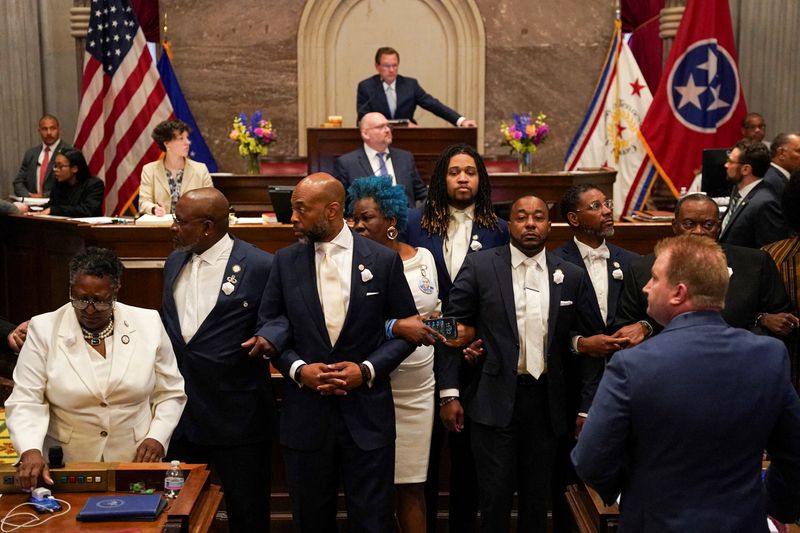
As the vote proceeded in the state House chamber, the Republican speaker, Cameron Sexton, repeatedly had hissing and yelling protesters removed from the balcony. When the House took its final vote, Black lawmakers stood in the front of the chamber linking arms, as protesters sounded airhorns and chanted angrily.
The Senate vote was also briefly delayed when state Senator Charlane Oliver, a Black Democrat, stood atop a desk on the chamber floor and unfurled a sheet with the words, “No Jim Crow 2.0,” written on it, while other Democrats stood in protest.
REPUBLICAN STATES RUSH TO TAKE ADVANTAGE
The Supreme Court decision found that Louisiana had relied improperly on race when drawing a second majority-Black district to comply with the Voting Rights Act’s safeguards for minority voters. The 6-3 ruling opened the door for Louisiana and other Republican-led states to eliminate Democratic majority-Black districts that had long been seen as legally protected.
Louisiana has suspended its May 16 U.S. House primary election to give lawmakers time to draw a new map, even though tens of thousands of voters already cast early ballots.
In South Carolina, Republican lawmakers are pushing legislation that would allow them to pursue a new map erasing a majority-Black district held by U.S. Representative Jim Clyburn, a civil rights activist and Democratic Party kingmaker who is serving his 17th term in office.
Alabama has asked the Supreme Court to reverse a court order that created a second majority-Black district in 2023 and permit Republican lawmakers to use a map with only one. Republican lawmakers this week advanced a bill that would allow them to postpone the May 19 U.S. House primary election if the court rules in their favor.
The flurry of moves has supercharged what had already been an unprecedented mid-decade national fight over redistricting, set off last summer when Trump pushed Texas Republicans to rip up their congressional map in favor of a plan that targeted five Democratic incumbents.
Other states, both Republican and Democratic, followed suit over the ensuing months. Republicans currently have built a net advantage of about four House seats across nine states, pending the outcome in Louisiana, South Carolina and Alabama. But litigation in Virginia, Florida and Missouri could further scramble the scorecard.
(Reporting by Joseph Ax; Editing by Daniel Wallis)