Parents know there are a lot of factors impacting their child’s health − anything from the area’s air quality to the paint on your walls. While city officials can advise keeping kids indoors during air quality alert days, there isn’t much they can do to help identify the many parts of a home environment that might result in a trip to the hospital.

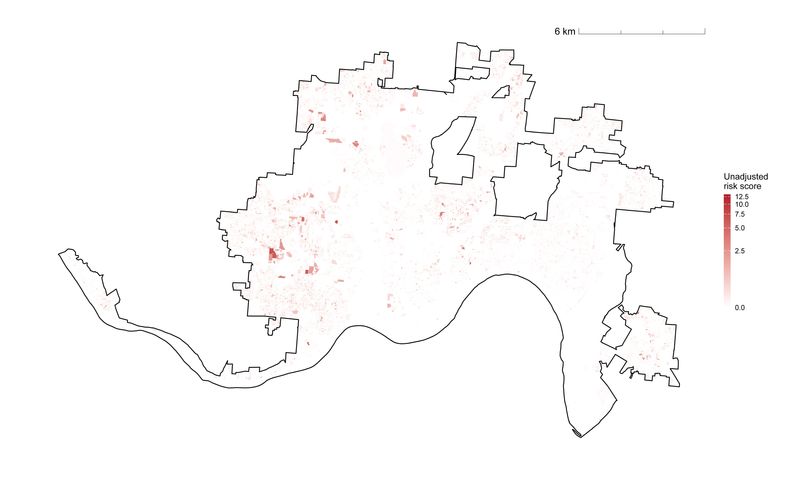
But a new tool, developed by researchers from Cincinnati Children’s, predicts the risk a child has of being hospitalized for every residential address in Cincinnati, offering a more precise look at the intricate, unit-level factors that are linked to potential hospitalization.
“By using a kind of model or a risk assessment score, we can generally share which types of addresses might be most associated with hospitalization,” said coresearcher Dr. Cole Brokamp, faculty member in the Division of Biostatistics and Epidemiology at Cincinnati Children’s.
The study − led by Carson Hartlage, doctoral candidate in University of Cincinnati College of Medicine’s Division of Biomedical Informatics − linked address-level information, like housing code problems, nearby violent crime and the value of a given home, to a child’s risk for hospitalization.
While there is not yet a publicly available tool you can use to assess your home’s risk, this research paves the way for more specific health interventions, for your child and the city of Cincinnati as a whole, Brokamp said.
New research goes deeper than previous population health studies
While traditional population health research relies heavily on ZIP codes, neighborhoods and census tracts, it often fails to consider how housing conditions, property values and environmental exposure varies within those specific areas.
This research will bridge those gaps, Brokamp said.
“That’s really the shift we’re trying to preach to people is there’s not going to be a neighborhood or a place, right? It’s going to be a set of homes with certain features and characteristics,” Brokamp said.
Carson and Brokamp reviewed over 10,000 electronic health records from children admitted to Cincinnati Children’s between July 2016 and June 2022. They then linked those records to the patients’ residential addresses.
“Instead of saying which neighborhoods would have higher rates of X or Y, it would be which specific homes over the course of a decade have had higher rates of hospitalization,” Brokamp said.
Using publicly available data from the Hamilton County Auditor, the Cincinnati Department of Buildings and Inspections, and the Cincinnati Police Department − as well as census information, filings from the Eviction Lab and birth records from the Ohio Department of Health − the researchers matched the 10,000 hospital admissions to 5,700 unique addresses.
Out of the roughly 77,000 residential addresses in Cincinnati, 7.4% of them were considered higher risk, having at least one hospitalization over the study period.
It’s not as simple as saying a single factor, such as market value, impacts the risk of hospitalization, but rather that a series of factors come together to impact that risk. So, for example, a home that has a low market value, several housing code violations and neighborhood violence may be higher risk; but the renovated house next door, with a higher market value and no violations, might have minimal risk.
2 models show addresses where hospitalization risk rises
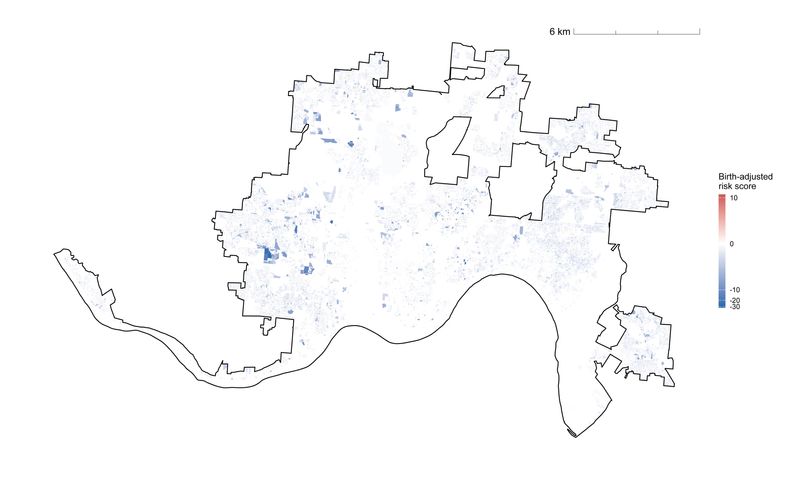
Brokamp and Hartlage developed two machine-learning models − the first estimating risk of hospitalization across all Cincinnati addresses, regardless of how many kids live there, and the second using birth records to account for how many children may actually live on the property.
After all, an apartment building with 40 families and five hospitalizations is different from a single-family home with five hospitalizations, Brokamp said.
Both models picked out market value of the address, nearby violent crime and housing code violations as key factors linked to child hospitalization.
Another study from Cincinnati Children’s, for example, found that kids who lived in a home with a housing infraction anytime in the past year were 34% more likely to be admitted to the hospital for asthma the following year. And nearby violent crimes have also been found to be large predictors for child hospitalization, Brokamp said.
The two models could also be used in different ways, Brokamp added. The first could be used to target addresses across Cincinnati for certain interventions, while the birth-adjusted model could be used to assess individual risk for a child with a known address.
“I hope that [the models] help us ask new questions about how we can respond to a population that is experiencing these things in real time,” Brokamp said. “And now we have the power to see where and when they’re happening and reach out to kids based on that.”
While imperfect, new research offers direction for public health interventions
The largest limitations of the study come down to reporting. Reporting behavior and enforcement history, especially around housing code violations, crime and other data sets, don’t always reflect the places with the greatest need, Brokamp said.
But the future for this framework remains bright, he said. It can be adapted to any number of other outcomes aside from hospitalization risk. It could be altered to gauge emergency department visits by address, or it could be refined to target environment health interventions, such as identifying lead service lines or older houses in need of renovation.
Above all, Brokamp hopes the information gleaned from these models gives a better picture of kids’ living situations that can improve medical care and point community organizations and local government in directions for intervention.
City agencies, for example, could use the information to prioritize housing inspections, enforce code violations or hold landlords accountable, while community organizations could use it to inform what services they offer to whom. And health systems may even use it to make more informed decisions about care management or to offer preventive care around conditions like asthma, Brokamp said.
“This housing-level data is another piece of the pie or ring of information we have around a child and family nested within the stuff we’re already using about the city and the neighborhood,” Brokamp said.
This article originally appeared on Cincinnati Enquirer: Your address holds clues to knowing your child’s hospitalization risk
Reporting by Esther Launstein, Cincinnati Enquirer / Cincinnati Enquirer
USA TODAY Network via Reuters Connect

By Esther Launstein, Cincinnati Enquirer | USA TODAY Network