The United States had won the American Revolution only 29 years earlier when the nation’s freedom was tested again during the War of 1812.
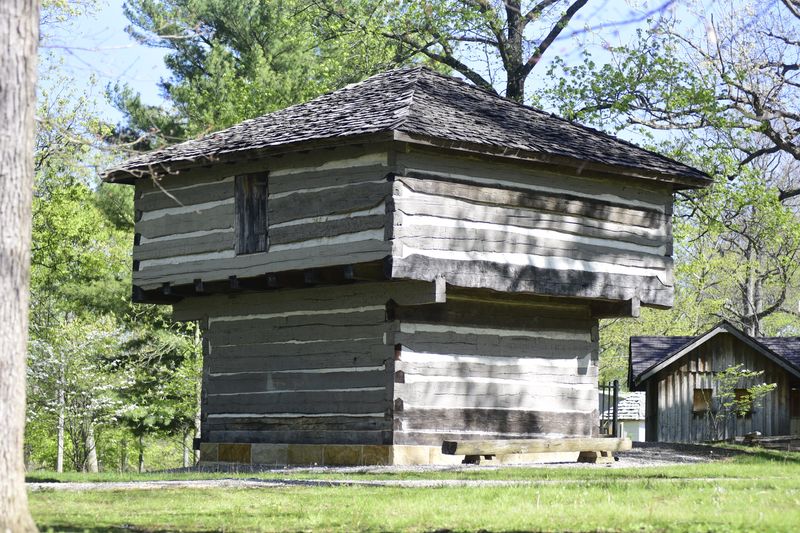
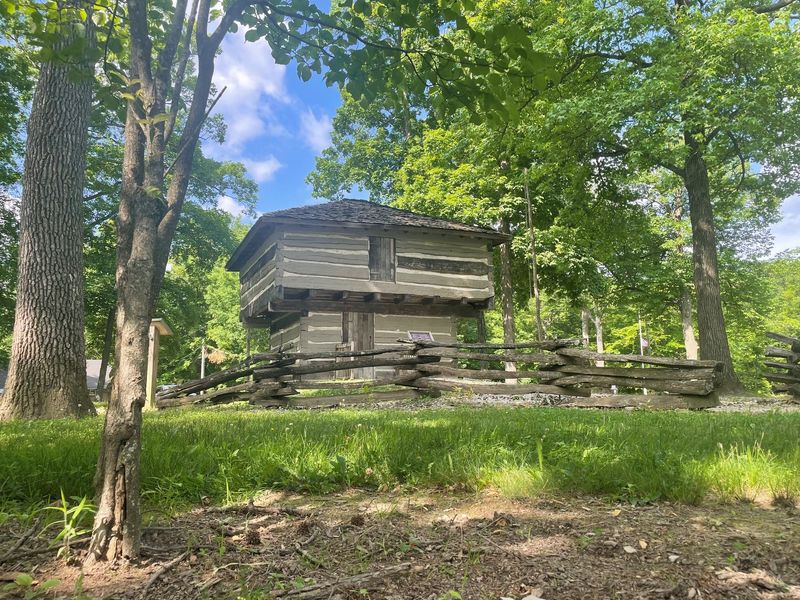
Nearly 225 years later, Mansfield remains home to the 1812 Blockhouse, one of Ohio’s few surviving structures of the second war for independence, which was built to defend the young city.

The 1812 Blockhouse is the main attraction at South Park, a 35-acre greenspace at 100 Brinkerhoff Ave. that Destination Mansfield—Richland County calls “a hub for historical and summer activities.”
“From 2025 through 2026, the Mansfield and Richland County community will celebrate America’s 250th birthday with a series of events highlighting South Park’s and Mansfield’s history since 1808,” Destination Mansfield noted.
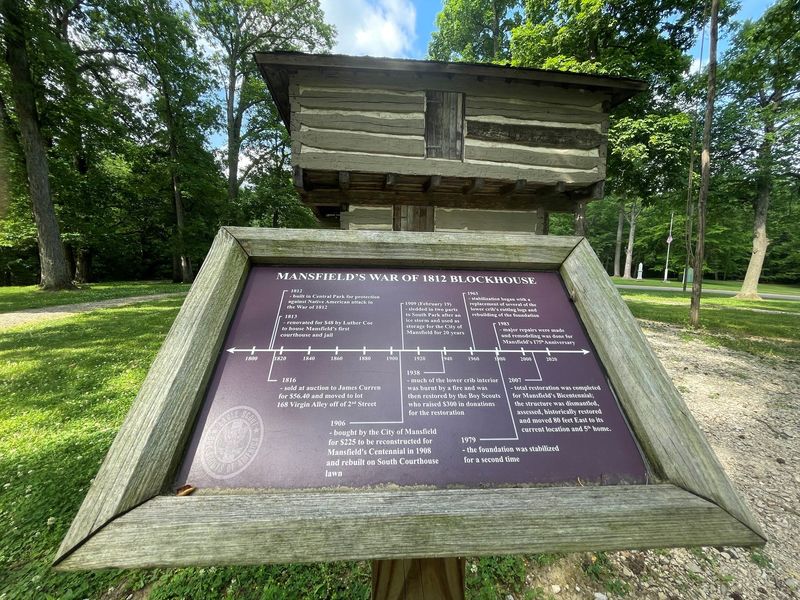
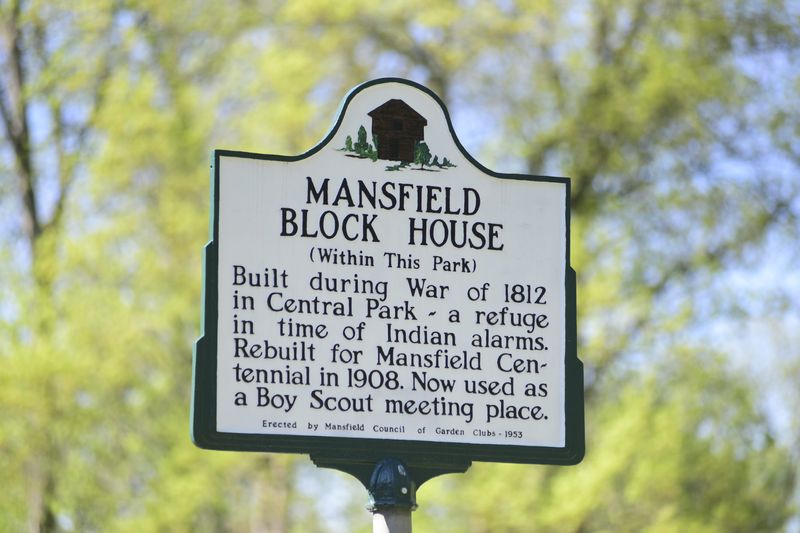
Signs throughout the park tell the story of how the 1812 Blockhouse helped Mansfield survive British aggression.
‘Native American uprising’
There were only a dozen settlers in the Mansfield area before soldiers arrived during the War of 1812.
That is, only a dozen people of European decent. The several hundred others who lived in Richland County, the name Ohio legislators assigned to the area in 1808, were from the Delaware, Wyandot, Mohican and Shawnee nations.
Richland County at the time was considered part of the nation’s extreme western frontier.
When the United States officially declared war against the United Kingdom on June 18, 1812, most of the region’s native inhabitants sided with the British.
During the summer of 1812, Mansfield settlers, with the help of U.S. troops, built 11 blockhouses to protect themselves from frontier raids.
Blockhouses were “a common form of protection in case of Native American uprising,” according to Historical Marker Database. They were made from whatever trees were available nearby.
Settlers built most of those fortresses around the city’s square, the area now known as Mansfield’s Central Park.
“The Blockhouse of 1812 was built by Col. Charles Williams and company from Coshocton, Ohio, with the help of local settlers,” the database noted. “Being temporary structures, the blockhouses, intended solely for use in the War of 1812, were demolished once they had outlived their purpose.”
Became a courthouse and jail after the war
One of the blockhouses, though, was rescued and remains a treasured piece of the Buckeye State’s history.
“As the War of 1812 came to a close, Mansfield found itself in need of a courthouse and jail,” the database noted. “Rather than building a new structure, the settlers decided to use the existing blockhouse that was then located at Central Park.”
The structure was renovated in 1813 by Luther Coe, according to a sign at Mansfield’s South Park.
After three years, the fortress-turned-jail had outlived its usefulness once again, so Mansfield leaders sold the building to a local resident, James Curren.
“Now protected from the fate of demolition predestined for the other blockhouses, Mansfield’s Blockhouse of 1812 lasted another 90 years before being reacquired by the city of Mansfield in 1906,” park signage noted.
Mansfield leaders moved the blockhouse downtown to the courthouse lawn in 1908 for the city’s centennial celebrations.
In 1909, they moved it to South Park, where it was used as a storage shed for 20 years.
Boy Scouts repaired fire damage in 1938, then the foundation was repaired in 1963 and further stabilized in 1979.
More remodeling was completed in 1983 for Mansfield’s 175th birthday.
By 2007, city leaders were preparing for Mansfield’s bicentennial, and the 1812 Blockhouse once again returned to prominence.
“The structure was dismantled, assessed, historically restored and moved 80 feet east to its current location and fifth home,” signage noted.
South Park has become a historical village that highlights Mansfield’s past during the USA 250 celebrations.
“Alongside the 1812 blockhouse, the 1808 Petersburg Log Cabin, and the blacksmith and woodworking shops, it is open to the public seasonally and during special events throughout the year,” Destination Mansfield noted.
Contact Zach Tuggle at 419-564-3508. Follow him on X at @zachtuggle.
This article originally appeared on Mansfield News Journal: Why this 1812 Blockhouse is a Mansfield treasure
Reporting by Zach Tuggle, Mansfield News Journal / Mansfield News Journal
USA TODAY Network via Reuters Connect
By Zach Tuggle, Mansfield News Journal | USA TODAY Network