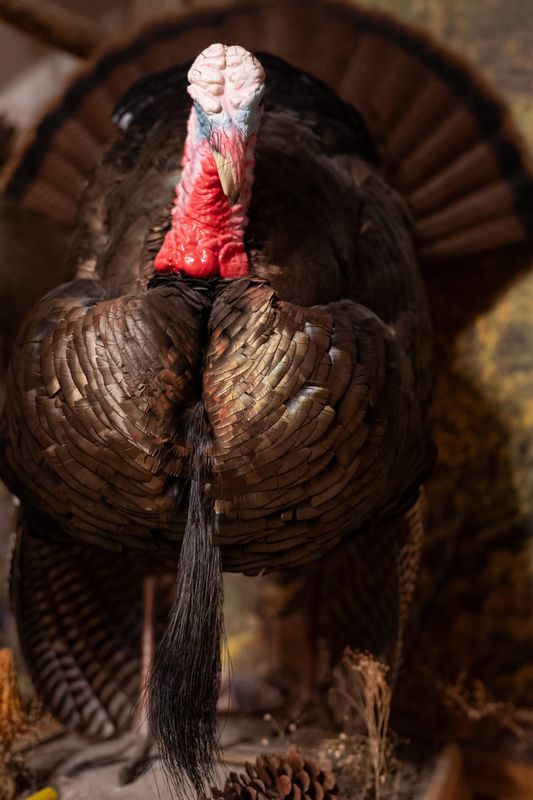
Bagging a wild turkey ranks high on many a hunter’s spring to-do list.
The chances of adding a checkmark to that list are fairly good, as such things are reckoned, suggested Mark Wiley, forest gamebird biologist with the Ohio Division of Wildlife, in an email.

“Ohio hunters will encounter a good class of 2-year-old gobblers during the 2026 spring season,” he wrote. “Spring permit success rate has exceeded 25 percent in each of the past three years, and I expect the same in 2026.”
A single bearded bird may be taken by a hunter regardless of zone and season dates. Season starting times vary by zone.
A special youth hunt runs April 18-19 in the South Zone, which comprises 83 counties, including all counties in central Ohio. The two-day season is open to licensed and permit-holding youngsters age 17 and under when accompanied by a non-hunting adult.
The regular season in the South Zone runs April 25 through May 24. Legal hunting hours are 30 minutes before sunrise until noon through May 3 and from 30 minutes before sunrise to sunset until season’s end.
The youth hunt in the Northeast Zone, which comprises Ashtabula, Cuyahoga, Geauga, Lake and Trumbull counties, is set for April 25-26. The regular spring season in the Northeast Zone runs May 2-31.
Counting all its parts, spring turkey hunting seems likely to produce results not unlike those of recent years, Wiley noted.
“Total statewide spring harvest is likely to approach 16,000 bearded birds again this year, if hunter numbers and participation match 2025,” he wrote.
Last year’s spring take of 16,014 checked birds not only surpassed the average totals from the previous three seasons by 1,653 but was the highest since 17,894 turkeys were checked in 2020 when a two-bird limit was in play.
Still, the turkey take is a long way from the harvest of 26,156 in 2001, the last year in a string of 24 during which records were set each spring.
Harvest numbers fluctuated during two decades afterward but began trending lower, causing the wildlife division in 2022 to reset to a single-bird spring limit for the first time in a generation.
The 2022 spring take bottomed out at 11,872. The harvest since has trended upward, perhaps toward stability.
Ohio State University researchers have been helping the division study the state’s turkey situation. Going into their fourth year, the researchers have “learned that hen survival rates meet or exceed rates estimated 20 years ago,” Wiley wrote.
Nests, however, haven’t been as successful in producing young over that same period, he wrote, without offering hints of why that might be.
He noted, moreover, that “preliminary estimates from the ongoing study suggest hens produce enough poults over their lifetime to maintain a stable turkey population.”
He did concede that predation might be a factor when it comes to survival of young turkeys. Additionally, it’s possible that a general decline in insect life noted in North America and elsewhere might lead to increasing stress on young birds, known as poults.
Last summer’s production of poults, though at a slightly above average at 2.9 per hen statewide, was down in all parts of the state except in southwestern counties where a hatch of 17-year cicadas occurred. With abundant food available, poults in those counties had a high survival rate, high enough to pull up the statewide average.
Based on harvests numbers, turkey abundance shows up in the state’s timbered counties of the south and east. That area, which includes the Appalachian plateau, is also home to plenty of hunters.
This article originally appeared on The Columbus Dispatch: Spring turkey season expected to bring success to Ohio hunters
Reporting by Dave Golowenski, Special to The Columbus Dispatch / The Columbus Dispatch
USA TODAY Network via Reuters Connect