First of a two-part series.
Al Hodge was a superstar of radio and television.

Millions of children idolized him.
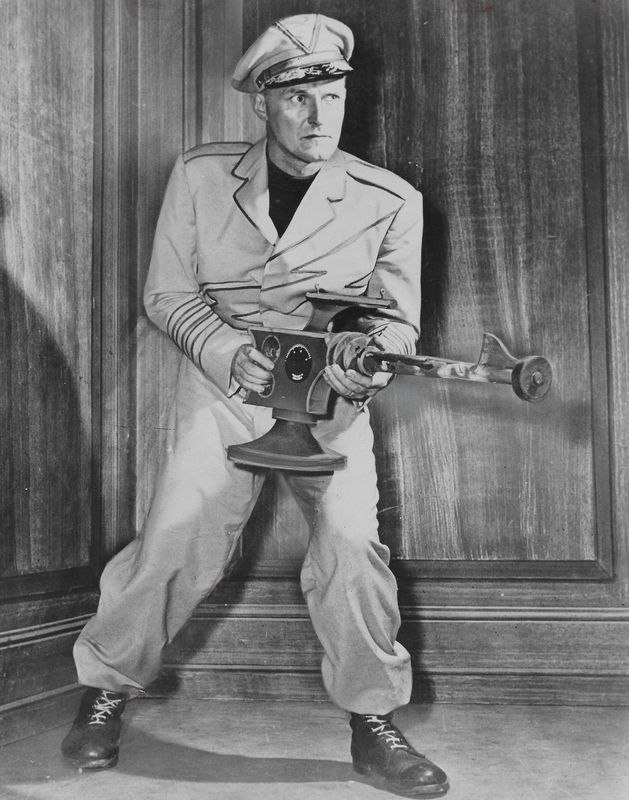
As the Green Hornet, he donned a mask to battle criminal masterminds. As Captain Video, he piloted a spaceship to vanquish intergalactic menaces.
In real life, Hodge won great fame but little fortune. Being a superhero wasn’t as lucrative then as it is now.
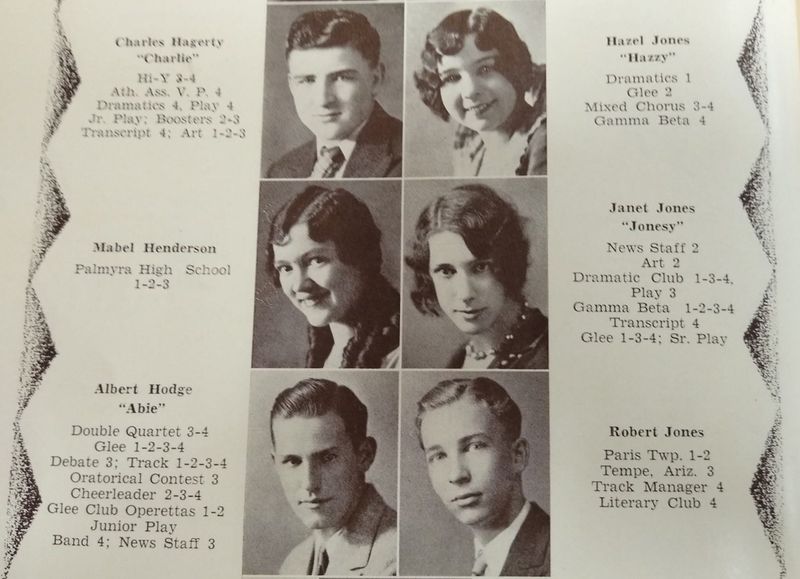
Albert Elmer Hodge Jr., the only son of Jessie and Albert Hodge Sr., was born April 18, 1912, in Ravenna and grew up on North Freedom Street. Neighborhood kids called him “Abie.”
His father owned Hodge Tailoring and Dry Cleaning, originally at 222 W. Main St. and later at 116 N. Chestnut St. The tailor used to regale his son with stories about how he had toured the United States and Europe in the 1890s as a trick rider in Buffalo Bill Cody’s Wild West troupe.
Abie grew into a tall, handsome, athletic teen. At Ravenna High School, he lettered in track as a high jumper. The boy acted in school plays, sang in glee club and led student assemblies as a cheerleader.
By the time he was a senior in 1930, Hodge knew he wanted to be an actor. He majored in drama and speech at Miami University, appearing in “Romeo and Juliet,” “The Taming of the Shrew” and other plays.
After graduating in 1934, he toured New England in a stock company. Sometimes the productions had eight roles but only four actors, so the troupe had to double up. Hodge learned to express emotions for a variety of characters through vocal inflections.
The 6-foot-2, brown-haired, blue-eyed, cleft-chinned actor was destined for bigger roles.
‘The Green Hornet’ arrives
Hodge worked briefly at the Muzak Corp. in Cleveland before moving to Detroit to join the writing staff at WXYZ, the radio station that produced “The Lone Ranger.” He earned $50 a week (about $1,200 today), writing copy, playing records and producing shows.
President George Trendle and writer Fran Striker, who had created the western featuring a masked hero, were developing a new character to battle gangsters in the modern world.
Newspaper publisher Britt Reid wore a mask to hide his identity while fighting crime with the aid of his faithful valet Kato and the sleek, superpowered Black Beauty automobile. The character was the great-nephew of John Reid, the secret identity of the Lone Ranger.
“It was originally called ‘The Hornet,’ and we discovered we could not copyright the name without an adjective in front of it,” Hodge recalled years later. “That was the reason we had to pick one. So it could have been ‘Blue,’ ‘Purple’ or anything. Of course, ‘The Pink Hornet’ wouldn’t fit very well. We suddenly decided upon the word ‘Green.’ ”
After a series of auditions, Hodge won the starring role, originating a character that would become internationally famous. Tokataro Hayashi, who owned a Japanese restaurant in Detroit, played Kato.
Hodge was scared to death before the show’s debut in January 1936, but he attacked the role with gusto, playing Reid as a foppish magnate who lowered his voice to a growl as the Green Hornet. This was three years before the debut of Batman in DC Comics.
Radio receivers picked up a buzzing sound. The theme song was “Flight of the Bumblebee.”
“The Green Hornet!” the narrator exclaimed. “He hunts the biggest of all game: Public enemies that even the G-Men cannot reach!”
The masked vigilante used a gas gun to immobilize criminals and then left them behind for police officers to arrest.
“They never let me kill anybody,” Hodge said.
‘A rip-snorting adventure’
The WXYZ program aired the 30-minute live show on a handful of Michigan stations. The Detroit Free Press praised it as “a rip-snorting adventure program.”
Hodge found that radio acting was different from theater acting. He had to make adjustments to “play a microphone.”
“That meant learning how to make an entrance so that it sounded as if you were coming from a distance, plus the right amount of voice to use when you raised or lowered it, depending upon where you were in relation to the microphone, plus maintaining a balance against someone else’s voice, which might be weaker or stronger than yours, and so on,” he explained.
The scripts were 28 pages. Sometimes when the show was running long, a producer would creep into the studio and remove two pages to save time. Hodge and the cast would have to make a seamless transition without the audience noticing.
Kids loved the program.
One day when Hodge was mowing his grass, a boy came up to him.
“Hey, Mister. Are you the Green Hornet?” he asked.
The actor confessed that he was.
“I’ll be right back,” the youngster said.
He returned with a group of pals who offered to finish mowing Hodge’s lawn in exchange for autographs.
A celebrity lived in their neighborhood!
Coast-to-coast fame
The Mutual Broadcasting System began airing the program nationally in 1938. Twice a week, the actors had to perform three live shows a night: one for the East Coast, one for the Midwest and one for the West Coast.
“I’m totally amazed at the number of people who listened,” Hodge noted.
In addition to his work on “The Green Hornet,” he also voiced characters on “The Lone Ranger” and “Challenge of the Yukon,” and directed episodes of the national programs. He even provided color commentary for University of Michigan football games.
Hodge supplied the masked hero’s voice in the 1940 Universal movie serial “The Green Hornet,” although Gordon Jones played the on-camera role.
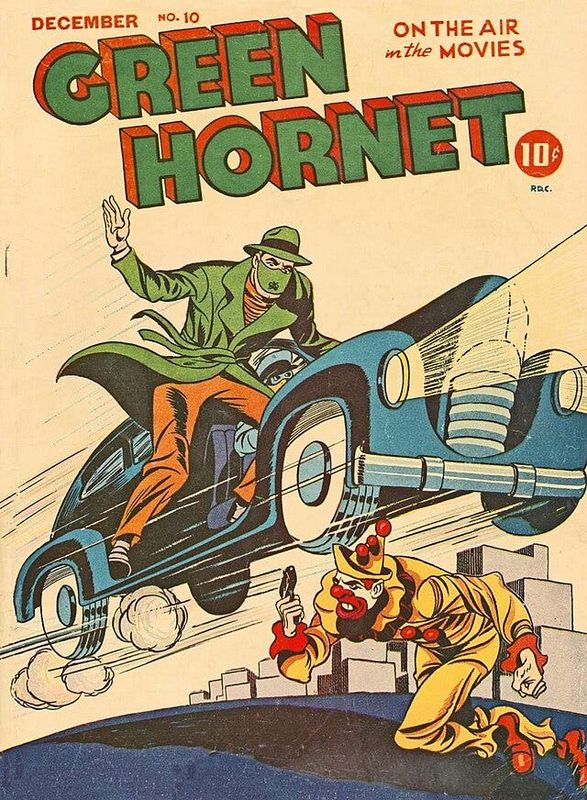
There would be Green Hornet comic books, Green Hornet trading cards, Green Hornet toys, Green Hornet lunchboxes, Green Hornet models, a Green Hornet television show and a Green Hornet movie, and it all began with Hodge’s portrayal.
The Ohioan starred on the radio series for seven years until joining the Navy in 1943 during World War II. After the service, he returned to Detroit in 1945 to reclaim his Green Hornet role but moved to New York six months later.
In the late 1940s, Hodge appeared on such national radio programs as “Gang Busters,” “Mr. District Attorney,” “Front Page Farrell” and “Mr. Keen.”
The actor’s popularity hit the stratosphere, though, when he switched to television.
“Captain Video” was about to blast off.
Hey, kids, don’t touch that dial! Tune in next week for Part II of the Al Hodge story.
Mark J. Price can be reached at mprice@thebeaconjournal.com
This article originally appeared on Akron Beacon Journal: Ravenna actor Al Hodge was Green Hornet on radio | Local history
Reporting by Mark J. Price, Akron Beacon Journal / Akron Beacon Journal
USA TODAY Network via Reuters Connect