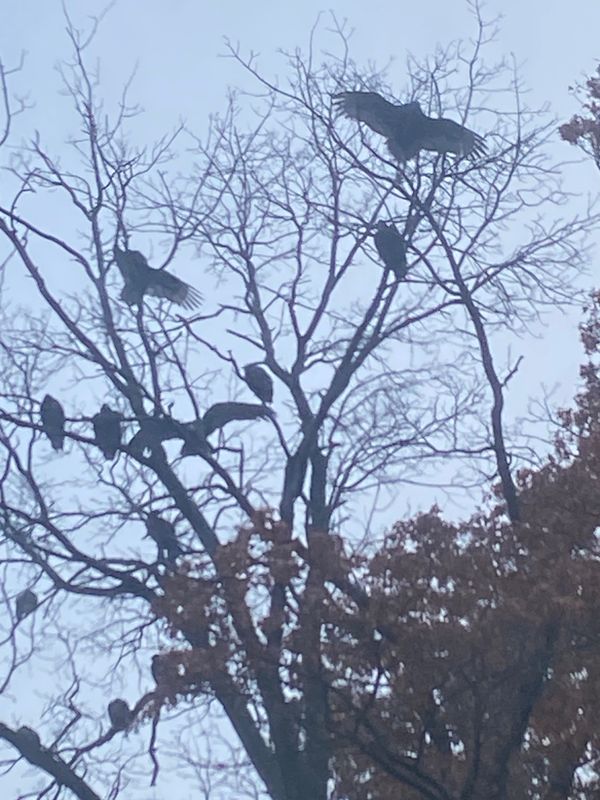
In our location here in the city with a pond on the property next to us, we constantly are in company with buzzards. Here we refer to them as buzzards, but turkey vultures are a common name.
Struggling to understand some wildlife species’ purpose, there is no reason to battle that question. Knowing that they leave daily to clean up the countryside should be enough.

Things were okay when they could be viewed from a distance. But, this past year, they have moved closer, spending early mornings and late afternoons in trees right along our east property line. So now their feathers are in flower beds.
Even worse, people report that they are on our rooftop. My response was that we are not dead yet. However, maybe the birds know something not yet revealed to me. They actually do not attack people nor animals.
Watching them from a distance in the morning, wings are outstretched. That pose is a way of warming their flight muscles. Solar radiation is enabled by their dark color, which absorbs heat readily. They also take this posture when drying feathers. They sunbathe and ultraviolet rays kill bacteria.
Turkey vultures cluster. They feed collectively. They even roost in communities. The term “kettles” is used to refer to avian species that wheel around and encircle together as they use thermal updrafts. Energy conservation and communication is going on as they glide together.
As for flight, there is efficiency as they glide on thermal air currents. Gliding or riding lower thermals gives them a vantage point. The “V” shape maintained during flight allows them to rock side to side.
In case readers are curious, this bird has no voice box, but it can hiss and grunt. The vulture has a keen sense of smell. It locates carrion easily by picking up on gases that escape early after death or as a carcass decays. As for beaks, they are made of keratin, the protein in fingernails.
The reddish head has folds around it to regulate heat. Just below each eye are tubercules, which dissipate heat. Nest builders they are not. What nesting they do is related to finding a hidden location in a thicket or steep slope, or perhaps a rock crevice. There is no use of nesting materials as we know it or see in smaller bird behavior.
Two creamy white eggs with brown blotches are laid. They are incubated for around 40 days. My curiosity does not drive me to hunt such a “nest.”
Though wing spans are nearly 6 feet wide, these guys weigh just under four pounds. Eventually, they will leave us and head off for warmer grounds. Seven perched in the front tree along Southern Avenue this morning.
Apparently, they know the snow will melt off.
Guess we will have them in our lives until the end — our end, since they can live for up to 16 years. Long live buzzards.
Mary Lee Minor is a member of the Earth, Wind and Flowers Garden Club, an accredited master gardener, a flower show judge for the Ohio Association of Garden Clubs and a former 6th-grade teacher.
This article originally appeared on Bucyrus Telegraph-Forum: Over the Garden Fence, reflections on vultures
Reporting by Mary Lee Minor / Bucyrus Telegraph-Forum
USA TODAY Network via Reuters Connect