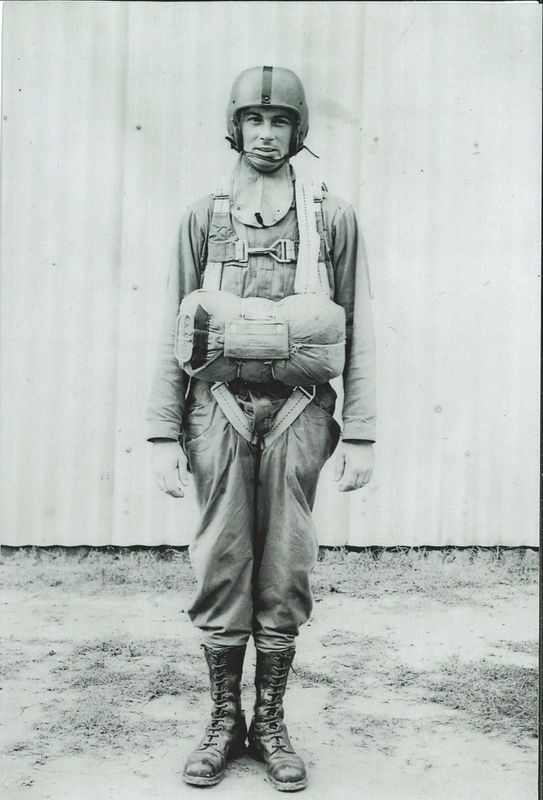
The postcard that Warren Decker sent home from Camp Wheeler, Georgia, on March 1, 1942, was written on a historic day as he began training to become a paratrooper. On that day, the U.S. Army had instituted a reorganization. One of the specific changes was separating its growing airborne units. No longer would they be the Provisional Parachute Command, but they were elevated and designated Airborne Command.

According to the book “Stand in the Door” by William Campbell Jr., the men in the camp were split up. Decker was assigned to the 2nd Battalion of the 503rd Parachute Infantry Regiment commanded by Maj. Edson Raff. They were then moved to Fort Benning, Georgia, for combat training, and then on March 29, Decker was moved to Fort Bragg, Georgia, with the rest of the 2nd Battalion.
The battalion was trained by Raff, a 1933 graduate of the West Point Military Academy. Raff was determined that Decker and the others would be the best trained and toughest there were. Day and night, they hiked the hills, woods and fields. Raff is quoted as saying: “They must be more than mere jumpers. They were ground fighters – troopers with parachutes, who must view the trip to battle as nothing more than a truck ride. They glorified not solely in jumping, but in being able to move fast and stealthily after hitting the ground.”
Raff worked them tirelessly, so much so that the 5-foot-5-inch major who was described as having “more temper than a wet hen,” was nicknamed “Little Caesar.” It’s said Raff secretly liked the nickname. Whatever the men thought of him at the time, they respected him; his training would be key to their surviving this war. On May 20, the War Department wired the commanding general of the 503rd and asked him to select his best battalion to be sent to the United Kingdom. Raff and the 2nd Battalion were chosen for the deployment.
On June 4, they arrived at the docks of New York Harbor and boarded the Queen Elizabeth. The men were assigned 20 to a room that, in peacetime, normally accommodated two passengers. The paratroopers were in hammocks stacked above each other. Some of the cords holding the hammocks broke after the first day, causing a domino effect as men fell onto each other.
The ship crossed the Atlantic without incident and on June 10 anchored near Glasgow. As they disembarked at the port, they were greeted by bagpipes and welcomed to the Isles. They then boarded a steamer and were transported on the Clyde River to Glasgow. Here, they were loaded into train cars for southern England. Arriving in Berkshire on June 11, they received a hearty welcome from the British. Decker and the rest of the 2nd Battalion were a welcome sight to the war-battered people, being the first unit of American Infantry to arrive in England.
They were transported to Chilton Foliat, where a camp had been established on the 2,300-acre grounds of the Chilton Lodge. The estate had been donated by Sir John and Lady Ward for use by the troops. Lady Ward was the daughter of an American ambassador who had married a British nobleman.
For the next 10 weeks, Raff put his troops through the most intensive training of their time in the service. That practice would pay off suddenly in an exhibition on Aug. 29, which could have ended in disaster.
Doug Stout is the local history coordinator for the Licking County Library. You may contact him at 740-349-5571 or dstout@lickingcountylibrary.org.
This article originally appeared on Newark Advocate: Newark’s Warren Decker among first US troops to reach England in WWII
Reporting by Doug Stout, Guest columnist / Newark Advocate
USA TODAY Network via Reuters Connect
By Doug Stout, Guest columnist | USA TODAY Network