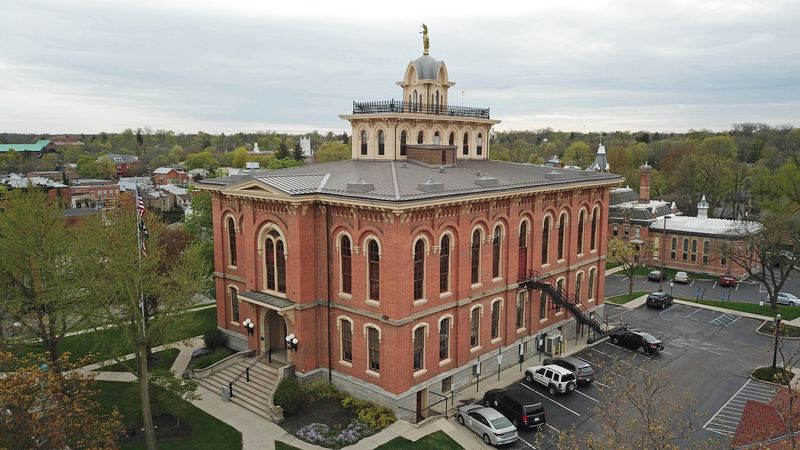
When Delaware County Commissioners renewed a 0.5-mill property-tax rollback this year for the fourth straight year, they boasted about reducing the tax burden on residents. But are the savings worth a cup of coffee?
“In these times of intense focus on property taxes, I am glad to support another significant rollback of the county’s property taxes to benefit property owners here,” Commissioner Jeff Benton said. “Thanks to our excellent stewardship of taxpayer funds, we are able to provide this much-needed property tax relief for the fourth year in a row.”

The latest savings are nearly $6.9 million for the upcoming tax year. For the owner of a $500,000 home, that amounts to $76.55 for the year. Broken down, that’s the equivalent to the cost of one 16-ounce Pumpkin Spice Latte at Starbucks every month (if it weren’t a seasonal offering).
The commissioners also have been providing a 1.0-mill rollback since 2007. While they have the authority to eliminate that rollback at any time, they have not. The additional 0.5-mill rollback has been renewed on a year-to-year basis.
So even though the newer rollbacks so far amount to over $25 million when spread across the residential tax base, the individual savings for a homeowner can appear inconsequential.
Few counties employ rollbacks
Commissioner Gary Merrell said he’s thankful he lives in a growing county “where taxpayers and elected officials are working together for the mutual benefit of all.” But is the rollback — permitted by Ohio law on the “inside” millage of up to 10 mills a county can impose without voter approval — really helping?
“It’s never a bad thing to give taxpayers some of their money back, even if it’s de minimis,” Union County Treasurer Andrew Smarra said.
Smarra acknowledged, however, that, “Its PR value is way more than its financial value.”
The original rollback that Delaware County Commissioners enacted in 2022 provided $4.8 million in tax relief. They then approved rollbacks of $6.5 million in 2023 and $6.7 million in 2024. The estimated value of the 2025 rollback will provide nearly $6.9 million in tax relief.
Delaware County’s strong tax base may allow for the return of tax money. Union County, also among Ohio’s fastest-growing counties, hasn’t done so. “With more agricultural and less commercial property,” Smarra said, “it hasn’t happened.”
Fairfield County hasn’t done a rollback in at least three decades, Auditor Carri Brown said: “That kind of relief is not as meaningful as when you’re looking at the larger bill.”
Delaware County has a more diverse property tax revenue stream and slightly higher sales tax than Fairfield County’s 6.75%, allowing for more cushion to give a rollback. Delaware’s sales tax is 7%.
Delaware County Auditor George Kaitsa, a former president of the Ohio Auditors Association, said that Erie, Geauga and Summit counties also have had rollbacks.
Summit County, which includes Akron, is asking voters to approve a charter amendment “placing an inflationary cap on what we can collect in the future,” said Brian Nelsen, chief of staff for County Executive Ilene Shapiro.
“Symbolically, it’s important,” Nelsen said of the actions of Summit and Delaware counties. “They have an elective ability to reduce taxes, and you don’t see school districts or municipalities doing it.”
Ohio’s constitution allows counties to levy up to 10 mills of inside millage without voter approval, so taking the rollback funds out of that “inside” millage is something commissioners control. That equates to 1% of property value to be levied in taxes without a vote from the public. One mill equals $1 of tax for every $1,000 of a property’s assessed value. It can vary among counties based on how counties use their statutory 10 mills. Inside millage funds operations such as sheriff’s departments, courts, administration and county employee salaries.
“It’s all part of the general fund budget,” Smarra said. “If you exceed your budget with significant non-taxable revenue, there’s absolutely nothing wrong with rebating that back to the taxpayers.”
Three years ago, Delaware County Treasurer Don Rankey proposed a $1,500 hardship bonus for county employees.
Rankey, whose term ended Aug. 31, said the one-time outlay would have come from some of the almost $20 million of investment income his office oversaw. The county commissioners rejected the idea.
Rankey said the rollbacks the commissioners approved have been too little.
In an email to The Dispatch, Rankey said county taxpayers have seen their property values rise 35% to 55%, resulting in an increase in property taxes and increasing the county’s tax revenue by almost $80 million.
“The commissioners could have reduced it by 1 mill — still a drop in the bucket,” Rankey said. “They didn’t even do that … because they are so greedy.”
Rankey has been a critic of county leadership in recent years over this issue and others. He is engaged in ongoing litigation with the commissioners over questions about his authority and powers as treasurer to purchase certain types of bonds.
This story has been updated to add context about an existing tax rollback that was enacted in 2007.
Delaware County and northern suburbs reporter Dean Narciso can be reached at dnarciso@dispatch.com.
This article originally appeared on The Columbus Dispatch: How Delaware County’s $6.9 million in property tax rollbacks can get you a Starbucks latte
Reporting by Dean Narciso, Columbus Dispatch / The Columbus Dispatch
USA TODAY Network via Reuters Connect