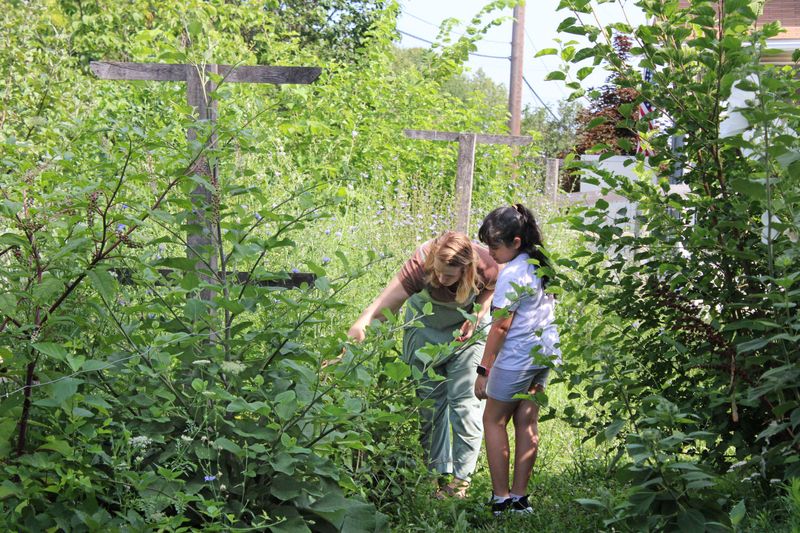
On the corner of Town Street and Martin Avenue sits a small U-pick garden. The tiny, but robust, garden has a little bit of everything.
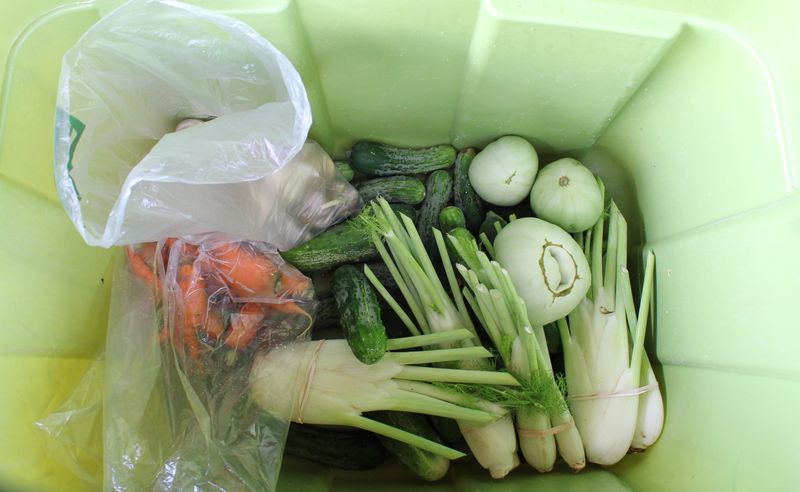
Tomatoes, cucumbers, zucchini, kale, collard greens, radishes and more fill the green space.

The garden exists for community members to pick their own food for free, at any time of the day, on any day of the year.
The free community garden is a part of Franklinton Farms, a nonprofit urban garden devoted to food access.
Each Sunday morning, Franklinton Farms hosts a guided U-pick, where members of the staff are there to instruct visitors through their produce gathering.
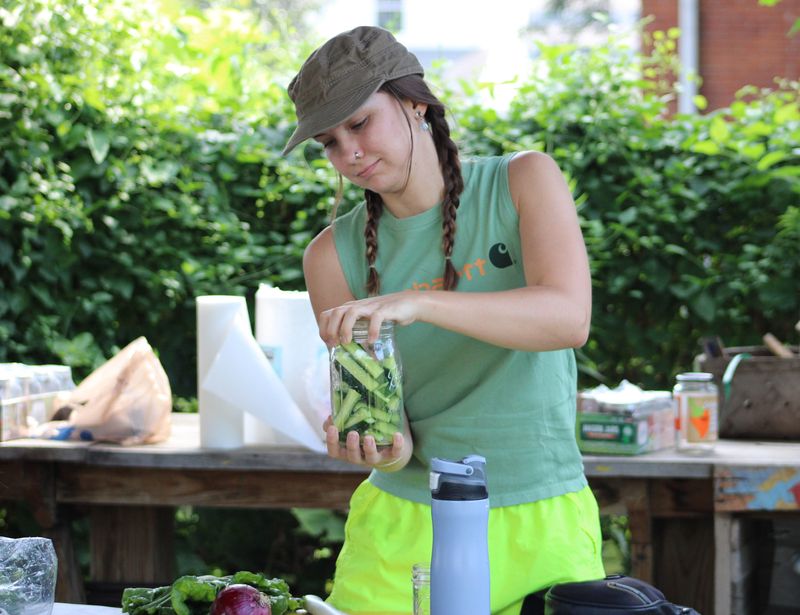
On July 12, both new and old visitors came to the garden to pick their produce. They smiled, chatted with each other and picked some vegetables. Later in the morning, the group moved to the Patrick Kaufman Memorial Learning Garden down the street to learn how to pickle their newly harvested vegetables as part of the Pickling Party that Franklinton Farms hosted that Sunday.
Growing food and community
Franklinton Farms is an urban garden aimed at nourishing the neighborhood with both food and community connection.
“Food is central to [the] community; everybody eats, everyone likes to gather around food. We provide the food and we provide a nice gathering space here in this U-pick garden,” Nick Stanich, executive director of Franklinton Farms, said.
The farm consists of an array of 11 gardens scattered between residential buildings and an urban landscape. At the U-pick garden, visitors can come and take what they need. The other plots are more specialized farms aimed at developing specific, larger amounts of produce. Franklinton Farms also hosts educational and community events in the learning garden, where the Pickling Party was held.
Franklinton Farms was founded in 2007 by a group of neighborhood residents working at the crossroads of environmental sustainability and social justice. The organization aims to contribute to the creation of an environment that respects, values and celebrates the land and the people within the community.
“Inner-city neighborhoods, especially here [in Franklinton], are subject to poor access to healthy food due to lack of access to grocery stores and poor transportation to those spaces,” Stanich said. “It made sense for us to grow food right in the heart of the city where people could get access to it easily.”
In Columbus, a large portion of Franklinton is considered a food desert, according to an interactive map released by the Institute for Local Self-Reliance in January. The map highlights United States’ neighborhoods lacking easy access to fresh food, specifically food areas in urban regions where at least 500 people, or 33% of the population, live more than 1 mile away from the nearest supermarket, supercenter or large grocery store.
Census Tract 51, which includes South Franklinton, has an average life expectancy of 60 years old, the lowest for the state and 18 years below the national average, as The Dispatch previously reported.
Right now, about half the food Franklinton Farms harvests goes back into the community at no cost. Plus, this estimated half does not include the produce taken by visitors free of charge from the U-pick garden. The U-pick pushes a lot of additional food back into the community too, Stanich said.
The past spring and summer, the farm has been donating about $1,000 to $1,5000 worth of produce each week.
Donations go to The All People’s Fresh Market, the Broad Street Food Pantry, Make-A-Day and Crossroads World Outreach Ministries. They sell food at the Worthington Farmers Market every weekend. What doesn’t sell gets donated, according to Stanich.
What do the gardens at Franklinton Farms look like?
To Stanich and other members of Franklinton Farms, the gardens exist as a third space – a place that people can interact and build community that is free of charge.
“It’s a type of third space that factors in food production; it factors in community engagement; it factors in environmentalism through native pollinator habitats and organic-style gardening,” Stanich said.
“You need a neighborhood that has these types of amenities so that we have more than just houses to live in, but we have a civic landscape to engage within.”
Franklinton Farms is highly productive. Some of its plots are market gardens, managed for more intensive food production that can be brought to the market.
One of the 11 gardens could have up to 40 beds, or sections of soil for planting, in it. Each bed might contain up to five different crops each year. At Franklinton Farms, they turn over beds constantly, Stanich said.
“We make a point to grow our food in as natural a way as possible.”
But because the farming team aims to yield high food outputs, this type of annual production doesn’t always allow mature plant colonies to exist in their active production spaces. To combat this, they incorporate permanent pollinator habitats around the perimeters of the gardens.
Most of the gardens have them, Stanich explained. They are good resources for bees, butterflies and birds.The high productivity of the farm gardens and the community resource that is the U-pick allow the urban farm to be a strong asset in community food production.
“This model, if more people want to do it, truly could feed a city’s produce needs,” Stanich said. “We exist just to show that it’s realistic. If you want to localize your food system or be more self-reliant in terms of food production, this is a way to do it.”
Cultivating the farm through volunteers and outreach
Franklinton Farms offers numerous opportunities for people to volunteer, including working in the U-pick and pollinator gardens. Volunteers can participate as individuals or as groups to help expand the capacity of the farm to nourish neighborhood well-being and connection.
“People can learn how to grow food alongside us, as part of their neighbors, as part of their neighborhood.” Stanich said.
Max Rojanasakdakul, a Franklinton Farms team member, explained that in his mind, people have become more disconnected from food. He sees involvement in Franklinton Farms as a way to connect to the process of getting produce into a market, or into a home-cooked meal.
“Food is a conversation between the land, the hands that plant the food and the hands that prepare them, as well as the mouths that consume them. I think, oftentimes, we think about food as sustenance, but we don’t think about all the work that goes into it,” Rojanasakdakul said.
For him, the nontraditional-style workplace – agricultural work in a city – is what makes Franklinton Farms so unique and so valuable.
Franklinton Farms provides, and will continued to provide, opportunities for volunteers and neighbors to come together around community.
Community work in action
Franklinton Farms’ mission of collective care is seen in everyday actions: people taking tomatoes from the U-pick garden, volunteers in the pollinator garden, a team member teaching a young event attendee how to identify a ripe blackberry. But, it is also seen in larger projects.
Last year, when transitioning out of a garden, a greenhouse needed to relocate to the U-pick garden a few hundred feet away. They didn’t want to disassemble it. So, they decided to pick it up and move it, similar to an Amish barn-raising venture, Stanich explained. They turned to the community for help.
Fifty-five volunteers showed up; they picked up the greenhouse together and walked it over to the location it sits now.
The saying of “many hands make light work” proved to be true in this endeavor. The group got the greenhouse relocated. In its new location, spinach has been grown, as well as scallions, cilantro and turnips; and it currently houses cucumbers and tomatoes.
It sits in the U-pick garden with produce free for everyone, anytime throughout the year.
Dispatch reporter Ella Diehl can be reached at ediehl@dispatch.com.
(This story was updated to add in the full name of the learning garden and organizations that receive donations from Franklinton Farms.)
This article originally appeared on The Columbus Dispatch: Franklinton Farms nourishes neighbors through food access
Reporting by Ella Diehl, Columbus Dispatch / The Columbus Dispatch
USA TODAY Network via Reuters Connect
By Ella Diehl, Columbus Dispatch | USA TODAY Network