This story has been updated with additional information.
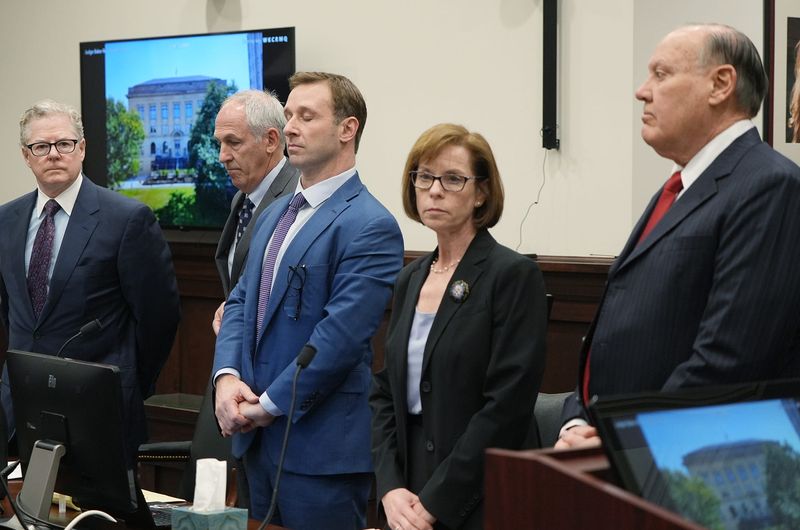
Jurors have been released from their service in the bribery trial of two former FirstEnergy executives, and prosecutors will seek to begin anew after the jury announced March 31 that it could not reach a verdict on any of the charges.

The jury deliberated for nine days, telling Judge Susan Baker Ross they had reached an impasse March 30 and receiving instructions to continue to try to reach a unanimous decision.
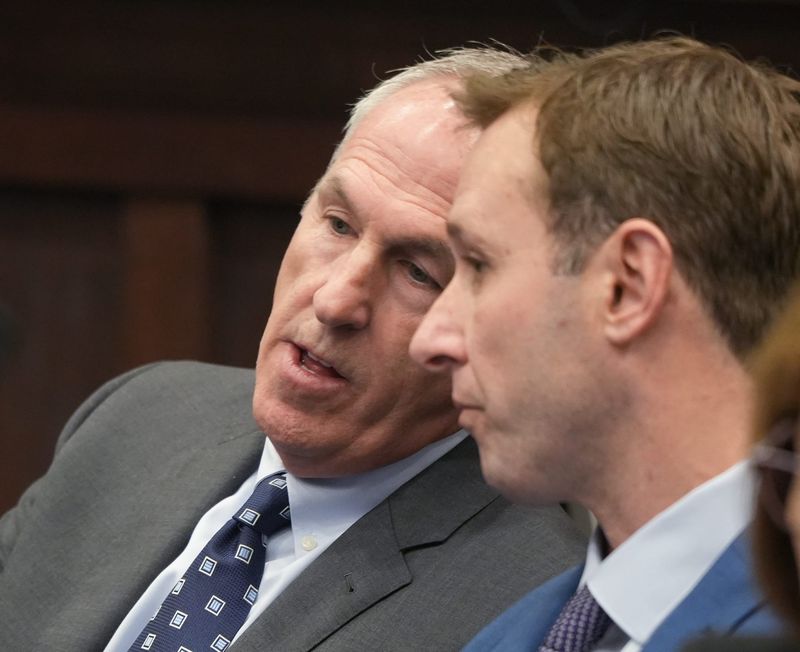
Defendants Charles “Chuck” Jones, former FirstEnergy CEO, and Michael Dowling, ex-FirstEnergy senior vice president of external affairs, are charged with bribing former Public Utilities Commission of Ohio Chair Sam Randazzo with a roughly $4.3 million payment before Randazzo entered the position.
Ohio Attorney General Matthew Meyer requested that Judge Susan Baker Ross declare a mistrial and set a status conference in 30 days.
Meyer said he and his team are grateful for the time and effort each juror put into the case, noting they took the matter seriously.
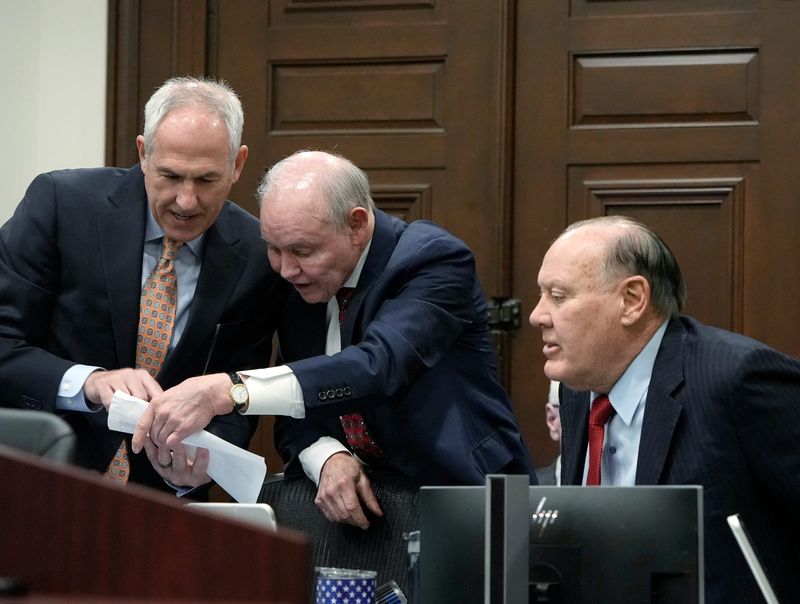
Carole Rendon, an attorney for Jones, and John McCaffrey, an attorney for Dowling, said they are awaiting a ruling from Baker Ross on acquittal of various charges and that they plan to file a new motion for acquittal.
“At this time, I will refrain from making any rulings on any pending motions, as well as the motion for a mistrial,” Baker Ross said in response.
In a written statement, McCaffrey thanked the jury for their “attention to the evidence and their service in the case.”
Prosecutors and defense attorneys together met with jurors March 31 after their dismissal.
Ohio Attorney General says defendants will be retried
“The state of Ohio can and will retry these defendants. Justice needs to be done,” Ohio Attorney General Dave Yost said in a recorded statement.
He also thanked jurors for devoting more than two months of their time to the trial.
Inside defendants’ trial for allegedly bribing top Ohio utility regulator
Meyer previously said that in exchange for the alleged bribe, Randazzo nixed a requirement that FirstEnergy file for a PUCO rate case in 2024, wrote part of House Bill 6 – which included a $1.3 billion bailout of two nuclear plants then owned by a FirstEnergy subsidiary – and lobbied the Ohio General Assembly for the passage of House Bill 6.
In the case, Dowling faced a maximum of 50 years in prison, and Jones faced up to 33 years in prison.
Defense attorneys contend the defendants made the payment to Randazzo to terminate an existing settlement agreement with a trade group called Industrial Energy Users of Ohio. But, they said, Randazzo stole the money.
The last of four witnesses who the defense called to testify, Kroll Managing Director Sherine Ebadi, testified March 11 that she concluded through a defense team-funded investigation that Randazzo stole the roughly $4.3 million from IEU-Ohio.
Defense attorneys also argued that Jones and Dowling did not want Randazzo as PUCO chair and instead wanted Columbus attorney Jason Rafeld in that position. The defense called Rafeld to the witness stand March 6.
Prosecutors said the defendants switched gears when they heard Randazzo was the “ascendant candidate” for the top PUCO spot and “scrambled” to pay him the alleged bribe.
Rachael Israel, an attorney for Jones, said March 9 that bribery charges as defined by Ohio law do not apply in the case because Randazzo was not a public servant or candidate for a public servant position at the time of the alleged criminal acts.
From Dec. 19, 2018, when Jones agreed to pay Randazzo the roughly $4.3 million, and Jan. 2, 2019, when FirstEnergy wired the money to Randazzo, the recipient was not a public servant or candidate for public office, Israel said. She pointed to a Cleveland.com news clip from early February 2019 that said Randazzo applied for the PUCO chair position “three weeks ago.”
Carole Rendon, an attorney for Jones, raised the point in her March 17 closing statements, stating, “… the only way that Chuck Jones could ever be convicted of bribing Sam Randazzo is if he was a candidate for that office on December 19 of 2018.”
Jurors appeared to take this point into serious consideration, writing the judge a question about when a payment needs to occur to coincide with the statute of bribery under state law.
Over about six weeks, attorneys have argued and questioned witnesses about multiple subjects pertaining to the case – Randazzo’s concealment of income, including from FirstEnergy and to what end he did it; what people who spent time around Randazzo knew about his relationship with FirstEnergy and the defendants; what people in and around FirstEnergy knew about the defendants’ relationship with Randazzo; the function of lobbying in Ohio and what disclosures are required to lobby in the state; the authority of PUCO chairs, commissioners and staff; and much more.
Randazzo, a previous defendant in the case, was not able to defend himself, as he died by suicide in 2024.
The highest-profile witness in the case, U.S. Sen. Jon Husted, testified virtually March 11. Husted, a Republican representing Ohio, previously served as lieutenant governor under Ohio Gov. Mike DeWine from early 2019 to early 2025 and said he knew the defendants from professional settings.
Husted testified that he didn’t remember what he discussed with Jones, Dowling and DeWine at a Dec. 18, 2018, dinner in Columbus. At the time, DeWine had been elected to lead the state’s executive branch, but he and then-lieutenant governor-elect Husted had not yet been sworn in. After the dinner, the defendants drove to the Columbus condo of Randazzo, their friend who worked as an energy lawyer.
Throughout the trial, the jury and witnesses have been required to abide by several admonitions. Among these, the jury was instructed not to view media about the case or perform research on related matters, while witnesses were required not to discuss several topics.
Witness admonitions included 14 listed topics, including Randazzo’s suicide; Jones and Dowling facing charges in federal court; FirstEnergy’s non-prosecution and deferred prosecution agreements; the arrest, trial and conviction of ex-Ohio House Speaker Larry Householder on federal charges for orchestrating a nearly $60 million illegal bribery scheme, largely bankrolled by FirstEnergy; and Householder’s related ongoing criminal case in state court.
What happens next?
With prosecutors immediately saying they will seek retrial, they await the procedural step of Baker Ross ruling on their motion for a mistrial. When a mistrial is declared in a criminal case because jurors were unable to reach a verdict, prosecutors also have the option of dismissing charges or offering a plea deal.
The defense, meanwhile, will continue to petition the judge to dismiss the case – just as it has done since the charges were announced.
Prosecutors often are willing to retry cases until they get a conviction. Michael Roper, for example, was tried four times in Summit County Common Pleas Court before being convicted in the April 2000 shooting death of a convenience store owner. He is serving a life sentence.
After a jury failed for a second time to convict Leon Newsome for starting a fire that killed two people in February 2024, prosecutors opted for a plea deal. Newsome pleaded guilty to reckless homicide in July 2024 and was sentenced to three years in prison. He had originally faced life without parole.
In the case of two brothers convicted in the assault death of 17-year-old Ethan Liming, prosecutors opted not to retry Deshawn Stafford for first-degree involuntary manslaughter, the most serious charge either brother faced and the one on which jurors deadlocked. Liming’s family was upset with this decision. The Stafford brothers received the maximum sentences for the assault charges for which they were convicted.
Beacon Journal enterprise reporter Stephanie Warsmith; Beacon Journal court reporter Bryce Buyakie; and Jessie Balmert, reporter for the USA TODAY Network Ohio Bureau, contributed to this report.
Patrick Williams covers growth and development for the Akron Beacon Journal. He can be reached by email at pwilliams@gannett.com or on X @pwilliamsOH. Sign up for the Beacon Journal’s business and consumer newsletter, “What’s The Deal?”
This article originally appeared on Akron Beacon Journal: FirstEnergy bribery trial ends in hung jury. State will seek retrial
Reporting by Patrick Williams, Akron Beacon Journal / Akron Beacon Journal
USA TODAY Network via Reuters Connect