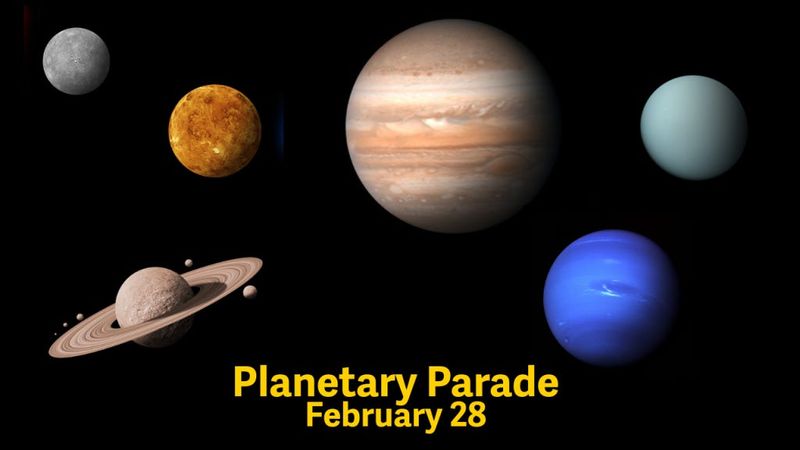
A year after a seven-planet parade graced the skies, the night sky on Feb. 28, 2026, will light up with stars and another planet parade.
This latest planet parade will feature six planets from our solar system. Here’s what you need to know and how you can watch it.

Which planets are part planet parade on Feb. 28? How to watch the alignment
According to Space.com, Mercury, Venus, Neptune, Saturn, Uranus and Jupiter will be visible shortly after sunset on Feb. 28.
However, you will need more than your naked eye to view all the planets. You will need an unobstructed view, clear skies and binoculars or a telescope to get a decent view of the planets.
Feb. 28 is generally when the spectacle will be most visible around the world, but the ideal viewing time might vary depending on your exact location.
When can you best see the planetary alignment?
The alignment will be most visible about a half hour after sunset, according to Space.com.
Because four of these planets are close to the sun, they will only be visible for a short time in the soft light of sunset. Venus and Mercury will be nearest to the horizon during sunset, followed by Saturn and Neptune. The last two planets, Uranus and Jupiter, will appear much higher in the sky.
Viewing these planets won’t be easy, so be sure to keep an eye on the weather, and prepare yourself for the best view with binoculars or a telescope.
What is a planetary alignment?
Planetary alignment occurs when several planets gather closely on one side of the sun simultaneously, according to Starwalk.
This is colloquially referred to as a “planetary parade” or a “parade of planets,” but these are not astronomy terms used to describe the event, according to NASA, which prefers the terms alignment or conjunction.
How does planetary alignment work?
All planets revolve around the sun along the same orbital plane, known as the ecliptic on Earth. As they travel along it, they eventually catch up with one another over time. When the planetary orbits meet, it looks as though they are aligned as they pass Earth, but the line will not be perfectly straight, according to Space.com.
With each planet moving at different speeds, the alignment will only last for a brief time, depending on each planet’s distance from the sun. This is also why planetary alignments do not always feature the same number of planets.
Ohio dark sky locations for astronomy, planet parade viewing
Of the 159 locations in the United States that are designated dark sky communities (those having little to no light pollution to interfere with astronomy), two are in Ohio:
Other dark sky destinations around Ohio, according to Ohio Magazine, include:
Wayne National Forest: Per the magazine, the isolated Lamping Homestead Recreation Area is arguably the darkest site in Ohio’s only national forest.
Burr Oak State Park: The nearest village is four miles away and has a population of less than 2,000, so it produces little light pollution.
Stonelick State Park: The night skies here are some of the darkest in Ohio, according to the magazine, and it’s a common destination for Cincinnati-area stargazers.
This article originally appeared on Akron Beacon Journal: 6 planet parade coming Feb. 28. What to know, best Ohio viewing spots
Reporting by Mariyam Muhammad, Akron Beacon Journal / Akron Beacon Journal
USA TODAY Network via Reuters Connect