While the original 13 colonies announced their independence on July 4 roughly 250 years ago, the fight for equality for many Americans was only just beginning.
In the first half of the 19th century, Rochester was undergoing a rapid change, spurred on by the advancement of the Erie Canal. A wide range of people were coming together to the Flour City and with them, a wide range of ideas and beliefs.

“You also had people from different economic strata coming together as well — farmers, New Englanders, businesspeople, craftsmen, tradesmen — all sort of being forced to live in community with one another,” said Christine Ridarsky, City of Rochester historian.
It was no surprise the confluence of factors, including a religious revival, created fertile grounds for the growing women’s suffrage movement.
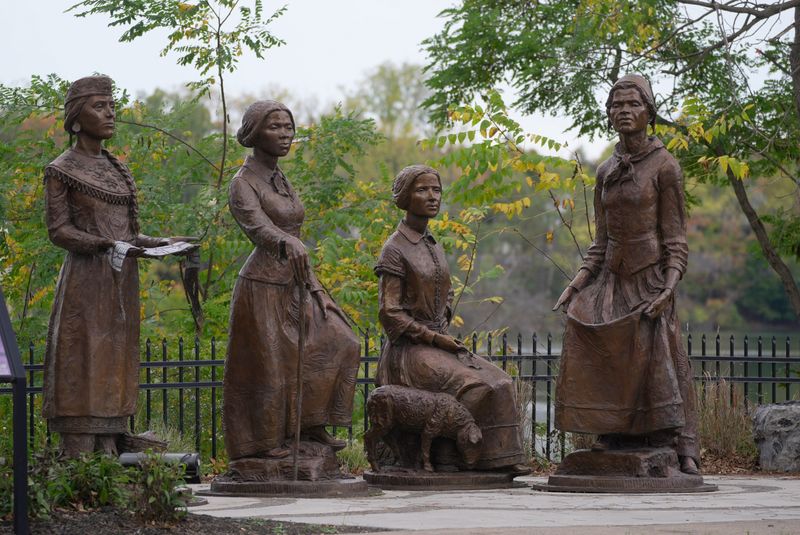
Upstate New York and the greater Rochester area were hotbeds for women’s suffrage for another reason, too. Many of the women most active in the movement had a Quaker background, with many of them moving to Rochester in the late 1830s and early 1840s, according to former city historian Blake McKelvey.
Susan B. Anthony and Amy Post both came from the Quaker tradition, Ridarsky said.
Those newly arrived Quakers found allies in supporters of the religious revival founded by Charles Grandison Finney, who promoted social reforms like abolitionism and equal education for women. The revival lasted several months in 1830 to 1831 in Rochester, which was also the site of the Fox Sisters’ Spiritualism movement.
“It was not entirely by accident that Rochester helped to cradle the woman’s rights movement, nor was it by chance that this city failed to give its small coterie of embattled suffragists any early victories. The circumstances in both cases were related to fundamental aspects of the community’s development,” wrote McKelvey in “Woman’s Rights in Rochester: A Century of Progress.”
The region would then see its profile raised when Seneca Falls hosted the first Women’s Rights Convention in 1848.
The inspiration came after Lucretia Mott and Elizabeth Cady Stanton were not seated as delegates at the World Anti-Slavery Conference in London in 1840.
Among the Rochesterians attending the conference were Mary H. Hallowell and Sarah Hallowell Willis; they would both serve as secretaries at the Women’s Rights Convention held a month later in Rochester. Stanton and Mott would also attend the Rochester convention. Rochester’s Abigail Bush served as president of that convention, the first woman to preside over a public meeting by men and women.
Post was a delegate at both conventions. And another notable Rochesterian at both conventions was abolitionist Frederick Douglass, who wrote about them in his anti-slavery newspaper, The North Star.
Despite Rochester being on the leading edge of the 19th century women’s suffrage movement, the sentiment didn’t extend to the rest of the county. Monroe County voted against the amendment to the state constitution to give New York women unfettered voting rights in 1917.
“It’s much like it is today. If you think of Rochester and [Monroe] County today, the politics of the county and the city are very different,” Ridarsky said. “That would have been the case at the time as well.”
As the nation marks its 250th anniversary, Rochester remains one of the places where Americans pushed the country to expand the meaning of democracy beyond the promises made in 1776.
U.S. democracy milestones
Western NY / Rochester milestones
— Steve Howe reports for the Democrat and Chronicle. An RIT graduate, he has covered myriad topics over the years, including public safety, local government, national politics and economic development in New York and Utah.
This article originally appeared on Rochester Democrat and Chronicle: Why Rochester was a center of the women’s rights movement | Exclusive
Reporting by Steve Howe, Rochester Democrat and Chronicle / Rochester Democrat and Chronicle
USA TODAY Network via Reuters Connect
By Steve Howe, Rochester Democrat and Chronicle | USA TODAY Network