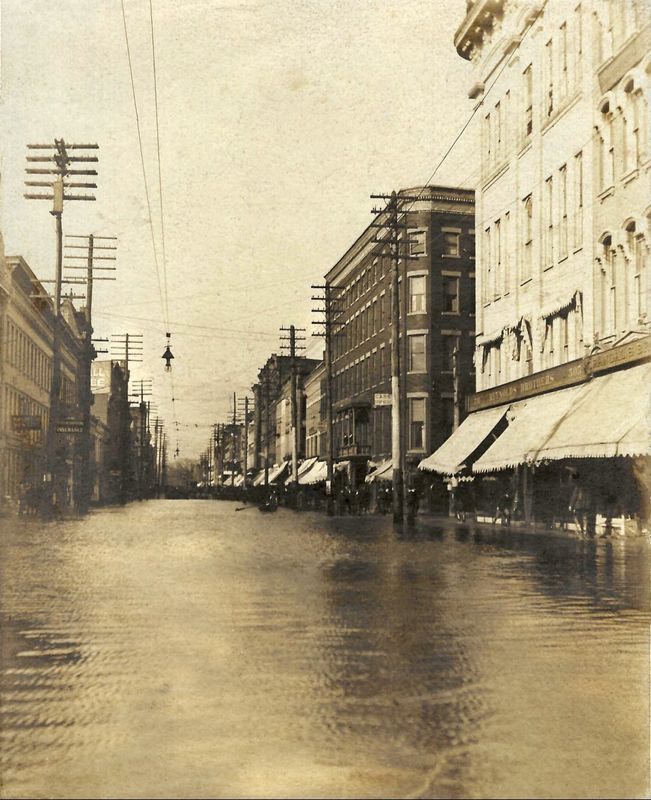
I have a new-to-me photograph of the Saturday, March 1, 1902, flood in downtown Elmira.
The Elmira Advertiser reported the rainfall on Friday, the day before, was 0.77 inches, at Gerrity’s drug store on Lake Street at 8 p.m.

It was not the day’s rainfall that caused the damage, but rather the melting of the snow in the hills. It had melted continuously for the past four days. Friday night’s temperature was 49 degrees. (Rainfall for the flood period was 1.53 inches; 0.77 on Friday, 0.24 on Saturday, and 0.52 on Sunday.)
The flooding began in the morning of Feb. 28, caused by ice jams and debris. The clogging and unclogging of Hoffman Creek at Second Street caused a sudden surge of water. Many cellars flooded. The first area affected was Hoffman and Gray Streets. The creek reached its brink at 11 a.m. when a large log filled the stone arch culvert at Water Street, and choked the flow. The creek quickly rose and exceeded its banks. Once it started, it was impossible to stop. The water in that neighborhood reached its highest level at 3 p.m. It dropped six inches by 4 and then rose six inches by 5.
The Chemung River broke the Southside levee at 8 p.m., at a low point between South Main Street and the Erie Railroad bridge. Water came over at 9 p.m., and a great torrent tore down Ferris Street and West Chemung Place. At Harmon Street, six crews from the Elmira Ice Company tried valiantly to hold the levee together, but it broke at 11 p.m.
The next morning, floodwater came over the north side of Madison Avenue at 4:45 a.m. The East Side’s Newtown Creek became a treacherous stream, overflowing and deluging the neighborhoods. The water churned early in the afternoon. Most residents believed there was no problem and so suffered great losses. By noon, many neighbors had evacuated.
At 2 p.m., water rushed into Brick Pond — the current tore through everything on Pratt and Sullivan Streets. On Linden Place, residents left their homes in boats. The Frog Hollow neighborhood was isolated from rescue. There had been a flood there earlier in December, and people were partly prepared.
In Elmira Heights, the Eclipse bicycle factory (on today’s Miracle Mile) closed at 2 p.m. so that workers could build a dike around the factory. However, by 5:30, water rushed into the cellar, damaging all the machinery.
In Horseheads, Newtown Creek flooded the eastern portion of town at 1 p.m. Big Flats and Painted Post reported to be “totally underwater.” Ithaca reported a “disastrous flood” with the lower part of the city under water. At 2 p.m. in Corning, the Chemung River rose six to eight inches per hour, and the dike finally broke at 3 a.m. Montour Falls reported the “worst flood ever.”
The next morning, Sunday, March 2, the local newspapers told the tales of the day before. “Everyone owning a camera had it out, and the picture harvest of the Flood of 1902 will be immense.”
Camera enthusiasts were out in large numbers. The Elmira Advertiser reported, “Whenever a friend met another friend plodding through the water up to his knees, the one with the camera would say, ‘Hold on a minute.’ The other looked up, and he would be told to go on, for the one with the camera had taken a good picture.” Spaulding Street was “a great canal.”
Damage to the Southside was immense, with the levees damaged or washed away. East of the Madison Avenue Bridge on the Southside, 75 feet of levee was gone where the water had rushed through. The low-lying tobacco lands in the Buttonwoods area (south-east of Brand Park) were underwater.
In the days following, Elmira cleaned up.
— Elmira city historian Diane Janowski writes a biweekly column.
This article originally appeared on Elmira Star-Gazette: This historic Elmira flood forced residents to flee homes in boats
Reporting by Diane Janowski, Special to the Star-Gazette / Elmira Star-Gazette
USA TODAY Network via Reuters Connect