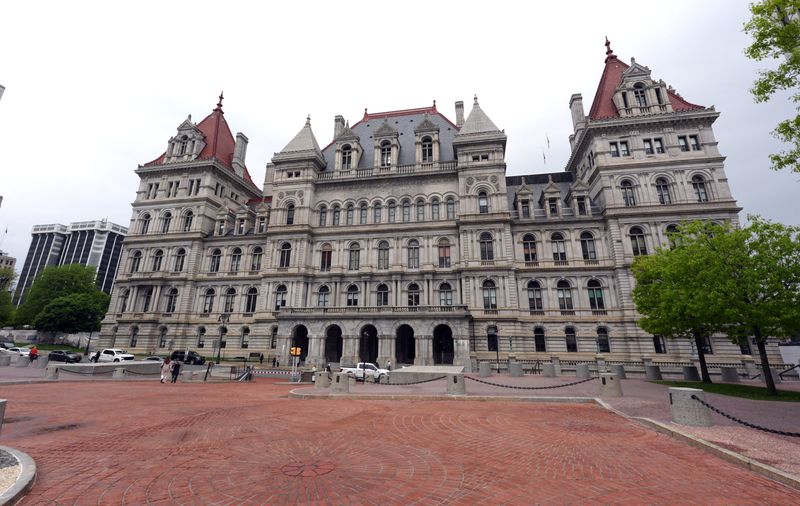
A Democrat-backed bill in New York that would roll back a landmark police transparency measure — the repeal of section 50-a of the state’s Civil Rights Law — is being considered by both the state Senate and Assembly.
Legislation introduced by Sen. Jessica Scarcella-Spanton, a Democrat who represents parts of Brooklyn and Staten Island, would seal unfounded, exonerated and pending claims made against law enforcement officers and require the claims to be redacted from their disciplinary records, making them exempt from Freedom of Information Law requests.

“Currently, the public has access to all disciplinary records of law enforcement officers — even if allegations were unfounded or exonerated,” Scarcella-Spanton said.
“While transparency is important, especially for oversight bodies, public access to these records can be extremely damaging to officers’ careers, reputations, and safety,” Scarcella-Spanton said. “Those officers cleared of wrongdoing should not face long-term consequences when they have been cleared of wrongdoing in their careers. This legislative fix addresses this issue, and also aims to assist with recruitment and retention of law enforcement officers.”
And while other upstate and Hudson Valley representatives have signed onto the bill as co-sponsors, a state government watchdog group is advocating against its passage.
Here’s what to know.
Why was New York’s 50a law repealed?
Following several civilian deaths at the hands of law enforcement officers in New York and across the country —spanning from Ortanzso Bovell’s fatal shooting in 2008 and Eric Garner’s chokehold death in 2014, both in New York City, as well as Daniel Prude’s restraint-related death in Rochester in 2020 — a social justice movement sparked the repeal of 50-a in 2020 to increase police transparency and accountability.
Previously, the measure blocked law enforcement from releasing most personnel records without a judicial order or the written consent of the officer. After its repeal, the release of disciplinary records after personal information like addresses and cell phone numbers have been redacted is allowed.
Many of these records in New York are currently only accessible through public-record requests and are often delayed or denied by police departments throughout the state, leading to legal fights, including lawsuits pursued by the USA TODAY Network.
Why certain Democratic lawmakers are backing the bill
Assemblymember Sam Berger, a Queens Democrat who sponsored the bill in the state Assembly, humanized the push to amend the police transparency measure.
“An allegation is not evidence, and a complaint is not guilt,” Berger said. “Yet in New York, police officers can have unfounded and disproven allegations publicly attached to their names forever. Behind every one of those complaints is a real person with a family, a reputation, and a life outside the uniform.”
Berger added that this type of permanent public access doesn’t apply to other professions.
“Police officers deserve the same basic due process protections afforded to other professionals,” Berger continued. “This bill preserves public interest and transparency for substantiated misconduct, even unsubstantiated misconduct, while ensuring that false accusations do not become a lifelong punishment.”
Watchdog group says bill would have negative impact on New Yorkers
However, state government watchdog group Reinvent Albany is opposing the legislation, asserting it “ignores the reality of investigations into public officials” and “creates a special exemption for a specific class of public employee.”
They say while the main argument for the bill is to ease the burden of shame on public employees from past investigations if they’ve been found not guilty, it would also decrease transparency as the public and media would no longer have access to these sets of claims.
“The worldview reflected in this bill is one where officers must be constantly on guard from false accusations, but the reality is that police rarely, if ever, face serious repercussions for actual violations,” their statement continued.
The organization also added that other public servants aren’t included in this legislation, only police officers, and that the number of police killings of civilians has increased since the 2020 nationwide Black Lives Matter protests.
“That’s why it remains important for even “unfounded” claims against officers to remain public,” Reinvent Albany said. “They establish patterns of conduct and give New Yorkers one more way to protect themselves from abuses of power.”
Emily Barnes covers state government for the USA TODAY Network-New York with a focus on how policy and laws impact New Yorkers’ taxes, communities and jobs. Follow her on Instagram or X @byemilybarnes. Get in touch at ebarnes@usatodayco.com.
This article originally appeared on Rockland/Westchester Journal News: Push to roll back NY police transparency measure surfaces in Albany
Reporting by Emily Barnes, New York State Team / Rockland/Westchester Journal News
USA TODAY Network via Reuters Connect