Could clean air be another reason to love the Mohawk Valley?
After all, 46% of American children live in counties that received an F on at least one of three measures of air pollution included in a recently released American Lung Association report, the 27th annual State of the Air. And 10% of kids live in counties that received a failing grade for all three measures.

“Clean air is essential to the health and wellbeing of families across New York. Children deserve to breathe air that won’t make them sick,” said Michael Seilback, assistant vice president of nationwide advocacy and state public policy for the American Lung Association.
“Unfortunately, too many people in the Albany-Schenectady, NY metro area are living with unhealthy levels of particle pollution. This air pollution is causing kids to have asthma attacks, contributing to chronic health conditions, and making people who work outdoors sick.”
How is the local air quality?
Oneida, Herkimer, Otsego and Madison counties didn’t receive any failing grades — because they are not included in the report. But what information does exist suggests that none of these counties would fail on any of the clean air measures in the report
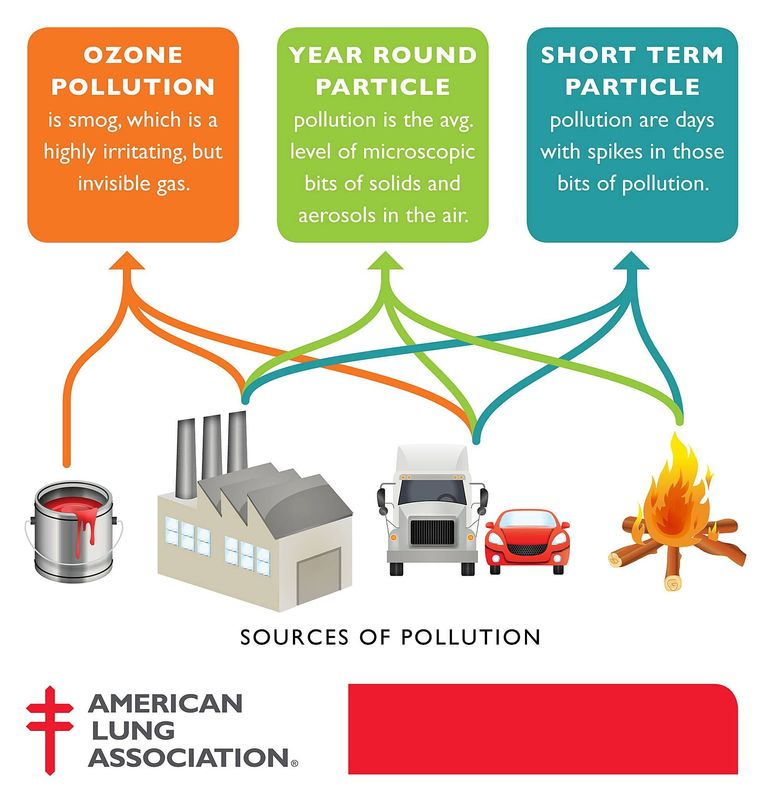
The report included data on ground-level ozone, otherwise known as smog; and both year-round and short-term particle pollution, or soot, for the years 2022, 2023 and 2024. This year’s report focused on children because they are more susceptible to the effects of air pollution than adults.
That’s because their lungs are still developing, they breathe in more air compared to their body size and they are frequently exposed to outdoor air, according to the lung association. So if they live in an area with air pollution, their lung development could be affected and they are more at risk of lung disease over the course of their lives, according to the report.
But only 25 of the state’s 62 counties are included in the report and they weren’t all graded on all three measures. That’s because many counties don’t have an air monitoring station so there was no data for them.
And some counties, like Oneida, have a monitor, but not the right kind measuring the right data for inclusion in the report.
So just how clean is, or isn’t, the air in these counties? That’s hard to say with certainty.
Air monitoring in New York
The New York State Department of Environmental Conservation has a network of more than 50 air quality monitors across the state, including East Syracuse, Fulton, above Watertown in Jefferson County and Piseco Lake in Hamilton County. The locations are chosen, using very specific criteria, based on where they can do the most good, according to DEC information.
Different monitors measure different things. The monitor in Utica continuously monitors levels of fine particulate matter in the air, that is, particles of 2.5 microns or less, which means particles that can be inhaled. It does not measure ozone.
The fact that many New York counties don’t have air monitoring stations isn’t necessarily a cause for worry.
“Most counties that are excluded do have an expectation — because of low populations, low industrial and vehicular emissions, low expectation of significant upwind sources of emissions and sometimes based on past history of clean results — that their air quality doesn’t need to be regularly monitored,” said Kevin Stewart, director of environmental health for the American Lung Association. “Setting up these stations does cost money in equipment and expertise so not every location will be assigned one.”
But if there’s evidence of routine air pollution episodes locally, then the county should probably have a monitor, he added.
And a few percent of the counties across the country without monitors have been shown by satellite data to have visible fine particle air pollution at high enough levels to be problematic, Stewart said.
About air pollution
Ozone forms when gases emitted by tailpipes, smokestacks and factories react with sunlight. Levels are usually at their highest on very hot, sunny days.
Particulate matter is a mix of tiny bits of solids and liquids that get into the air from power plants, diesel- and gas-powered vehicles and equipment, factories, fireplaces and wood-burning stoves. Factories may emit particles or release gases that turn into particulate matter in the atmosphere.
Particulate matter is labeled coarse, fine or ultrafine, but the report looks at data on fine particulate matter (which also includes ultrafine particulate matter). Canadian wildfires were a major source of particulate matter in New York during the years included in the report.
The health risks of these kinds of air pollution include heart attacks, strokes, asthma attacks, preterm births, impaired cognitive function later in life and premature death. Particle pollution can also cause lung cancer.
Local data
Data from the air quality monitor in Utica shows that the area meets National Ambient Air Quality Standards for fine particulate matter, according to DEC.
And the lung association report includes historic data for the Utica-Rome metropolitan area showing that it met the National Ambient Air Quality Standard for the annual weighted average number of high ozone days from 2008-to-2010 data through 2017-to-2019 data, the last data included for Utica-Rome.
But from 1996-1998 through 2007-to-2009, the area exceeded the standard except in 2004-to-2006.
Oneida County currently meets all the national standards, according to DEC.
And a DEC report from 2025 shows that all counties in the state met fine particulate matter standards between 2018 and 2023.
But on certain days, mostly when the weather is sunny and hot, both ozone and particulate matter levels can rise above safe levels. In these cases, the state issues health advisories, color coded based on the severity of the risk.
Pollution over time
Overall air pollution across New York has improved in this century. Between 2000 and 2023, particulate matter levels have fallen 90% statewide, sulfur dioxide levels 98%, nitrogen oxides 84%, volatile organic compounds 71% and carbon monoxide 59%, according to the DEC.
“New York is a proven leader in protecting and improving air quality with some of the strongest regulations in the nation helping protect the health and well-being of our communities,” reads a statement from the DEC. “DEC’s experts worked closely with permitted facilities and vehicle manufacturers, among many other partners, to achieve these air pollution reductions.”
Grades around the state
But the lung association report does show that some areas of New York still have problems with air pollution at least some of the time.
High daily ozone levels are a bigger problem downstate with nine downstate counties receiving grades of D or F for the number of high ozone days in those counties (out of the 23 counties graded for ozone). But Chautauqua County in western New York also received a D.
Hamilton and Tompkins counties, on the other hand, both received A’s. And Onondaga and Oswego counties, the two closest to Oneida County, both earned B’s.
The Ithaca-Cortland metropolitan area was among 35 nationally (out of 226) that did not have any high ozone days.
Onondaga County did not fare so well for short-term particle pollution, scoring a D with one day between 2022 and 2024 getting a purple health warning (the second highest level), three days getting a red warning (the third highest level) and one day getting an orange warning (the fourth and lowest level).
Only 14 counties were graded for this measure and there was no clear geographic pattern to good or bad grades. Only Steuben County scored an F (with one purple day, four red days and two orange days). But Albany, Monroe, Queens and Bronx counties also scored D’s.
The Syracuse-Auburn metropolitan area was ranked as the 76th worst in the nation (out of 224 metro areas), Elmira-Corning the 53rd worst, Albany-Schenectady the 69th worst and Rochester-Batavia-Seneca Falls the 89th worst for short-term particle pollution.
For year-round particle pollution, the report simply scored counties as passing or failing. All 14 of the included counties in New York passed.
The New York City metropolitan area, including counties in New Jersey, Connecticut and Pennsylvania, was ranked the 12th worst in the nation for short-term ozone levels, the 69th worst for short-term particle pollution and the 78th worst for annual particle pollution (out of 211).
This article originally appeared on Observer-Dispatch: How clean is the air in the Mohawk Valley? It’s hard to say
Reporting by Amy Neff Roth, Utica Observer Dispatch / Observer-Dispatch
USA TODAY Network via Reuters Connect