While some residents are pushing back against the use of surveillance technology in the city, the Binghamton Police Department is looking forward to the continued use of state-of-the-art law enforcement technology funded by the state.
On Aug. 10, members of the Binghamton Police Department, City of Binghamton Mayor Jared Kraham and representatives with the New York State Division of Criminal Justice Services came together to demonstrate and display some of the technology being utilized by the department, including license plate readers, electronic bikes, pole cameras, drones, a 3D crime scene laser scanner and a mobile command vehicle.

The presentation of this technology comes just over a month after New York Gov. Kathy Hochul announced $100 million in state funding through the Law Enforcement Technology and Equipment Grant Program. Of that available funding, $75 million will go toward the improvement and modernization of police equipment, and the other $25 million will be used to fund a new statewide records management system, replacing a “decades-old platform” to improve the way in which agencies share information, according to Hochul’s announcement.
This newly available funding is building upon a previous grant through the same program which awarded $127 million to 378 law enforcement agencies statewide in 2024 for law enforcement technology. The Binghamton Police Department received $468,668 through that program and used it for technology that has now become a part of its daily operation. The deadline for the newest round of funding is Sept. 2.
This bid for more LETCH funding, however, comes amid a strong push by some Binghamton residents to end the city’s contract with Flock Safety, a company contracted by the city for the ALPRs. With the Flock Safety contract set to expire on Sept. 8, local organizers and residents are asking city council to ensure the agreements with Flock Safety and other ALPR vendors, like Motorola Solutions, are discontinued.
Technology currently used in Binghamton
Through state funding and an additional $66,000 from the Office of the District Attorney’s Traffic Diversion Program for the installation of cameras in 2024, LPRs and pole cameras have become an integral part of police investigations in Binghamton.
Joseph Popcun, executive deputy commissioner of the state Division of Criminal Justice Services, said the technology used in Binghamton and in other municipalities creates an “entire ecosystem of data” that is used to “not only solve crimes but prevent crimes in the first place.”
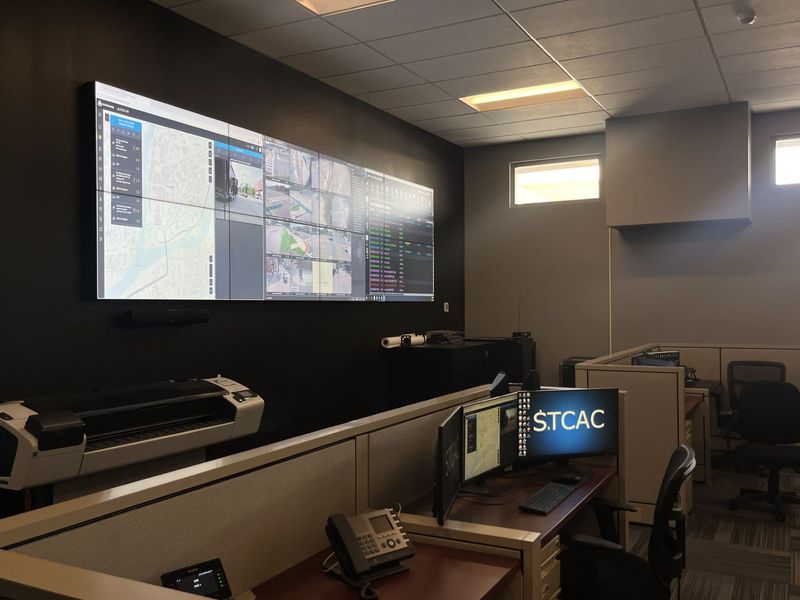
Popcun said that in the past five years, he believes this level of technology paired with a crime analysis center, like the Southern Tier Crime Analysis Center in Binghamton, has been the “key to reducing crime across the board.”
“The more tools and technology we can give to the officers, the better job they can do, and it also focuses their efforts on building community relationships,” he said.
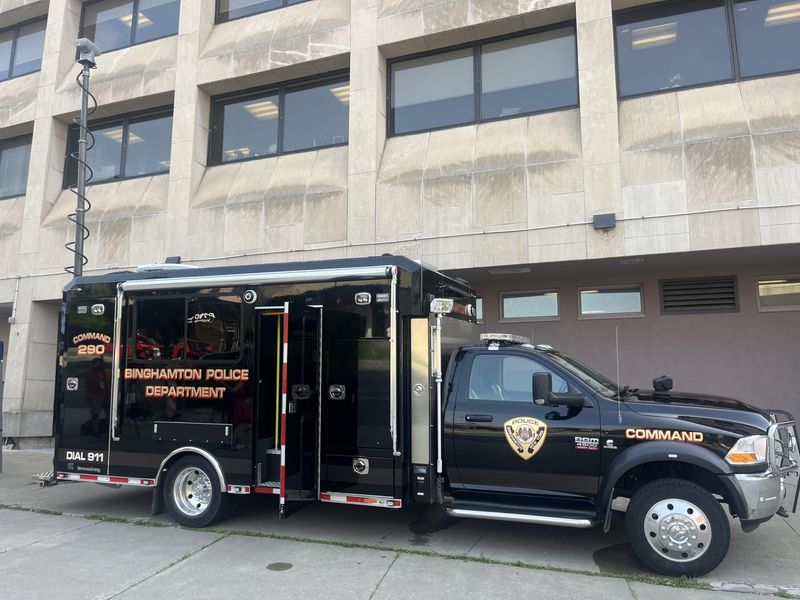
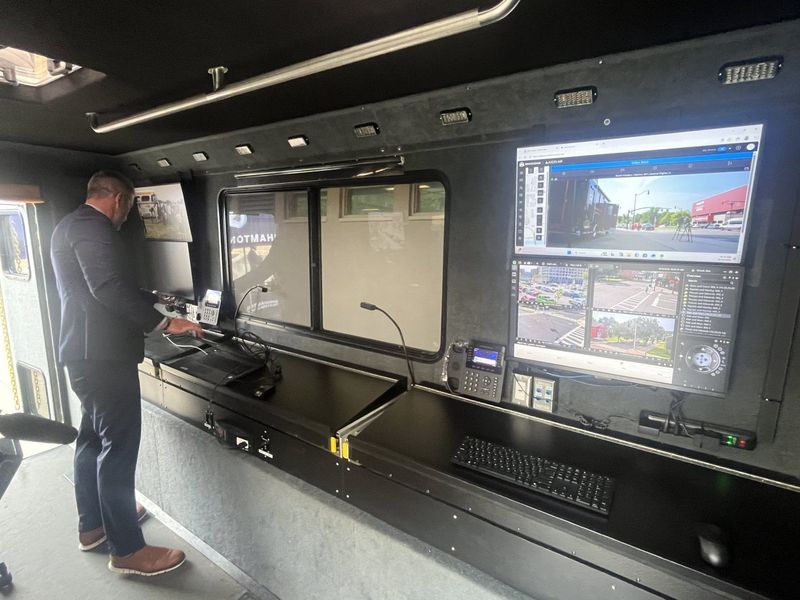
One of the newer pieces of technology, the Binghamton Police Department’s mobile command vehicle, is instantly noticeable with a tall pole camera affixed to the rear. Inside, there’s room for several workstations and monitors that show real-time surveillance footage from outside the vehicle or from anywhere in which there is a pole camera in the city.
The department’s drones, which can fly up to 400 feet, are helpful in solving missing persons cases or in the search for missing pets, Popcun said. While the drone flies in the air, the operator is able to watch a live feed captured by its camera.
Binghamton Police Chief John Ryan said the department’s 3D scanner is especially helpful when processing a crime scene. It is able to scan the location of a crime, inside a building or outside, and create a 3D representation of the area in its entirety, which can later be used in the prosecution of a case. The scanner, he said, was used at the crime scene of a fatal shooting on Aug. 8 on Binghamton’s North Side.
Kraham said he believes this investment in police technology has led to current “historic lows” in Binghamton.
“These are expenditures that would be very difficult for the City of Binghamton with limited budgets, so when the state can support that with law enforcement grants, it helps expand our capabilities,” Kraham said. “Right here at Binghamton City Hall in this crime analysis center, we have the tools and technology that not that many years ago would only exist in major metropolitan police agencies. We’re very, very grateful.”
‘Now is not the time to pull back’
On Aug. 6, the Binghamton City Council unanimously passed a resolution urging Kraham to terminate the city’s contract with Flock Safety. In the resolution, the council also asked that Kraham refrain from entering into any other new or similar surveillance contracts until “comprehensive local policies governing privacy, data retention, auditing, transparency and public oversight have been adopted.”
In response to this recent push from council members and residents, Kraham said he hears from many residents that support providing more resources to the police department and “want to feel safer in their community,” something he said technology is a “critical part of.”
He said he understands the severity of concerns regarding privacy and constitutional protections, but the use of LPRs in Binghamton meets “the gold standard for data retention.”
Ryan said he is also “sensitive” to the concerns of residents, but the department’s “specific and strict policy,” along with regular audits of the program that stores LPR data, are measures put in place to safeguard privacy. Personnel who wish to access the data have to show “reason and justification” pursuant to an investigation or a “legitimate criminal justice purpose” to gain access, he said.
“Where and how it’s shared and with who and under what circumstances — it’s all dictated strictly by policy and there’s supervisor controls in place,” Ryan said.
When asked how many LPRs are currently being used within the Binghamton city limits, Kraham said he didn’t “want to get into specifics.” As for the future of police technology, Kraham said now is “not the time to pull back.”
“We’re not going to cancel the contract — we’re going to continue to have LPRs in the City of Binghamton,” he said.
This article originally appeared on Binghamton Press & Sun-Bulletin: Binghamton police showcase high-tech tools like drones, license plate readers
Reporting by Jillian McCarthy, Binghamton Press & Sun Bulletin / Binghamton Press & Sun-Bulletin
USA TODAY Network via Reuters Connect
By Jillian McCarthy, Binghamton Press & Sun Bulletin | USA TODAY Network