WASHINGTON, D.C. — The butter kept Mary Savig up at night.
Of the nearly 250 objects she curated to appear in the Smithsonian American Art Museum’s exhibition on state fairs — some a century old and fragile to the touch, others irreplaceable family heirlooms and a few marquee pieces of state history — the butter, in particular, made her anxious.

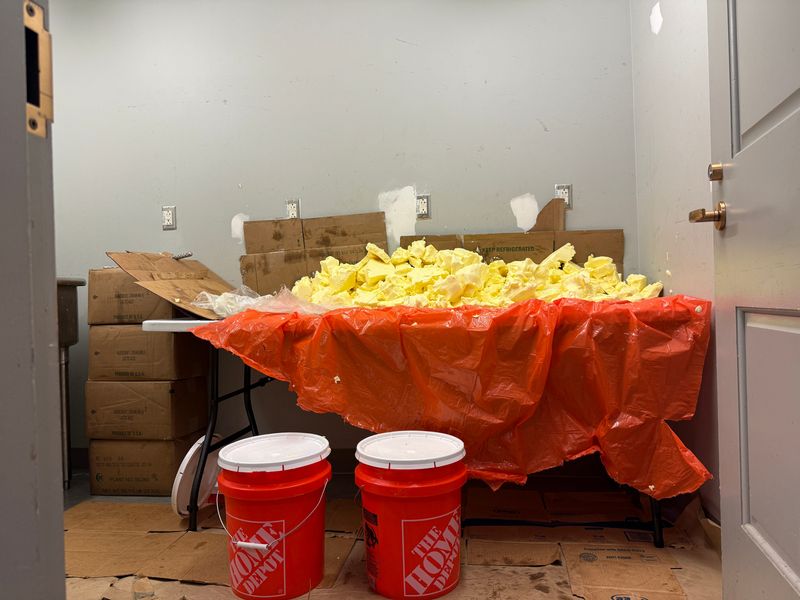
All 800 pounds of it.
After five years of researching fairs from South Carolina to Alaska, from California to the Navajo Nation, from Iowa to Minnesota to Texas — the Holy Trinity of American fairs — Savig and her team knew one of the exhibition’s centerpieces had to be a nod to the Midwestern tradition of butter sculpting.
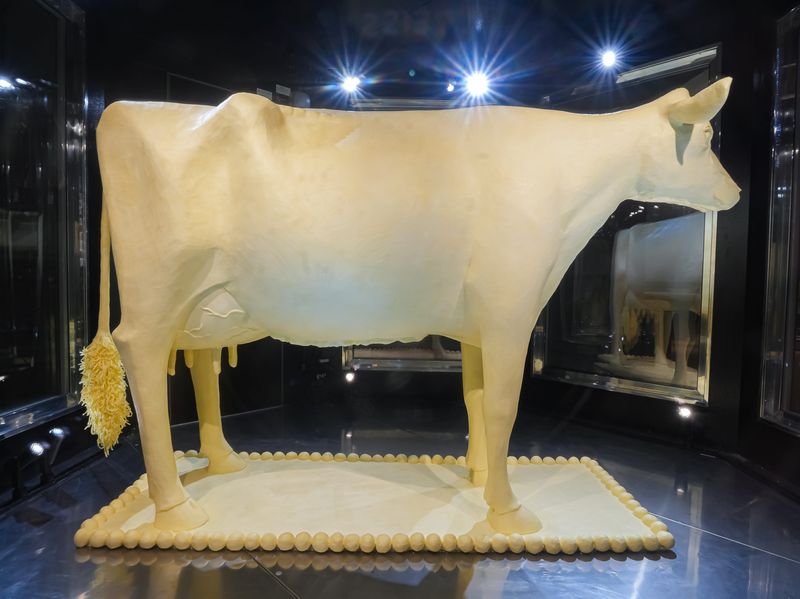
And, after some debate, they commissioned an enduring and iconic fair symbol: A Butter Cow.
So, for much of the past year they’d been wrestling devilish details into submission: They’d queried gobs of HVAC companies to find the one, an outfit from Maryland, jazzed to custom-make a 360-degree refrigerated display case.
They’d found the only possible power source in their 1859 building with enough electrical juice to charge the chiller. Fortunately, the plug was located in the Octagon Room, the gallery situated at the top of the Grand Staircase, which felt right, Savig says, like placing their dairy masterpiece as the show’s capstone jewel.
They’d even developed the lighting scheme to bounce off the refrigerator’s onyx interior and bend around the sculpture’s contours, a chiaroscuro of the artists’ sharp angles and smooth lines.
And that’s to say nothing of sourcing the butter itself. About a half ton of it. Which they purchased from a Minnesota woman who copped to having a special butter sculpture of her own preserved in the back of a freezer.
The admission felt like a back pat from the cosmos, Savig says, a conspiring toward success despite the insanity of constructing a butter sculpture in a swampy D.C. summer — then keeping it temperate and protected enough to last for the exhibit’s yearlong run.
“The one thing we could not control was the butter delivery,” Savig says.
Here’s the problem: The Renwick Gallery is across the street from the White House — less than a city block from the West Wing and the Oval Office and the who’s who of American Power. So if there’s a special guest or a big event or an important meeting, Secret Service reroutes all deliveries.
A security issue, they say. And “extreme fear of melting” isn’t on the list of requests that will change their minds.
So, yeah, Savig, the Renwick’s curator-in-charge, was losing sleep while tracking her packages halfway across the country. You can’t have a butter cow without the butter, and losing the sculpture would rip the heart from her show — plaque-filled arteries and all.
Providentially, her worry was wasted: Not only was President Donald Trump’s social calendar conveniently quiet during the delivery window, but the butter came basically ice-block frozen.
“It actually needed to thaw out for a few days,” Savig says, letting a few breathy giggles escape, the sort of nonverbal c’est la vie disbelief reserved for when the exact opposite of your fear turns out to be true.
Where others may see a sweaty, deep-fried sideshow, Savig, a native Minnesotan, has always viewed the fairgrounds as a place similar to America itself: Complex, yet malleable; trendsetting, yet craze-obsessed; propelled by a collective spirit, yet defined by individual narratives.
Untamable, really, she says. A place that holds the past, present and future somehow in both fealty and tension.
“I think state fairs and fairgrounds resist easy descriptions, and so does this idea of what ‘American’ is right now. It really resists assumptions,” she says.
“There is no one way of saying, ‘Who’s American?’ or ‘Who goes to state fairs?’”
The fair is a box of assorted chocolates made human, a sampling of all types. And, to Savig, the arts and crafts displays are especially emblematic of the depth and diversity and complexity of makers across the country.
“The works on view at fairs are so personal. They’re the personal stories of these artists that come from all walks of life,” Savig says. “They do exactly what we want from art: They tell a story about how something’s made and something about the maker and their place in the world at a particular time.”
“State fairs have this tremendous history of virtuosity and creativity that has not yet been told in a museum setting.”
That lack of institutional curation is because works shown at state fairs — think intricate weavings and hand-stitched clothing and artisanal jewelry and seamless woodworking and canned jars of fruit placed with mesmerizing Kusama-like symmetry — have long been maligned by Tastemakers as somehow lesser art.
Amateur by virtue of where they’re hung. Hobbyist when judged by ribbon. Vernacular. Folk.
Or worse, unwelcome in the textbooks of capital A “Art.”
Until now.
Which brings us back to the butter. All 800 pounds of it, defrosting in a closet that doubles as a catering kitchen.
And to its sculptor, Iowan Sarah Pratt.
‘Tradition with a bit of whimsy.’ The art — and failure — of butter sculpting
Pratt shuffles through the paperwork in her tote — the awesome amassment of an elementary school teacher and a mother of three and now a graduate student — and pulls out her sketchbook.
She always has one close, she says over a wide-rimmed mug of cherry chocolate latte, the sort that requires ten fingers to hold.
The 49-year-old came from a family of makers, you see, where work of the hands was appreciated: drawing, painting, carving, Play-Doh, quilting, cross-stitch embroidery.
As a child, she dug up clay to roll into little beads she’d fire in the summer camp bonfire. And she’d pass hours hunting her neighborhood for discarded trinkets or weird rocks and unusual stones.
She’d glue them together into a mosaic or mount them on little curio boxes for her special treasures — an unpolished version of what professional creatives call objet trouvé, found object art.
That proclivity makes a little more sense now, decades into her artistic career, Pratt jokes, because butter sculpting is a form of this sort of salvage work: art created from products not considered conventional creative materials.
“Butter sculpting is an artistic expression to me,” Pratt says. “’Tradition with a bit of whimsy,’ is one of the ways I like to put it.
“Because I think there’s something to be celebrated about tradition, but also not holding it so tightly that we can’t be playful and change things along the way.”
For more than 20 years, butter has been a constant for Pratt. From high school to college, there was butter. Alongside various moves, butter. Amidst her wedding, butter.
And the births of her three children, butter, butter, butter.
She became bolder with butter, yes, but Pratt’s always felt uneasy that she hasn’t been classically trained. Just mentored. Tutelage in the ways of art through — you guessed it — butter.
She sort of still is; Imposter syndrome has a way of sticking to her like sweat in an Iowa August.
She can sense it when she looks back through her old sketchbooks, back when she first started carrying one around in college. Back when she was tending her artistic skills quietly, almost embarrassed-like. Back when all she wanted was to find where she fit, where she felt full and could let loose with some big main character energy.
“Having learned through an apprenticeship made me feel like I had something to prove, or like I wasn’t as much of an artist,” she says, leaning back against the booth of this West Des Moines coffee shop, one where she often comes to draft and draw.
As she flips through her sketchbook now — hardback, with big rings — she sees her mind on paper: sketches for butter sculptures that have all the stiff angles and marginal measurements of architectural blueprints situated among doodles, journal entries, ideas and her words.
Words? Oh, you know, she says, when you read a word in a book and then out of nowhere a friend mentions that same word and then it’s on a podcast and then in a movie. The word keeps repeating. Those words.
For Pratt, it’s like the word starts to glow, becoming a joint connecting certain moments or concepts or people — a trail she always found worth following, especially in flashes of uncertainty.
“Transformation” was a word she tracked, popping up right when she was deciding to take a sabbatical from teaching to get a master’s degree and work on formulating a real path forward in butter sculpting.
“Curious,” too, about when she got the unbelievable opportunity to work at the Smithsonian.
But the one she thinks of most when it comes to butter sculpting is FAILURE.
How to become a butter sculptor: Be really bad at showing cows
Ping. That tinny sound heralding a new email echoes around Pratt, like a spoon hit sharply against a wine glass.
Some curators with the Smithsonian want to meet her, learn more about her work, maybe get a tour of the cooler where the cow is kept on display when they visit the Iowa State Fair.
Wait … the Smithsonian? Now that tinny sound is pinballing around her brain with incredulity.
“An automatic yes,” Pratt says of her reaction back in the summer of 2023. “I love museums.”
In fact, the first job she ever wanted was archaeologist.
No, scratch that, it was Indiana Jones, honestly. She just wanted to be Indiana Jones.
“What I really wanted was to be a teacher and then sneak out the window and go on these adventures where I’d find some treasure,” she says.
But, close second, she wanted to be a dairy farmer.
Unfortunately, for a kid who desperately wanted to milk and muck out, Pratt had the hapless luck of being born “in town” in Toledo, Iowa. Her friends lived on land, out in the country.
And while they raised animals for 4-H, she was stuck entering the craft competitions — cool, she says, but just not as cool as having your own pig.
“I yearned for that,” Pratt says. “So this is not a story of: I always wanted to be an artist. But: I always wanted to be involved in agriculture.”
At 14, she begged her friend Kari Lyon to take her to the State Fair for the full 4-H treatment. The Lyons obliged and put her to work. First assignment: Wash one of the cows.
Sure, Pratt thought, I’ve had a dog. Unfortunately, she used way too much shampoo, which can leave residue and lead to dandruff. A big no-no when cows are judged at least partially on looks and, yes, locks.
Job two: Walk the cows from their pens to the milking parlor.
Well, without the proper command of the lead, Pratt, ahem, made a commotion. Almost took out a stroller and lost her right foot, she says.
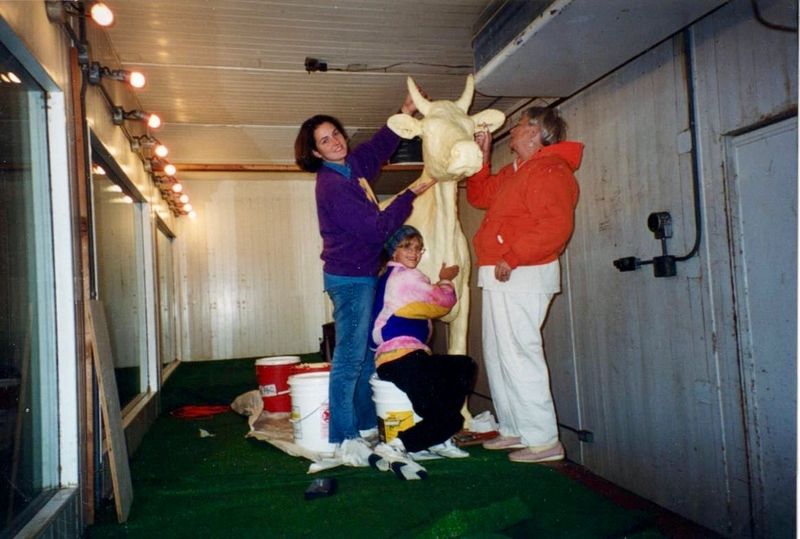
So, last resort: Go to the butter cooler where Great Aunt Norma Lyon was carving the butter cow.
A bit of history here: As the 20th century dawned, pasteurization and other technological advancements shifted the dairy industry from largely local farms that sold either direct to consumers or through country groceries to large creameries and co-ops that could distribute regionally. As these companies grew, so too did the organizations promoting their industry interests, as historian Pamela Simpson writes in her book, “Corn Palaces and Butter Queens.”
And these new dairy associations saw butter sculpture as a powerful form of advertising. A tub of butter doesn’t make headlines. But a butter cow? Or a butter Columbia protecting a butter fallen Spanish-American War soldier, as was created for the 1898 Minnesota State Fair? Now that will garner some ink.
In Iowa, the Beatrice Creamery Co. sponsored a butter cow in 1911, kicking off a tradition upheld today by the Iowa Dairy Association.
So politely shooed from the Cattle Barn, off Pratt went to Norma and the butter cow. And spending hours inside a refrigerator scratched some artistic itch she had, one she probably couldn’t have articulated. She barely stopped to eat; the work satiated.
Pratt came alive.
And she came back the next summer. And the next summer. And the next.
“It was my failure that led me to that opportunity,” she says. “And this path.”
OK, so The Smithsonian.
Pratt immediately thought history and figured the curators might want some of the wire loops and wooden paddles used to carve the cow. Or maybe some of her memorabilia of Norma, who’d sculpted the State Fair’s butter cow for nearly 50 years and trained Sarah before she took over.
On the day the highly trained curators were to visit her on the fairgrounds, Pratt cleaned up the workspace behind the butter cooler and laid out Norma’s book, an autographed photo and her tools. Her own little butter sculpture exhibit.
At best, she was expecting them to take an instrument or two, maybe the book for research purposes. And if one of her tools ended up in a display case in the Smithsonian, she thought, oh, she was so going to see it.
By the time Savig and her colleague turned up in Iowa, they were in the middle of a monthlong swing through Midwestern fairs. During these long days of reconnaissance for their exhibit, they treaded fairgrounds, visited local historical societies and conducted interviews with artisans and experts.
After a pit stop in D.C. their fall was booked out too, hitting a couple of southern and West Coast gatherings.
Savig’s curatorial work has long been squinting and looking sideways at art history. The fairs concept, in fact, sprung from another gathering where the art can sometimes be othered or wholly dismissed.
“We did a whole show on the Burning Man festival several years ago,” which was incredibly popular, Savig says, “and I was like: ‘What is my Burning Man?”’
Her answer surfaced like a cheese curd ready for its ranch dressing: The State Fair.
And the idea stuck like, well, the oily residue after a boat of curds. Her excitement only grew as she began reaching out to artists and plotting the research trip tour-de-force, she says.
Pratt gave the spiel she’d worked on about the history of butter sculpting and took them into the cooler. They were caught up talking when Savig asked, nonchalantly: Now, how will we get the cow to D.C.?
“That was the first inkling,” Pratt says, but her mind almost couldn’t comprehend what was being suggested. Her art? In the Smithsonian?
“It took them several times of asking until I realized they did not want my autographs or my tools or my books,” she says. “They wanted a butter sculpture.”
That fall, the Pratt family took a trip to D.C. and toured the Renwick and its Octagon Room with its vaulted ceilings where, in a year and a half, Pratt and her two daughters would be sculpting. In the Smithsonian.
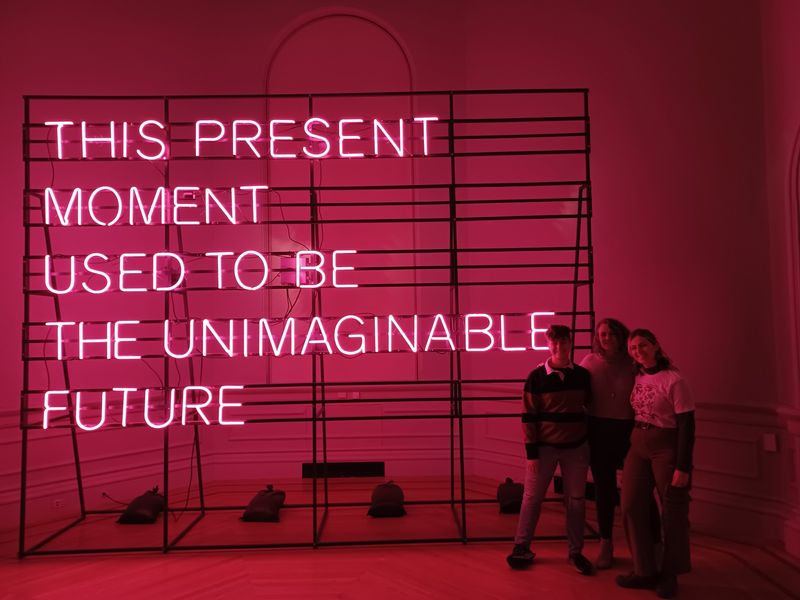
The piece on exhibit at the time was a neon sign, bright pink, that flashed between: THIS PRESENT MOMENT.
And: USED TO BE THE UNIMAGINABLE FUTURE.
Her word at the time was TRANSFORMATION.
Curiosity created the cow: Real-life bovine in butter
In less than a week, just after the hot dogs and fireworks of July 2025, the Pratts would be leaving for D.C. And, flipping through her sketchbook, Pratt feels like they need something more tangible, interactive even, to inspire their upcoming work.
Pratt’s nervous, and when Pratt gets nervous, she works with her hands. Has since she was a child.
So she fashioned the metal armature for the cow’s framework, assembled it, just to get eyes on its full shape. Then disassembled and loaded it into a U-Haul for the family’s trip east.
And she’s been sketching cows. So. Many. Cows.
Over the course of almost two years, Pratt and the curators had a handful of Zoom meetings to talk about logistics. They initially discussed sculpting the cow in Des Moines and shipping it, but the Renwick didn’t have a freight elevator and schlepping hundreds of pounds of butter cow up a grand staircase seemed one absurdity too far.
So the Pratts would instead drive their tools out to D.C. and spend a week carving there, inside the specially made cooler.
The Smithsonian was on the hook to get new butter for the build because every other fair would need their supply at some point during the year the exhibit was on. So long as they could source the butter — and everyone seemed so worried about that butter delivery — Pratt was confident their cow would last the show’s run.
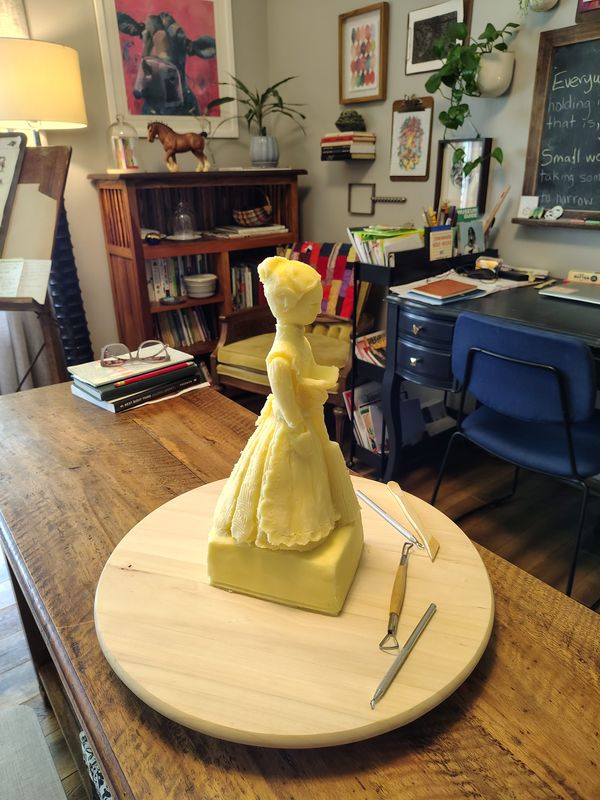
Pratt had only ever seen a butter sculpture last for about 11 days, so she carved a quick piece in the spring 2024, a small statue of Caroline Shawk Brooks, widely considered the world’s first butter sculptor, and kept it in a basement mini fridge.
More than a year later and Caroline was fine. (For what it is worth: It’s still in that fridge today, and Caroline is still fine.)
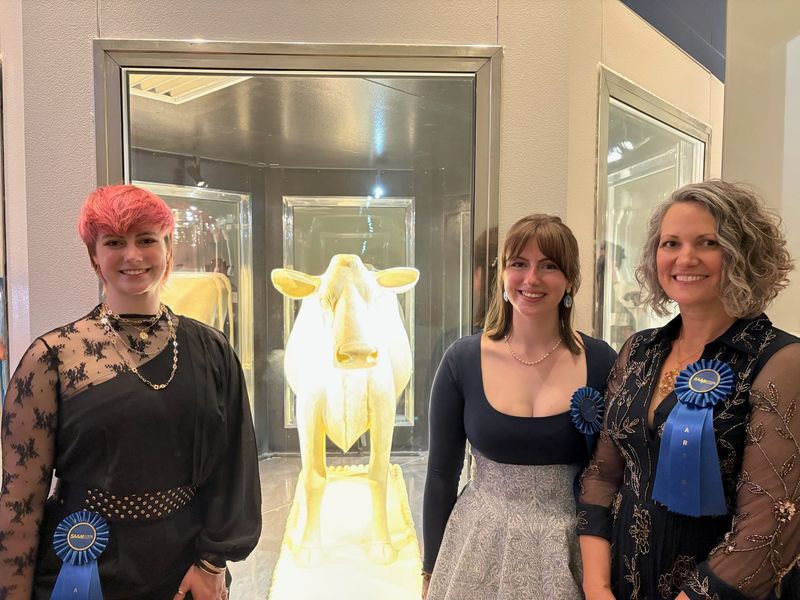
Her daughters, Hannah and Grace, had been her apprentices for years, but, the way their schedules fell with college, they’d often work on the companion sculpture pieces while their mom did the traditional cow.
And as they held artists meetings to talk about the Smithsonian piece, Pratt realized that while she spent her formative years around dairy cows, her daughters hadn’t. They were town kids surrounded by suburbs instead of country.
They knew butter, absolutely, not necessarily udders.
So she cold-called her favorite dairy, Picket Fence Creamery, who pointed her to the two brothers who did their milking. Her request was simple: Can we visit? Just to, um, spend some time with the cows?
When the women arrived at the farm, the brothers coerced some cows into a semi-covered area. And the artists got to work observing: The way the cows move. The way they interact. Their bone structure. Their eyes. Their stare.
“I feel like there’s a deep connection between animals and humans,” Pratt says. “Animals are very curious, and they will side-eye you. Or they’ll stop what they are doing and watch you.”
Before they leave, they snap a photo of the cow they’d picked to sculpt. Their inspiration. She didn’t have a name, the brothers said, which felt akin to a blank canvas for Pratt. Perfect.
On their way east, the Pratts bought a kiddie pool to use as sanitation control. They’d have special butter shoes and butter outerwear they’d wear in the cooler and take off in the unfilled inflatable.
If bugs got into the museum, they could destroy other works of art. In the concrete hallways of the agriculture building at the Iowa State Fair, that had never been a concern.
They’d also need to sculpt 360 degrees of the cow, which they don’t have to do in Iowa. The way the butter cooler is set up in Des Moines, visitors only see one flank.
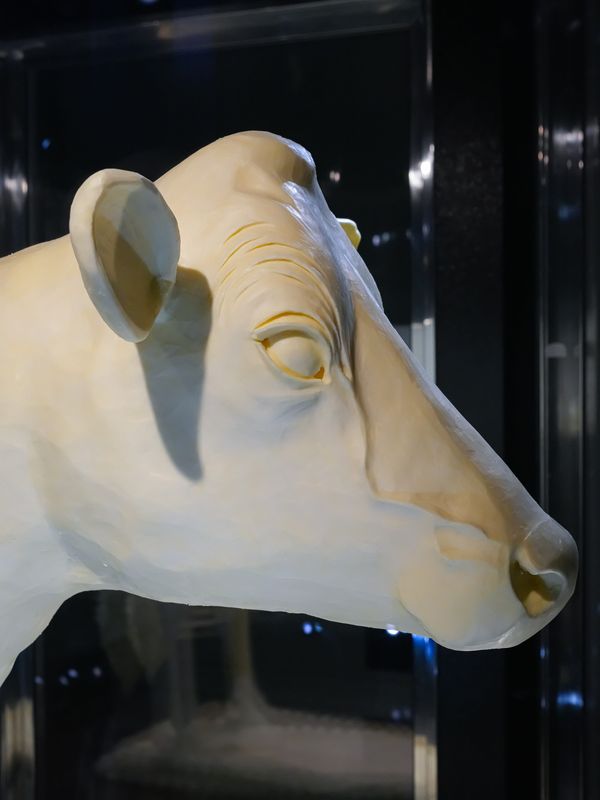
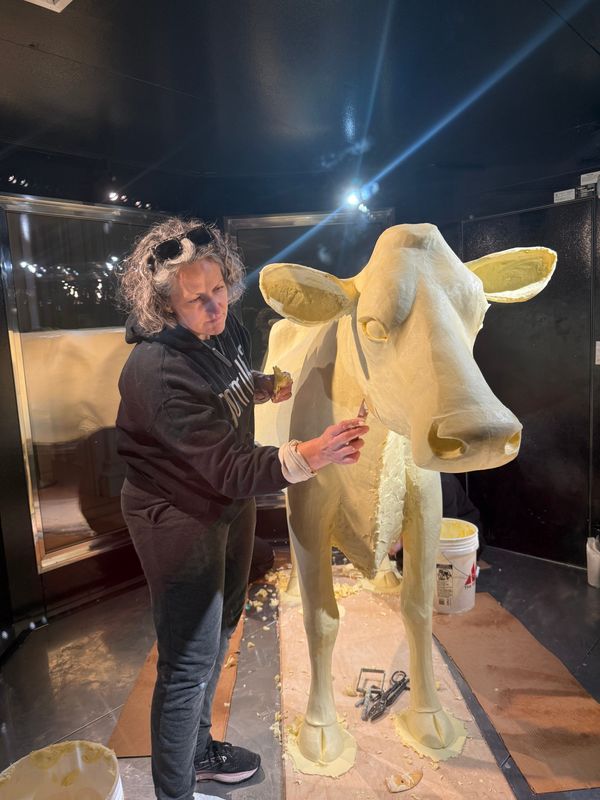
And the space, the actual cooler — which has a distinct sci-fi look, the sort of place where an alien would be dissected — was much smaller than their usual cooler. As the cow filled out, they played a game of Twister, ducking under and around. To sculpt the face, they had to lean back and squat at the same time.
“Every two hours or so, we’d step out and we’d do a critique,” Pratt says. “We’d look at the reference picture of our lovely cow from Iowa and make adjustments.”
But really, so much of it was good old muscle memory. Once they got the frame put together and the initial layers on, sculpting came naturally.
“It was so fun because you’d step away and you’d come back an hour later and, all of a sudden, the cow has an eye,” Savig says.
For Savig, watching these artists work, digging into the butter with tools smaller than toothpicks for the most minuscule of details, carving and recarving when they weren’t satisfied with the first try, was an assault on the art world’s general disregard of the medium.
Placing state fair work — both art made from the unconventional as well as incredibly conventional objects made with craftsmanship and expertise — among the American greats is a throughline of the show and, now, a personal mission of Savig.
“Sarah’s amazing,” Savig says. “It shouldn’t be, ‘oh, well, it’s butter sculpture,’ like it’s kitschy or it’s ephemeral. It’s the quality of the work that stands against some of these other artists.”
“They’re at the same level. They’re extraordinarily well made. And they’re conceptually challenging.”
Indeed, an early review of the show compared the Renwick’s butter cow to the work of Damien Hirst, one of the most important and respected sculptors of the modern era. A juxtaposition that is validating, Pratt says.
Because even as crowds line up annually to watch her work at the State Fair and to see the final creations, Pratt can’t shake that it is all sort of a novelty. The way people shuffle past the case, make silly faces in selfies, can give the work an air of jokiness.
“Almost like a curiosity in a way,” Pratt says.
So as the Pratts pondered a title for their butter piece, they wanted to allude to that oddity-like feeling. But they also wanted to honor that this whole Smithsonian experience was allowing them to shed the noun construction of curiosity and embrace a more active tense.
They named it Curious Regard.
A nod, also, to the word that had been most highlighted in Pratt’s sketchbook right then: CURIOUS.
The ‘unimaginable future’: What’s next for Smithsonian butter sculptors
When Pratt’s daughter, Hannah, was in middle school, she was assigned to write a paper on a famous Iowan. She picked her mom — mostly, Sarah’s sure, so she didn’t have to call anyone else, Pratt says with a laugh.
Mother and daughter spent an afternoon sharing stories of childhood and growing up and butter and wanting to be archaeologist.
Guess that Indiana Jones dream didn’t come true, Pratt said at the time.
But in the paper’s conclusion, Hannah wrote that her mom was wrong.
Her dream really had come true because, well, one, she was a teacher and, two, during the summer she has adventures at the Iowa State Fair, telling stories of people and places and traditions through the artworks she creates.
And a realization struck Pratt like the mallet on a Midway Hi-Striker.
Pratt always thought being an archaeologist was about objects from far flung places. Treasures. Until that paper, she hadn’t stopped to understand that just as important as the stuff is their stories — including the tale of growth and change within the person who’d gone on the adventure.
Action sequences or no, Pratt spent her life looking for a story in which she could be the protagonist. Her fullest self, with big main character energy. And as crazy as it sounds: She found it in butter.
“What I have learned about a lot of artists is that there’s lots of ways of becoming,” she says.
“Butter sculpting may be an artistic expression to me, but it’s also a way to share a story of who we are as a state and a community.”
And, recently, she’s started looking for new ways to share those stories.
For a while now, Pratt has had this inkling that there is more to butter sculpting. Maybe there’s a business or a consultancy in it.
Or more keynotes and workshops on sculpting’s history and impact, speeches and demos she’s crafted recently through a yearlong grant that supported her traveling to talk butter in rural Iowa.
Just more, she feels. She’s still figuring that out.
She’s also taking additional art classes through her grad school program — a little of that classical training — and “already they’re rocking my world,” she says. Her first assignment is a self-portrait, and she’s working with watercolors, a medium in which she’s long had interest.
“I feel like the more space I have made for that part of my life — butter sculpting and artistic endeavors and art — more opportunities have come up,” she says. “So I feel like that’s a path worth exploring.”
“I just want to keep being curious.”
Pratt has gone back to repair Curious Regard a few times over its year on exhibit, when small ribbons of a black-green growth start to appear amidst the butter.
The Smithsonian’s experts determined that the ribbons aren’t a mold, per se, but more like what happens in an aged dairy. A blue cheese, say. A crystallization of little pockets of liquid within the butter.
Even though repairs were always a part of the plan — Savig kept 100 pounds of butter in the staff freezer, so as to not lose sleep again when their cow needed a touchup — anxiety churned up a cyclone in Pratt’s gut the first time Savig called to setup a return visit. She felt like a kid who left the back door open.
“Mary was like, ‘Why are you feeling bad about this?’” Pratt says. “She’s like, ‘I don’t hide it. I point it out to visitors when they come: Look at this, this is what the butter does over time.’”
“So something I am embracing is: Failure is part of the journey and sometimes it’s the necessary catalyst for the next great thing.”
Pratt went back to D.C. for her final round of repairs on the butter cow just before July 4, just before she starts working on this year’s Iowa State Fair pieces.
Her daughters came along, too. They’d started on the sculpture with her just before their senior year of college. Now, they’ve graduated and are figuring out what follows.
Pratt, too, was at a threshold when they got to D.C., having taken a sabbatical from teaching to give butter sculpting her full attention.
To pour into herself, really. Into this transformation, she says.
“It’s been a dream come true of a dream I didn’t know even to dream,” she says.
“It feels like this coming together of all the work and all of our energies. It felt like the present moment of the unimaginable future.”
Pratt looks up, placing the big mug back on its comically tiny saucer. There’s that word again, she says.
Another one she’s written down recently, that’s been following her in conversations. And, gosh, doesn’t this one feel like it’s glowing? And brightly.
It’s her newest word — the one she’s using to define whatever comes next: UNIMAGINABLE.
Courtney Crowder is a senior writer and Iowa Columnist. You can contact her at (515) 284-8360 or ccrowder@dmreg.com.
This article originally appeared on Des Moines Register: The Smithsonian needed a butter cow. Iowa’s Sarah Pratt got the call.
Reporting by Courtney Crowder, Des Moines Register / Des Moines Register
USA TODAY Network via Reuters Connect
By Courtney Crowder, Des Moines Register | USA TODAY Network