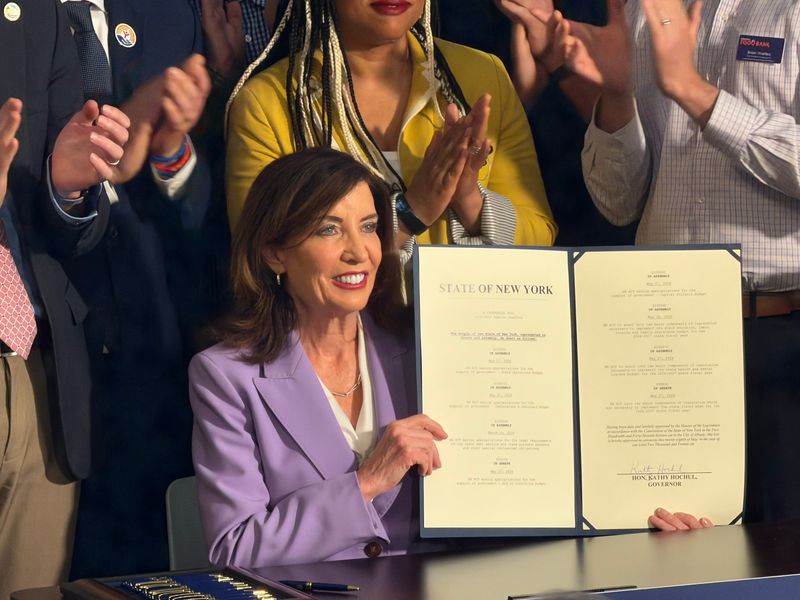
This year, to the benefit of millions of New Yorkers, Gov. Kathy Hochul put on a full court press to rein in New York’s overly burdensome climate mandates. By taking a stand to lower costs by adjusting the Climate Leadership and Community Protection Act’s — or CLCPA — timelines, the governor sent a clear message: working New Yorkers can’t be left footing the bill for policies that move faster than technologies or economics allow.
Unfortunately, it seems lawmakers in Albany haven’t got the message. Instead of moving toward climate commitments in a reasonable and financially prudent manner, they are fast tracking legislation that puts an unrealistic mandate on the trucking industry, which will ultimately result in increased costs to consumers.

The proposed legislation (S.1180C/A.3575C) establishes an Indirect Source Review, or ISR, program, which would impose heavy fines on warehouses and distribution centers based on the trucks that serve their facilities. In other words, putting the blame on the trucking industry yet again for providing the essential transport of goods to the nearly 90% of communities across New York State who rely wholly on our services.
Under ISR, unless electric vehicles are servicing the warehouse, the warehouse operator will be fined for the emissions generated, something largely outside their control. There is no wiggle room and other clean powered vehicles, such as renewable clean diesel or hydrogen fuel cell trucks which have contributed to a 99% reduction in pollutants since 1974, would still generate fines to the warehouse operator.
The only option for compliance is electric, which is out of reach for small carriers due to vehicle costs approaching $400,000 for some models, insufficient charging infrastructure along New York’s freight corridors, and order backlogs stretching years. As a result, ISR as currently designed, doesn’t incentivize the transition, it fines small businesses for failing to complete a transition that isn’t yet possible.
Plain and simple, and as was the case with the now-delayed Advanced Clean Trucks Rule, there simply isn’t the infrastructure in New York to support an industry wide transition to electric trucks. Without the proper infrastructure in place, our industry will see fines stack up, businesses close, and workers will face an uncertain future.
For the bulk of our industry which serves New Yorkers, trucking companies are largely not the publicly traded global logistics giants the bill sponsors would lead you to believe. They are multi-generational family-owned carriers running five to ten trucks or single, owner-operators, who haul produce from Hudson Valley farms, lumber to construction sites in Queens, and medical supplies to hospitals who keep our neighbors healthy.
These businesses don’t have the luxury to window shop and pick and choose the latest and greatest in electric hauling vehicles. Instead, they invest in affordable, clean diesel technology so that they can put food on the table for their families, while also reducing their environmental footprint.
The sponsors of this legislation frequently invoke the needs of communities near warehouses and distribution facilities, but those communities aren’t asking for policies that threaten jobs, raise costs, and undermine economic opportunity. They want the chance to succeed, support their families, and access affordable goods. California pursued this same approach and paid the price: an independent analysis found its warehouse ISR produced no verifiable emissions reductions attributable to the program itself. Any marginal climate gains came from other regulations already underway, like the state’s clean fuels standard. What ISR actually delivered was administrative chaos and ballooning compliance costs. All reasons why California’s Legislature recently declined to expand the program statewide, walking away from the very approach it pioneered. New York is now being asked to repeat that experiment.
The good news is that Albany doesn’t have to choose between cleaner air and economic stability. Despite the failures of ISR and its ability to threaten affordability gains, there are real ways to reduce freight emissions without hitting New Yorkers at their wallets. What lawmakers in Albany should be looking towards is expanding charging and alternative-fuel infrastructure and modernizing fleet incentive programs.
Thankfully, we already have the guide, as the New York Truck Voucher Incentive Program and the NYC Clean Trucks Program have proven that technology-neutral incentives move the needle faster and more fairly than costly mandates.
When she led the push to re-examine CLCPA timelines, Hochul showed she understands that affordability and economic reality must be part of every climate conversation. We hope the Legislature will come around to this reality as well.
Kendra Hems is the head of the Trucking Association of New York.
This article originally appeared on Rockland/Westchester Journal News: Albany’s warehouse bill unfairly hits the wrong New Yorkers | Opinion
Reporting by Kendra Hems, Special to the USA TODAY Network / Rockland/Westchester Journal News
USA TODAY Network via Reuters Connect