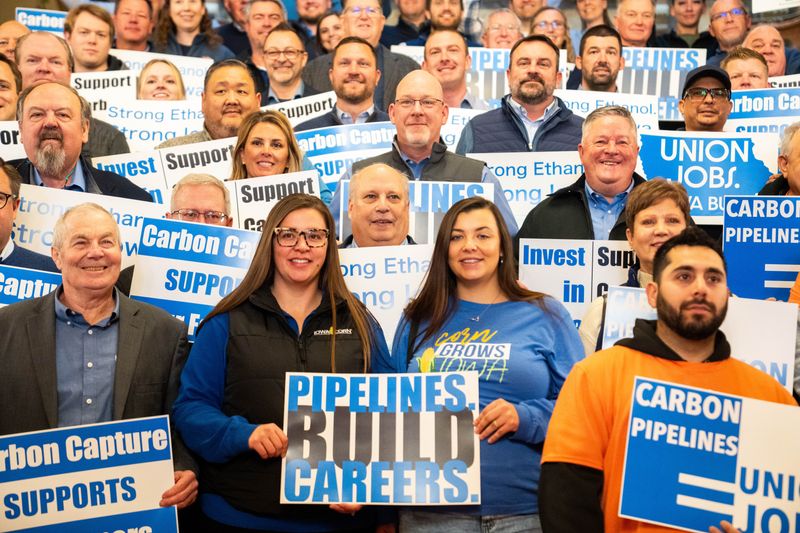
For the following reasons I strongly support the passage of Senate File 2067. It is innovative and necessary if Iowa is to capitalize on the value of her natural resources and the creativity and innovation of her citizens.
This is longer than your normal mass-mailed postcard showing a point of view for a particular piece of legislation. Yet, I urge you to take the time to review it.

The flaw that has negatively affected the agricultural economy and rural America is 10 decades of status quo ag policy. These policies have consistently provided farmers with financial safety nets. The result has been a fear of, and dearth of creating new value-added market opportunities. A government subsidy check is viewed as the best risk management strategy.
In the case of 45Z, carbon intensity scoring and year-round E15, producers, processors and entrepreneurs are aggressively working with outside industries to develop new sustainable markets based on innovative carbon capture and storage technologies.
When policies, with properly defined lifespans, are designed to enhance and enable new opportunities, we know what benefits can accrue to rural America. We have already identified the kind of economic and environmental gains possible by reviewing what occurred when similar opportunities were exploited in the first decade of the 21st century.
All of this occurred when policies like the Energy Policy Act of 2005 and the Energy Independence and Security Act of 2007 were enacted. They provided the basis to build the new industry. These gains in energy and agricultural prices were driven by these policies which responded to changing market demands that in turn created new solutions.
Today we have a similar but different explosion in demand. It is the demand for low carbon sources of energy. Regardless of one’s view of carbon pollution, the global consensus is that we need to reduce the release of carbon into the atmosphere. This opportunity is comparable to that of the gestation and growth of the ethanol industry. Ethanol addressed a need for a climate-smart and renewable fuel source.
The global demand for low carbon fuels is estimated in the tens of billion gallons. Low carbon fuel demand can and needs to be gestated by a strong commitment to 45Z, carbon capture and sequestration, low carbon intensity scoring, and the resulting monetization of these carbon sequestering tools and processes. This can and should be addressed in the same thoughtful and aggressive manner as was the development and build out of the ethanol industry.
Will tax credits and subsidies be required? Yes, but I quickly refer you to the elimination of production ethanol tax credits. The resulting D6 RIN value does not affect or cost the U.S. budget or taxpayer. Yes, those who buy them for pollution control purposes may pass some of the cost on to consumers. That occurs at every level of service impacting the consumer. (Have you ever checked your auto service invoice when you have an oil change? There is always an environmental disposal charge.)
In summary, the agriculturally based ethanol industry, driven by creative policies, solved energy supply problems using environmentally sustainable and cost-effective technologies.
Based on my direct involvement in the development of Renewable Fuel policies and the build out of the ethanol industry from 2001 to 2008, I believe the same transition away from government support will occur as carbon sequestration and low carbon fuels technologies mature.
The global demand for low carbon products, along with new uses for sequestered high-quality carbon products, will simultaneously increase supplies, cheapen prices, and dramatically reduce, if not eliminate any form of government subsidy. Over the medium-term development costs to the U.S. taxpayer will be minimal.
What is the net taxpayer impact of a serious commitment to 45Z, carbon capture and storage, and E15? It will be no more costly, and likely much less, to the U.S. budget than is the scope of intangible drilling costs and depletion allowances allowed at the well-head. The various tax credits or expenses allowed per gallon of fossil fuels from processing to distribution may result in another 10 cents to 40 cents per gallon of benefits to the producer, processors, and distributors.
Finally, I would point out that, in Iowa, 30,000 to 35,000 jobs are tied to the ethanol supply chain. These jobs have an average salary of $50,000 to $60,000. Approximately 4,000 of these jobs reflect direct employment at Iowa ethanol plants. These jobs have average salaries of $65,000 to $85,000. This is the equivalent of 300 to 350 jobs per Iowa county.
Most counties in Iowa are rural. Developing the CCS infrastructure has the potential to add $1.50 to $3.00 gross value to every bushel of corn produced in the state. Obviously, this won’t all aggregate to the farm because it requires additional and highly sophisticated skill jobs that ultimately reside in every county of the state.
The possibility of extracting hydrogen from Iowa subsurface reserves, and processing it with captured carbon, portends the possibility of manufacturing a more abundant and cheaper urea fertilizer.
In conclusion, research into new sustainable and environmentally responsible uses for carbon is expanding exponentially. I support a strong, responsible, and quick commitment to finalizing Senate File 2067.
Thomas C. Dorr of West Des Moines is former consultant and undersecretary for USDA Rural Development from 2001 to 2007. He was president and CEO of the U.S. Grains Council from 2009 to 2012.
This article originally appeared on Des Moines Register: Why Iowa will be better off with a carbon capture pipeline | Opinion
Reporting by Thomas C. Dorr, Guest columnist / Des Moines Register
USA TODAY Network via Reuters Connect