WASHINGTON, D.C. — Debra Wykert was ready to be creative again. Finally.
This was 2022 after a few tough years for the family. There was COVID-19, of course, and her husband had been diagnosed with cancer, too, right as the pandemic seeped into our lives and lungs.

But he’d gone through treatment and come out the other side. Thank goodness.
So when she wanted to, well, “come alive again,” as she told her local newspaper, she turned to her needles and thread. A sewing project — losing herself in the rhythmic stitch, stitch, stitch, stitch — would get her back into the “mood I wanted to be in as a happy person,” she said.
But that sewing project — a temperature quilt that used colored fabrics to chronicle the daily highs and lows across a year — didn’t just bring Wykert back to herself.
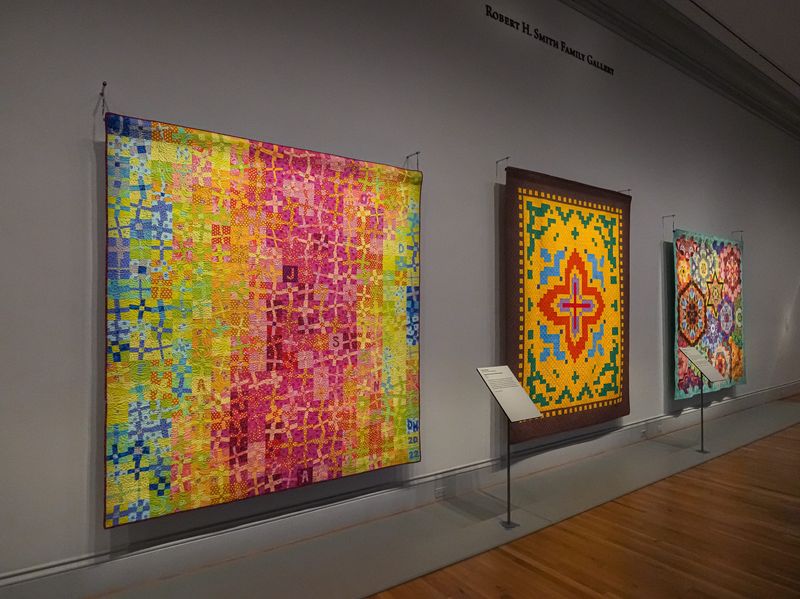
It also brought her work to Washington D.C., to the Smithsonian Institution, where her Iowa State Fair blue ribbon-winning quilt, and the story sewn into its every seam, was selected to hang among the nation’s best in the exhibition, “State Fairs: Growing American Craft.”
“I’ve always loved sewing. I love creating something,” Wykert told the Muscatine Journal. “I love giving my quilts to friends and family members or donating them to charities — it’s just a way I can give a piece of myself to others.”
From Wykert’s needlework to dollhouse-ready miniatures to intricate three-dimensional embroidery pieces to one of the exhibit’s crown jewels, an iconic butter cow sculpted by Iowan Sarah Pratt, Iowa-made objects are well represented in the exhibit.
Iowa is the most well-represented, in fact, with nine objects — the largest collection from any one state. (Take that, Minnesota. And just go ahead and sit down, Texas.)
Featuring nearly 250 objects, the State Fairs exhibition marks the first time these sorts of works have been honored by an institution as prestigious as the Smithsonian, a point of pride for head curator and native Minnesotan, Mary Savig.
Savig spent five years researching state fairs, a few incredibly hot months blasting through step goals across fairgrounds and hundreds of hours talking to artisans at fairs dotting the American landscape from Alaska to Florida.
And she returned to D.C. with lists of pieces she felt represented that swath of American fairs, but, maybe more importantly, carrying the narratives behind those works.
“People at fairs are always so willing to tell their stories to a stranger,” she says, “and I think that willingness and that generosity is just one of the best experiences we can experience.”
And, to her, crafts that are catalysts for very particular memories, like Wykert’s, are “the heartbeat of the show.” Like the best art, she says, the works featured tell a story about the maker and their place in the world at a given time.
“Everyone is able to say what they want to say” on the fairgrounds, she says.
But “it’s just as important for artists to be able to communicate who they are, as then people come and they have a discourse with it. They also socialize with the works,” Savig says.
Not only do viewers bring out their inner critic when they walk through fairground art exhibits, judging blue ribbons for themselves, Savig says, they also are exposed to different perspectives through the works, some historical and others very au courant, some positive and others critical. The contours of Americanness, or Iowa-ness, are reflected and refracted and magnified through the lenses of these pieces and their origins.
“What’s really interesting about the fairgrounds is that they are sites where there’s social discourse in a way that people might be challenging other people and their ideas,” Savig says, “and it seems to be productive.”
Here’s a closer look at the Iowans whose work is highlighted in the exhibit and the stories behind their pieces.
Rod Zeitler, ‘Home Canning Display’ and ‘Silk Ribbons from the Iowa State Fair’
If the Renwick Gallery’s nearly 800-mason jar pyramid seems impressive, you haven’t seen Rod Zeitler’s Iowa City dining room. It’s an ad hoc storage facility for the Iowa State Fair’s winningest canning competitor, lined on all sides and up the walls, sometimes 10 boxes high, with even more mesmeric canned goods.
Mind the special built-in bookcase in the living room, though, those are this year’s competition-worthy jars. Blue ribbon jars. Jars that look uniform, have the right headspace, right seal. Zeitler approved.
“I think it’s a little bit of an obsession,” Zeitler said of his canning previously.
“But canning, for me, is a bit of an art in addition to the science of it,” he said. “And it’s the art part that gets me ribbons.”
For Savig, having a large-scale display that nodded to many 19th century fairs’ obsession with bounty was important historical context for the exhibit overall.
“There was this whole category called serial art that emerged as part of world’s fairs and state fairs that was meant to showcase American abundance,” she says. “It’d be these huge displays of apples and pears and flowers that were really meant to go to waste because the idea was: ‘We produce so much, we can do even this.’”
Then, during World War II, when food conservation became especially important, fairs started hosting canning displays as a way to educate on preservation.
“And also safe canning methods, because botulism was a real problem,” Savig says.
Savig tasked one of her exhibit designers to come up with the biggest floorplan possible for a canning-abundance display, and, given their gallery’s space restrictions, the final blueprint meant they’d need about 800 pieces.
“He was like, ‘No problem,’” Savig says of calling to ask Rod for that many jars. And he also loaned them hundreds of his ribbons collected over two decades to provide a colorful background for the exhibit’s descriptive plaque.
“There probably aren’t many people that have that many jars,” Zeitler said. “First of all, most people aren’t crazy. But I knew I had the products and could supply them with what they want.”
Zeitler joined the exhibition team for part of the installation in D.C., and he would would swap jars or reface them or even slyly remove this one or that one as the pyramid was coming together.
He’d say it wasn’t exactly right, Savig remembers. “He is so interested in the esthetics of it all.”
Mary Shotwell, ‘My Millefiore.’ Debra Wykert, ‘Temperature Quilt — Wonky Weather’
For the better part of five years, Mary Shotwell worked on “My Millefiore,” a quilt done in the Millefiori style, which attempts to translate the kaleidoscopic nature of Venetian glass onto fabric.
Made by English paper piecing, an incredibly precise category of needlework, the Millefiori method requires exact fabric cuts of geometric shapes that are then intricately stitched to resemble flowing floral designs.
“The fact that it got a special award at the Iowa State Fair for handwork meant a lot to me because English paper piecing is a very time-consuming, but relaxing kind of activity,” Shotwell told KCCI last year.
“When I first started, frankly, I wasn’t any good at it at all,” she continued. But “the more I learned and the more I got into it, the more I loved it.”
Wykert also fell in love with fabric work over time, as she told a local news station in her hometown of Muscatine.
“I started in a sewing group, and there were six to eight of us, and we’ve been sewing together now since ’95,” she told the station. “We meet at least a couple of times a week.”
Temperature quilts like the one Wykert made are a well-known category that act as a visual record of a year of weather. A patchwork, each block represents one day’s reported high and low temperature using specific colors and patterns.
Iowa’s back and forth between extreme cold and extreme hot made for a striking quilt design, said Wykert, who worked on “Wonky Weather” for about 150 hours.
“There are a lot of areas that don’t get that major fluctuation like we do here,” Wykert told the station. “To me, it’s just kind of bright and beautiful, and just reminds me of the Midwest.”
In Savig’s research, Iowa’s fabric department stood out as one that sought new sewists and just had an excitement and enthusiasm flowing within its ranks of volunteers and entrants.
“They had a record number of quilt applications over the last few years,” Savig says, “showing that a lot of these are not dying arts, but it’s also on the fair to keep that energy up.”
Deborah Zeitler, ‘Green Vessel with Beads’ and ‘Leather Shoes’
Deborah Zeitler, wife of the Iowa State Fair’s winningest canning competitor, Rod Zeitler, actually started entering fair competitions first. Watching just how much fun she had preparing and competing eventually pushed her husband to find a hobby and try for a ribbon, too.
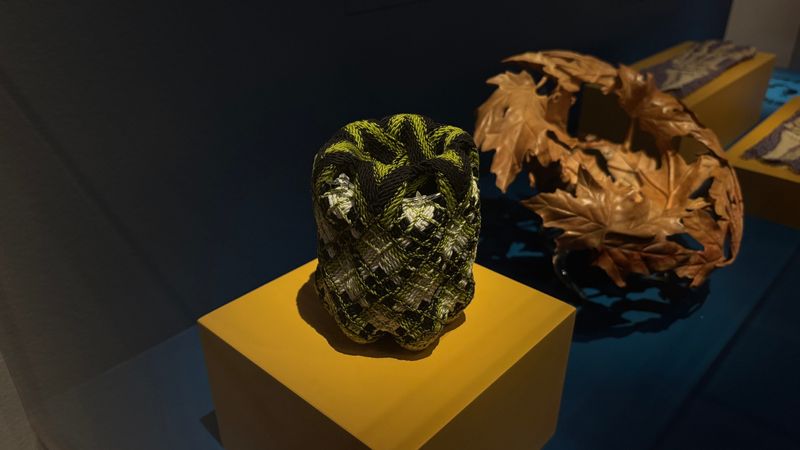
But unlike Rod, who is all-in on one competitive pursuit, Deb Zeitler is a multihyphenate when it comes to fair contests and has won 19 sweepstakes ribbons, a top divisional prize, for her weavings and fiber art. The green vessel on display at the Smithsonian is an example of her handiwork, featuring beads and cotton yarn.
Zeitler initially became interested in textiles after impulse purchasing a floor loom, as she described on the Handweavers Guild of America’s YouTube show. Knowledge picked up from local weavers only deepened her curiosity and she branched into handwoven fabric, felt and ply-split braiding, an ancient type of fiber work that creates sturdier and more hard-wearing pieces.
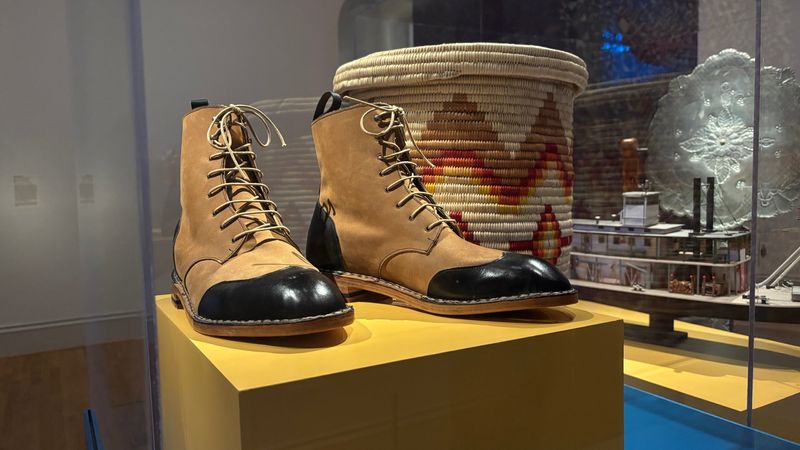
She’s also a shoemaker and, in 2023, she designed and crafted the saddle shoe-esque leather boots featured in the Smithsonian exhibit.
With leather soles, leather linings and hand-stitching around the shoe’s outsole, the boots display one of Deb’s current interests, as she told the Handweavers Guild, which is making sneakers out of her handwoven fabric and leather.
Beth Grabau, ‘The Pump House’
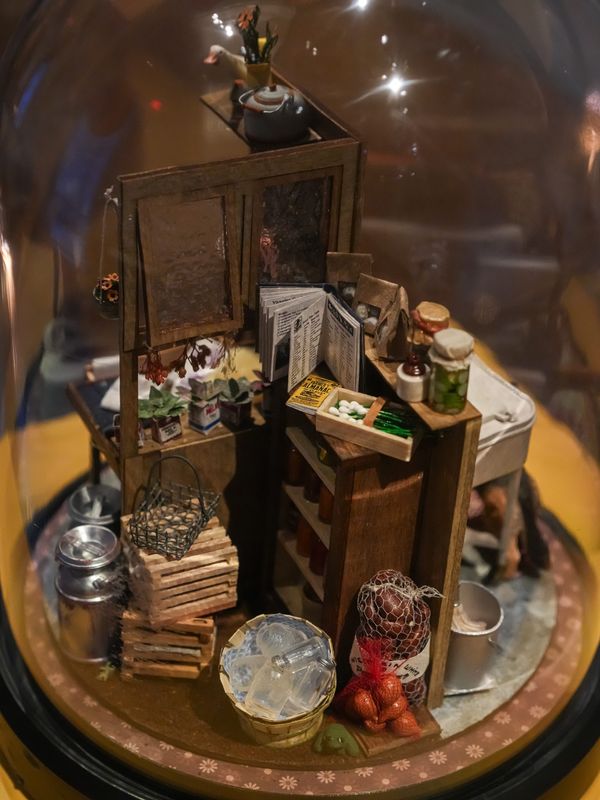
An Adel resident, Beth Grabau based this miniature scene on memories of doing laundry in the dirt-floored pump room on her grandparents’ farm near Cedar Rapids. And, indeed, most of the intricate wood items featured are tokens of her grandmother’s life, including fresh farm eggs and canned goods, braided rugs made from cloth scraps and teeny-tiny, embroidered tea towels.
“She remembers there being toads that lived down there, so she added a toad to the piece,” Savig says.
The piece is 1-inch scale, meaning 1-inch equals 1-foot, Grabau — an award-winning miniaturist — told the Iowa State Fair’s podcast.
“You get to the point when you have been doing the hobby long enough that you can kind of tell when something is in scale or out of scale,” Grabau said. “And that is one of the judging criteria for our division in the cultural building is how well you adhere to the scale.”
“There is math, yes,” Grabau added with a laugh. “Sometimes you have to figure out how big is something in real life and then shrink it down.”
This particular project started with a miniature kit Grabau purchased at a Halloween sale, the only real remnant of which is the bat on the top of the glass cloche — an Easter egg that Savig points out on all her tours.
Anne Hanson, thread pattern design by Alison Cole, ‘Tiger Swallowtail Butterfly’
For Cedar Rapids’ Anne Hanson, embroidery is a family affair, a passion she’s shared with her mother and sisters for decades.
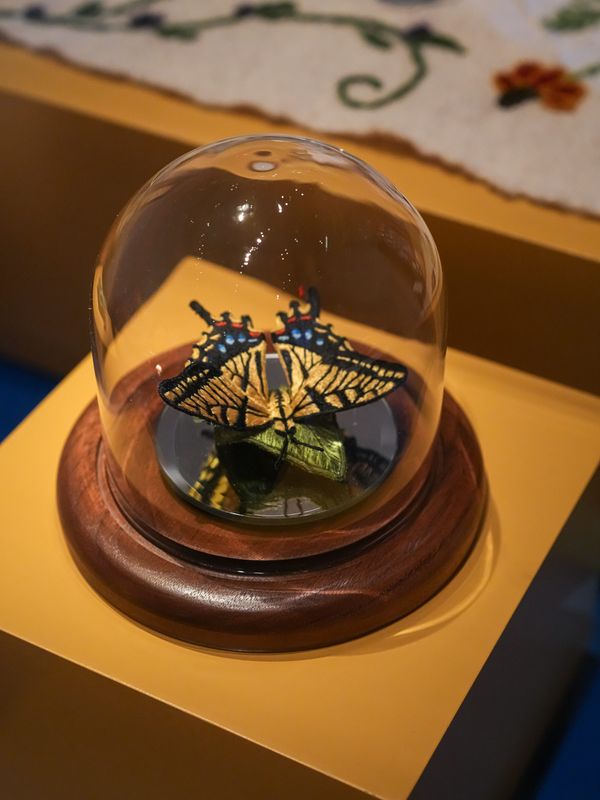
Made of 6-stranded silk floss, the life-like “Tiger Swallowtail Butterfly” piece is a “stump work,” an embroidery style that allows for three-dimensional designs, according to the gallery’s display text.
Since this project won four divisions at the 2023 Iowa State Fair — embroidery, counted cross-stitch, counted thread techniques and needlepoint — Hanson has made several additional butterflies and plans on making more.
“It is all still a bit surreal,” Hanson wrote on Facebook after traveling to D.C. to see her work on display.
“I guess the most exciting thing about this is that my goal has always been to share my love of embroidery with other people. The State Fair is a great way to do that.”
Sarah Pratt, Hannah Pratt, Grace Pratt, ‘Curious Regard’
The Pratts, Iowa State Fair’s official butter sculptors, are the hands behind one of the only pieces made specifically for the Smithsonian exhibition.
A necessity because their entry is, well, perishable.
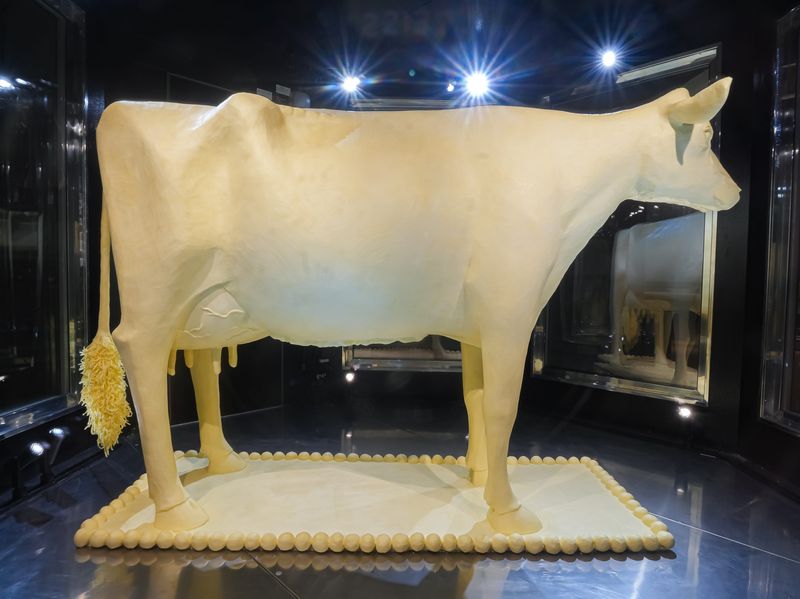
Last summer, the mother-and-twin-daughter team spent a week in D.C. molding the exhibit’s butter cow, a Jersey carved from salted butter layered over an armature of wood and metal.
Since then, the team has been out east multiple times for small touchups, but, at least when housed in it specially made cooler, the cow has held up remarkably well.
The butter was acquired from the same Minnesota co-op that supplies the Iowa State Fair, Savig says. And the woman who sold her all that dairy was a former Princess Kay of the Milky Way, the group of young women who represent Minnesota’s dairy farmers and who, notably, win their likeness sculpted out of butter during that state’s fair.
“She said she still has her butter sculpture,” Savig says.
Courtney Crowder is a senior writer and Iowa Columnist. You can contact her at (515) 284-8360 or ccrowder@dmreg.com.
This article originally appeared on Des Moines Register: Why Iowa dominates the Smithsonian’s inspiring State Fair art exhibit
Reporting by Courtney Crowder, Des Moines Register / Des Moines Register
USA TODAY Network via Reuters Connect
By Courtney Crowder, Des Moines Register | USA TODAY Network