Robert Schumann’s “The Two Grenadiers” (1810-1856), is intricately connected to the memory of Napoleon Bonaparte (1769-1821). Based on a poem by Heinrich Heine (1797-1856), the song laments the fate of the grenadiers who mourn the downfall of Napoleon, exiled to the solitary island of Saint Helena after his catastrophic defeat at the Battle of Waterloo (1815). One of the embittered soldiers vows to rise from his grave and ride to glory with the Emperor he still adores:

“That will be my Emperor riding by my grave;Swords will be clashing and flashing;And armed, I’ll rise up from the graveTo defend the Emperor, my Emperor!”(Translation by Richard Stokes)
Schumann’s path intersected with Heine’s in Düsseldorf, where Schumann lived across the street from Heine’s birthplace. What caused such a dedication to a disgraced French emperor in Germany’s premier Romantic poet and composer? Especially in the 1820s and 1830s, at a time when Europe’s reactionary governments deemed all references to Napoleon a reminder of the tumultuous upheavals caused by the French Revolution of 1789?
A 19-year-old artillery lieutenant during the July 14 storming of the Bastille, Napoleon played no role in the inception of the Revolution. With violent fever gripping France, he returned briefly to his native Corsica and did not resurface on the French political scene till 1793, when the 24-year-old was promoted to brigadier general for his audacious triumph at Toulon.
He dutifully served the First French Republic (1792-1804) and his inspired victories at Arcole and Rivoli during the First Italian Campaign (1796-1797) immediately became the stuff of legends. Even the criminally mishandled Egyptian Campaign (1798-1801) ignited French imagination and birthed the field of Egyptology thanks to the discovery of the Rosetta Stone, a key to hieroglyph deciphering.
As the Revolution struggled and stumbled through the macabre excesses of the Terror and the breathtaking corruption of the Directory, Napoleon orchestrated the Coup of 18th Brumaire (1799). Now First Consul of the French Republic, he enacted the Napoleonic Code (1804), the founding tome of modern civil law, which established uniform jurisdiction throughout France and was extended to the European territories Napoleon conquered as the first Emperor of the French (1804-1814/15).
Napoleon granted revolutionary France, drowning in blood, beseeched by invading European armies, directionless and self-contradictory, a path to glory. The kind of deep pride and fulfillment Marius experiences in volume three of Les Misérables when he shouts into the velvety darkness of the Parisian night, “Vive L’Empereur!” after studying the bulletins of the Grande Armée where his father, Colonel Pontmercy, served with distinction. The veterans Heine depicted in “The Two Grenadiers” appear in the novels of Stendhal, Balzac, Dumas, and Hugo, who chronicled, with near surgical precision, the aspirational greed and vapid corruption of Restoration France (1815-1830) and the July Monarchy (1830-1848) which followed Napoleon’s fall from grace.
Heine’s fondness for Napoleon was deeply personal. The Napoleonic Code granted equal rights to Jewish citizens in the conquered territories, where medieval ghettos were torn down on Napoleon’s orders. Born into a Jewish family, Heine welcomed the emancipation brought about by the Napoleonic reforms of German laws. Disgusted by the reversal of emancipation after Napoleon’s downfall, he relocated permanently to Paris in 1831, where he witnessed the return of Napoleon’s remains in 1840. Along with over a million viewers, Heine watched as the funeral cortège passed under the Arc de Triomphe, an homage to Napoleon’s martial triumphs, towards Hôtel des Invalides, Napoleon’s final resting place:
“The old conquerors have since passed away, and it was a whole new generation that watched the funeral, and with burning anger, yet certainly with the melancholy of piety, they gazed upon this golden catafalque, in which, as it were, all the joys, sorrows, glorious errors, and broken hopes of their fathers − the very soul of their fathers − lay entombed!”
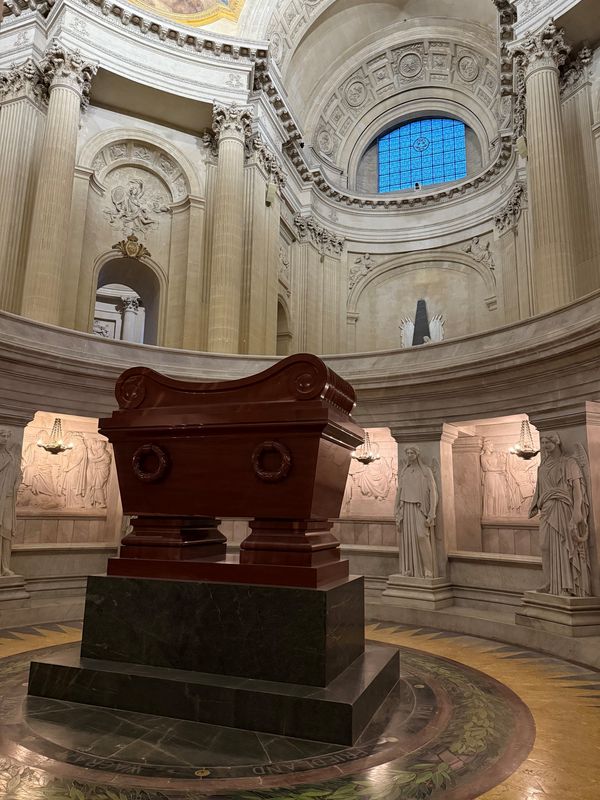
Carved out of a single block of Russian quartzite and weighing 35 tons, Napoleon’s massive sarcophagus contains five additional coffins made of mahogany, ebony, oak, tin, and lead. Napoleon is buried in the uniform of the Mounted Chasseurs of the Imperial Guard, adorned with the Legion of Honor, an order he established in 1802.
Just like Heine during the funeral procession, I found myself face-to-face with the emperor under the Invalides dome, where I lingered in profound silence till closing time. I shared my solitary thoughts with the circular emptiness guarded by Jean-Jacques Pradier’s mournful allegories of Victory (1790-1852), frozen in eternal vigilance around the earthly remains of a mere mortal who, momentarily, ruled the world.
Professor Anna Barker teaches in the UI College of Liberal Arts and Sciences Russian Program. She is a Fellow of the International Napoleonic Society and serves of the Board of Directors of the Napoleonic Historical Society. Her book “13 Notes from Napoleon, Iowa: Musings on the Edge of the French Empire” was published in 2025 (Ice Cube Press).
This article originally appeared on Iowa City Press-Citizen: The Age of Revolutions: Napoleon | Guest Column
Reporting by Anna Barker, Special to the Press-Citizen / Iowa City Press-Citizen
USA TODAY Network via Reuters Connect
By Anna Barker, Special to the Press-Citizen | USA TODAY Network