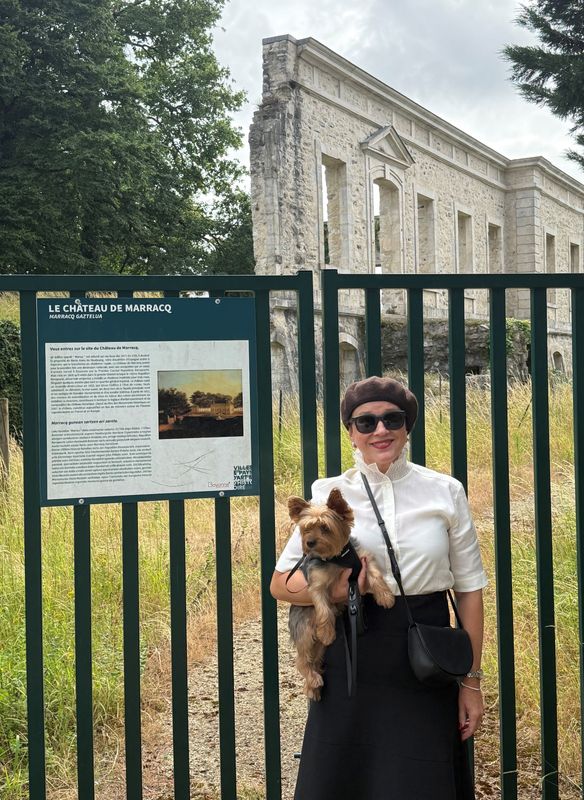
A forlorn ruin on the outskirts of Bayonne, situated between the Bay of Biscay and France’s Pyrenees border with Spain, Château de Marracq may seem an unlikely location for the exploration of the origins of the national liberation revolutions of Central and South America. But a meeting that took place here on May 5, 1808, initiated the process that eventually resulted in Colombia (1810), Venezuela (1811), Peru (1821), Panama (1821), Ecuador (1822), Bolivia (1825), and the rest of Central and South America gaining independence from Spain and Portugal in the 19th Century.

Since 1700, Spain has been ruled by the French Bourbons, with Louis XIV (1638-1715) placing his grandson, Philip V (1683-1746), on the Spanish throne after genetic diseases ravaged the pool of Habsburg dynasty applicants. Under the Habsburg king Charles V (1500-1558), Spain occupied a vast empire that extended in Europe from the Netherlands to Naples and in the Americas from Mexico to Peru. The outcome of the War of the Spanish Succession (1701-1714) required a guarantee that France and Spain remain sovereign, but they retained a close alliance. Together, the French and the Spanish Bourbons provided massive financial and military funding for the American Revolution—France and Spain had been bested by Britain in military and diplomatic endeavors in the past, and funding an anti-British, anti-royalist rebellion in North America suited both European monarchies’ geopolitical interests.
But when the ideas of the American Revolution traveled across the Atlantic Ocean and toppled the monarch who supported the American cause, Louis XVI (1754-1793), the Spanish, along with all the royal houses of Europe, feared the domino effect. After the violent excesses of the 1790s Reign of Terror, with the stabilizing figure of Napoleon (1769-1821) consolidating power and gaining international prestige, Spain decided to once again ally with France. Why? Because France was fighting Britain, Spain’s centuries-old foe, and thus the newly minted French Empire, with Napoleon at the helm, found a loyal ally in Spain during the naval Battle of Trafalgar (October 21, 1805), where the two continental powers were soundly defeated by Horatio Nelson (1758-1805)—hence his imposing pillar at London’s Trafalgar Square.
The affair at Trafalgar undermined Spanish and French trust, but Napoleon recovered from this loss with his spectacular victory at Austerlitz (December 2, 1805). And the Spanish royal house descended into dynastic discord, which Napoleon exploited at Château de Marracq in 1808. Napoleon invited both Charles IV (1748-1819) and his son, Ferdinand VII (1784-1833), for an audience. Nothing seemed more natural—Bayonne is situated on the border with Spain. But what the Spanish royals did not anticipate was the forced abdication of both kings and the eventual imprisonment of Ferdinand VII at the Château de Valençay (1808-1813), under the watchful guard of Napoleon’s foreign minister, Talleyrand (1754-1838). This political maneuver resulted in the placement of Napoleon’s brother, Joseph (1768-1844), on the Spanish throne, exacerbating the catastrophic Peninsula War (1807-1814) and precipitating the national liberation revolutions in Central and South America.
Francisco Goya’s (1746-1828) massive Prado-housed oil paintings, The Second of May and The Third of May (1814), and the 82 harrowing Disasters of War (1810-1820) etchings provide a brutal eyewitness account of the Napoleonic occupation of Spain. With central authority undermined in Madrid and uprisings breaking out sporadically against French control, the Spanish colonies saw their chance for independence. Enter Simón Bolívar (1783-1830), known as the Liberator, the South American revolutionary counterpart to George Washington (1731-1799), who initiated the anti-colonial national liberation movement in Venezuela.
The scion of a wealthy Venezuelan family, Bolívar was in Paris during Napoleon’s empire proclamation (May 18, 1804.) He attended the December 2, 1804, Notre Dame coronation, immortalized by Jacques-Louis David (1748-1825), and was in Milan when Napoleon was crowned King of Italy (May 26, 1805). During his subsequent stay in Rome, Bolívar juxtaposed the accomplishments of the Roman Republic against the overreach of the Roman, Spanish, and French empires and made a commitment to return to South America and initiate a fight against Spanish colonial rule. Inspired by the ideals of the American Revolution, Bolívar’s War of Independence, fought between 1810 and 1825, brought freedom to his native Venezuela, as well as Bolivia, Colombia, Ecuador, Panama, and Peru.
European imperial powers orchestrated one final attempt to regain control of their North American colonies. While the United States could not enforce the Monroe Doctrine during the Civil War (1861-1865), Emperor Napoleon III (1808-1873) placed the Habsburg Emperor Maximilian (1832-1867) on the Mexican throne, with disastrous consequences. But that’s a cautionary tale for another day.
Professor Anna Barker teaches in the UI College of Liberal Arts and Sciences Russian Program. She is a Fellow of the International Napoleonic Society and serves of the Board of Directors of the Napoleonic Historical Society. Her book “13 Notes from Napoleon, Iowa: Musings on the Edge of the French Empire” was published in 2025 (Ice Cube Press).
This article originally appeared on Iowa City Press-Citizen: The Age of Revolutions: From Napoleon Bonaparte to Simón Bolívar | Guest Column
Reporting by Anna Barker, Special to the Press-Citizen / Iowa City Press-Citizen
USA TODAY Network via Reuters Connect

By Anna Barker, Special to the Press-Citizen | USA TODAY Network