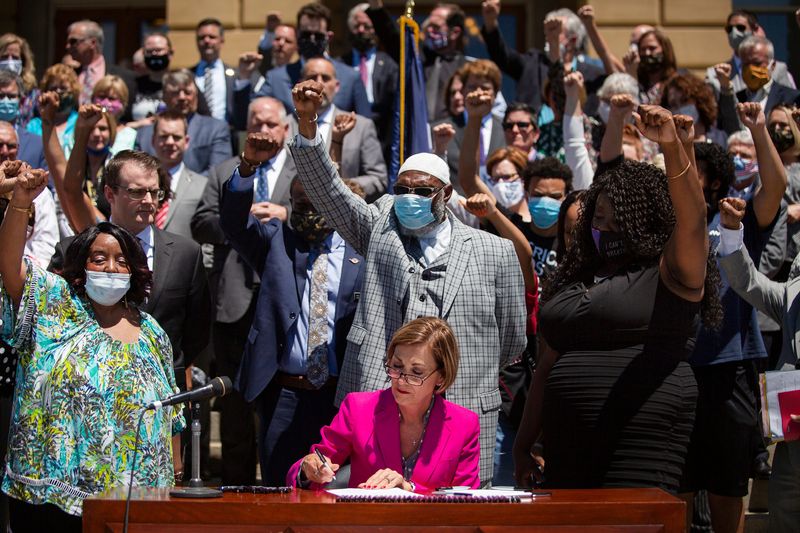
Requirements that law officers undergo annual implicit bias prevention training would be repealed under a bill headed to Gov. Kim Reynolds’ desk as GOP lawmakers move to scale back part of Iowa’s landmark law addressing police misconduct.
Senate Republicans passed House File 2711 to eliminate longstanding affirmative action plans across state agencies over Democrats’ objections that it would undermine community trust and deepen disparities facing underrepresented communities.

The bill passed in a 31-15 party-line vote on Wednesday, April 29, adding to Republicans’ comprehensive steps to ban diversity, equity and inclusion efforts across Iowa.
This would reverse part of the law that swiftly and unanimously sailed through the legislature in 2020 after the murder of George Floyd — a Black man — by White police officers in Minneapolis, sparking a nationwide reckoning with racial injustice.
The law requires law officers go through annual training on preventing implicit bias and de-escalation techniques. This bill leaves the de-escalation training requirements intact.
The bill also dismantles affirmative action plans and reporting requirements for multiple agencies, including the Iowa Department of Education, Department of Administrative Services, Board of Regents, Iowa Judicial Branch and other educational institutions.
Entities would have to report on their use and promotion of Iowa-based businesses instead of promoting minority and women-owned businesses.
Republicans said the bill will save taxpayer dollars by eliminating affirmative action requirements and staff positions dealing with those requirements.
Sen. Jason Schultz, R-Schleswig, said “a malicious ideology has crept into our state code” over the years and argued this bill “puts all Iowans on an equal footing under the law.”
“I sum it up as the soft racism of low expectations,” Schultz said. “This is a toxic belief that not all people are equal.”
The Senate Judiciary Committee previously advanced the bill with an amendment that struck language eliminating certain programs, including implicit bias training requirements, meaning it would have left the provisions of the 2020 law intact.
Senators reversed that change on the floor to keep the provision in the bill, leaving the measure as passed by the House in March.
Democrats warned it could risk federal funding should the law put the state out of compliance with the federal Civil Rights Act.
“No one in this state, no one here has been enforcing racial quotas for the last 10 years,” said Senate Minority Leader Janice Weiner, D-Iowa City. “Affirmative action is simply our promise that we will look everywhere for the best candidate for the job. Repealing that plan doesn’t promote merit. It returns us to the nepotism and corruption of the old system, when employers just look for their friends to hire, not the best possible candidates.”
Weiner cautioned against repealing implicit bias training, which she said help officers approach emergencies with knowledge about the wide range of cultures they may interact with on the job.
“How is it not in the interest of their community and of our taxpayers?” she said. “… It enriches us to learn about others, and it also enhances officer safety. This bill will accomplish none of the goals it purports to. It removes transparency from the government, encourages nepotism and cronyism takes important knowledge away.”
Sen. Herman Quirmbach, D-Ames, said the bill closes the door on opportunity for underrepresented Iowans and signals that their experiences don’t merit consideration in policymaking.
“Affirmative action was never about quotas or lowering standards,” Quirmbach said. “It was about making sure that the talent and opportunity are not limited by race, gender or background. It was about opening doors that had too often been closed.”
Marissa Payne covers the Iowa Statehouse and politics for the Register. Reach her by email at mjpayne@registermedia.com. Follow her on X at @marissajpayne.
This article originally appeared on Des Moines Register: Reynolds to decide on ending police bias training, keeping de-escalation
Reporting by Marissa Payne, Des Moines Register / Des Moines Register
USA TODAY Network via Reuters Connect