Just as rivers define Iowa, so they did Samuel Clemens.
The legendary American author and humorist drew heavily on his time as a Mississippi River steamboat pilot from 1857 to 1861 for works such as “Tom Sawyer” and “Huckleberry Finn” ― and for his pen name, Mark Twain. It was the phrase crewmen would shout to signal the water ahead was deep enough for navigation.

Around a quarter-century later, as a world-renowned storyteller living in green and peaceful New England, Clemens published his 1883 memoir, “Life on the Mississippi,” describing nostalgic visits to the mighty, muddy, restless river and the often-raucous events of his younger days there.
He wrote that most travelogues of the river began in New Orleans and ended at its midpoint in St. Louis, missing the “amazing region” that had grown up along the river to the north. That included his childhood home of Hannibal, Missouri, and Keokuk, where the mouth of the Des Moines River marks the beginning of a 310-mile stretch where the Father of Waters forms Iowa’s eastern border.
That was almost a quarter of his 1,200-mile journey to St. Paul, Minnesota, and he wrote that the newer, fast-growing communities along the river in Iowa were full of energy, “bristling with great towns, projected day before yesterday, so to speak, and built next morning.”
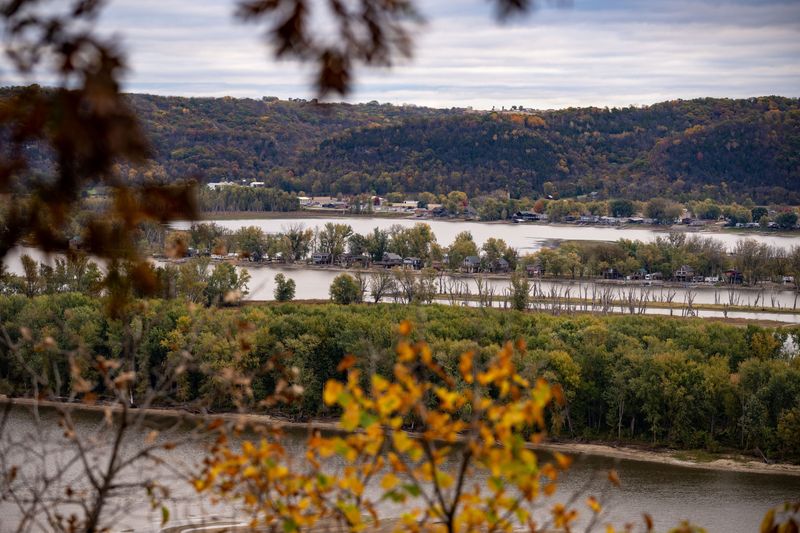
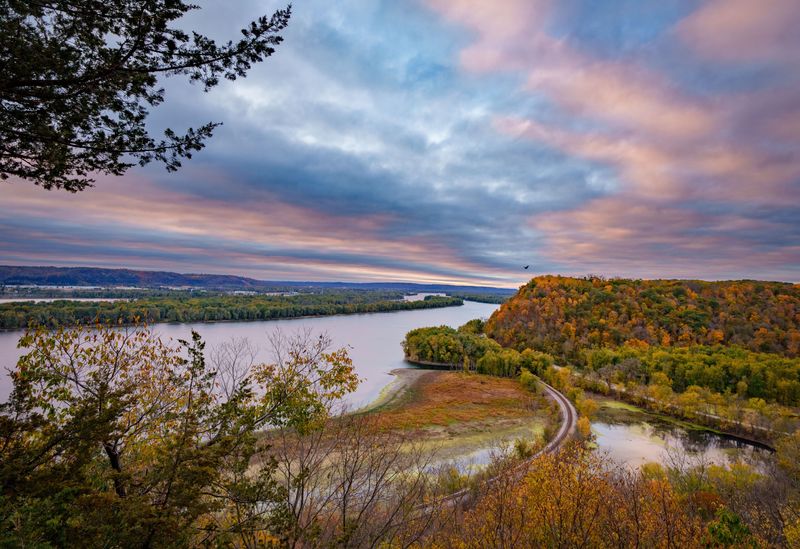
A resident of Keokuk and Muscatine during his piloting days, he spent the larger part of two chapters describing Iowa’s river towns and their neighbors on the eastern bank in and Illinois and Wisconsin on its eastern banks. As the United States celebrates its 250th anniversary, his description guides us on a photographic journey up the great river.
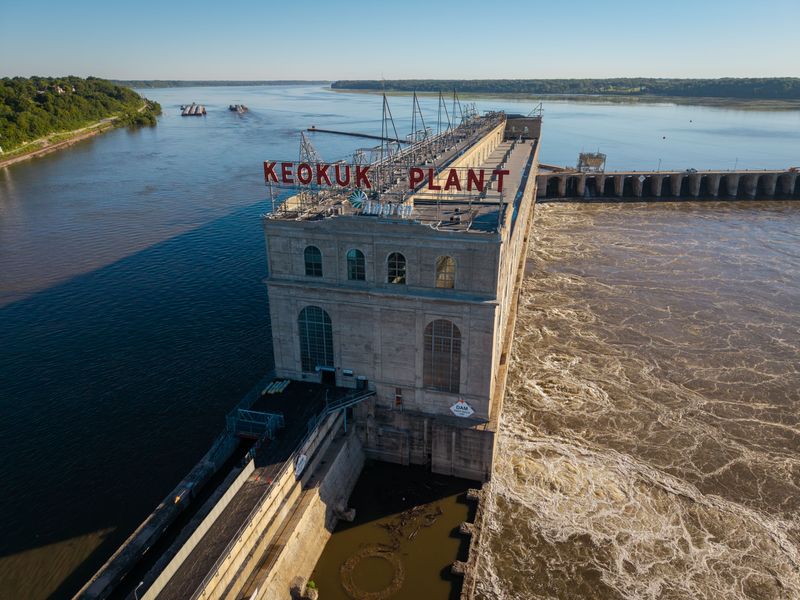
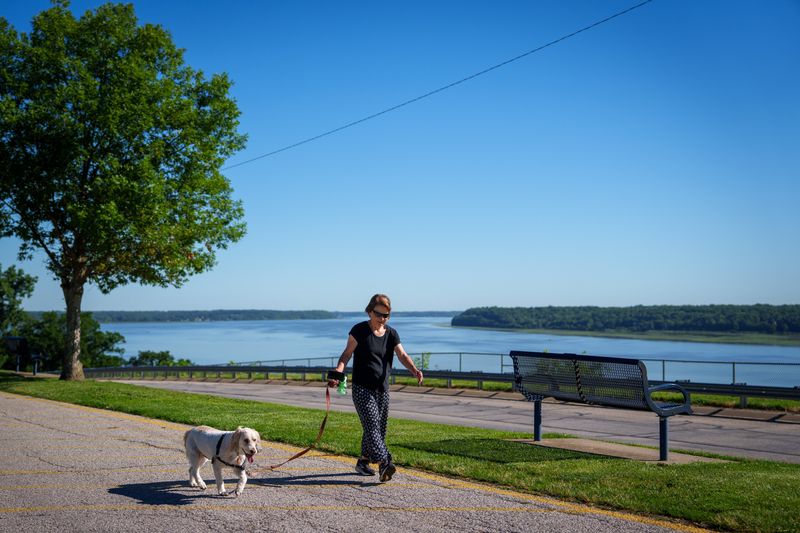
Keokuk | ‘Reputation of being a beautiful city’
“The town has a population of fifteen thousand now, and is progressing with a healthy growth. It was night, and we could not see details, for which we were sorry, for Keokuk has the reputation of being a beautiful city. It was a pleasant one to live in long ago, and doubtless has advanced, not retrograded, in that respect.”
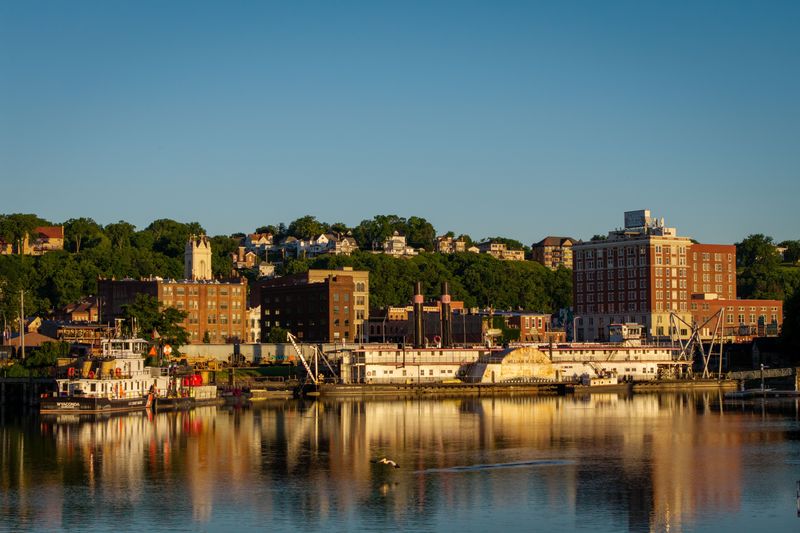
Burlington | Praise for the opera house
“In Burlington, as in all these Upper-River towns, one breathes a go-ahead atmosphere which tastes good in the nostrils. An opera-house has lately been built there which is in strong contrast with the shabby dens which usually do duty as theaters in cities of Burlington’s size.”
Muscatine | Meeting the ‘only son of the Devil’
“We had not time to go ashore in Muscatine, but had a daylight view of it from the boat. I lived there awhile, many years ago, but the place, now, had a rather unfamiliar look; so I suppose it has clear outgrown the town which I used to know. In fact, I know it has; for I remember it as a small place — which it isn’t now. But I remember it best for a lunatic who caught me out in the fields, one Sunday, and extracted a butcher-knife from his boot and proposed to carve me up with it, unless I acknowledged him to be the only son of the Devil. I tried to compromise on an acknowledgment that he was the only member of the family I had met; but that did not satisfy him; he wouldn’t have any half-measures; I must say he was the sole and only son of the Devil — he whetted his knife on his boot. It did not seem worth while to make trouble about a little thing like that; so I swung round to his view of the matter and saved my skin whole. Shortly afterward, he went to visit his father; and as he has not turned up since, I trust he is there yet.
“And I remember Muscatine — still more pleasantly — for its summer sunsets. I have never seen any, on either side of the ocean, that equaled them. They used the broad smooth river as a canvas, and painted on it every imaginable dream of color, from the mottled daintinesses and delicacies of the opal, all the way up, through cumulative intensities, to blinding purple and crimson conflagrations which were enchanting to the eye, but sharply tried it at the same time.”
Davenport | A ‘beautiful city, crowning a hill’
“We had a glimpse of Davenport, which is another beautiful city, crowning a hill — a phrase which applies to all these towns; for they are all comely, all well built, clean, orderly, pleasant to the eye, and cheering to the spirit; and they are all situated upon hills. …Davenport has gathered its thirty thousand people within the past thirty years. She sends more children to her schools now, than her whole population numbered twenty-three years ago.”
Rock Island | A ‘wonderful park’ and ‘fine forests’
“The charming island of Rock Island, three miles long and half a mile wide, belongs to the United States, and the Government has turned it into a wonderful park, enhancing its natural attractions by art, and threading its fine forests with many miles of drives. Near the center of the island one catches glimpses, through the trees, of ten vast stone four-story buildings, each of which covers an acre of ground. These are the Government workshops; for the Rock Island establishment is a national armory and arsenal.”
Dubuque | Home of a well regarded plow factory
“Dubuque has a great number of manufacturing establishments; among them a plow factory which has for customers all Christendom in general. At least so I was told by an agent of the concern who was on the boat. He said — ‘You show me any country under the sun where they really know how to plow, and if I don’t show you our mark on the plow they use, I’ll eat that plow; and I won’t ask for any Woostershyre sauce to flavor it up with, either.’”
Tete de Mort | ‘With death for a certainty’
“A few miles below Dubuque is the Tete de Mort — Death’s-head rock, or bluff — to the top of which the French drove a band of Indians, in early times, and cooped them up there, with death for a certainty, and only the manner of it matter of choice — to starve, or jump off and kill themselves.”
Pikes Peak | Bluffs charm with ‘soft beauty’
“The majestic bluffs that overlook the river, along through this region, charm one with the grace and variety of their forms, and the soft beauty of their adornment. The steep verdant slope, whose base is at the water’s edge is topped by a lofty rampart of broken, turreted rocks, which are exquisitely rich and mellow in color — mainly dark browns and dull greens, but splashed with other tints.”
Effigy Mounds | ‘Unholy train’ rips sacred solitude
“And then you have the shining river, winding here and there and yonder, its sweep interrupted at intervals by clusters of wooded islands threaded by silver channels; and you have glimpses of distant villages, asleep upon capes; and of stealthy rafts slipping along in the shade of the forest walls; and of white steamers vanishing around remote points. And it is all as tranquil and reposeful as dreamland, and has nothing this-worldly about it — nothing to hang a fret or a worry upon.
“Until the unholy train comes tearing along — which it presently does, ripping the sacred solitude to rags and tatters with its devil’s warwhoop and the roar and thunder of its rushing wheels — and straightway you are back in this world, and with one of its frets ready to hand for your entertainment: for you remember that this is the very road whose stock always goes down after you buy it, and always goes up again as soon as you sell it. It makes me shudder to this day, to remember that I once came near not getting rid of my stock at all. It must be an awful thing to have a railroad left on your hands.”
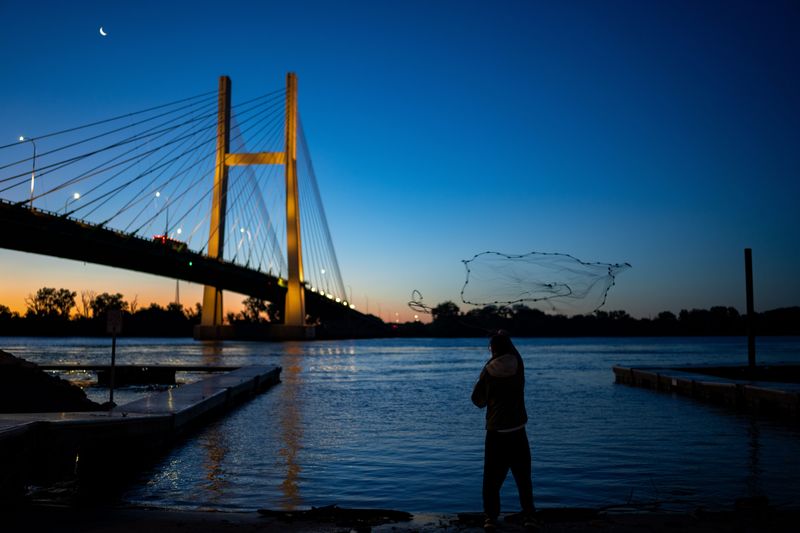
The river at night | ‘Strange, and fine, and very striking’
“Along here, somewhere, on a black night, we ran some exceedingly narrow and intricate island-chutes by aid of the electric light. Behind was solid blackness—a crackless bank of it; ahead, a narrow elbow of water, curving between dense walls of foliage that almost touched our bows on both sides; and here every individual leaf, and every individual ripple stood out in its natural color, and flooded with a glare as of noonday intensified. The effect was strange, and fine, and very striking.”
This article originally appeared on Des Moines Register: Iowa’s ‘Life on the Mississippi’ from Mark Twain to today
Reporting by Zach Boyden-Holmes and Bill Steiden, Des Moines Register / Des Moines Register
USA TODAY Network via Reuters Connect












By Zach Boyden-Holmes and Bill Steiden, Des Moines Register | USA TODAY Network