Tariffs are unfair, and our representatives should say so
Iowans who vacation in Las Vegas can see magician shows that feature distraction and sleight of hand. Here in Iowa distraction, and sleight of hand was practiced in an Aug. 17 Register guest essay by state Rep. Ryan Weldon and in comments by U.S. Rep. Zach Nunn. Their ploy is to distract from the damage done by President Donald Trump’s tariffs. This damage is lower farm income and higher prices of Chinese goods to Iowans.

They distract by using the term “fair trade.” It implies Weldon and Nunn are experts in “fair” trade. What is “fair” trade? Before Trump tinkered with tariffs, we in the U.S. bought cheap goods from China. Chinese citizens subsidized the production of these cheap goods and put up with environmental damage. This made Chinese goods cheaper to us in Iowa.
Plenty of Chinese people, including my former Chinese students, must be angry about this subsidized production and environmental damage in China. But the Chinese, before Trump’s tariffs, enjoyed low prices on grain shipped from Iowa. These prices were low because our government subsidizes agriculture. Our prices are low also because farm environmental damage, especially water pollution, is pushed downstream to urban areas and onto future generations.
Before Trump’s tariffs, the governments of China and the U.S. argued but arrived at tariffs and balance of payments including exchange rates. Were these agreements “fair”? Each country had a different view on that. But, one thing is certain. Both countries prospered. Iowa prospered.
What seems clearly unfair are the tariff-driven higher prices paid by Iowans for Chinese goods and by Chinese citizens who buy our grain. Iowa’s politicians should focus on tariff unfairness instead of trying to distract us like the magicians of Las Vegas.
Jon Lindgren, Des Moines
Republicans sign America’s death warrant by bowing to Trump
America’s new message we must convey to the world: “We’re so very sorry!”
Not a single second passes where unrelenting human suffering shouldn’t evoke America’s heartfelt sympathies, accompanied by committed, truthful, responsive action. That, however, appears to no longer be the case in President Donald Trump’s America. Truth, humility, and humanity are in short supply in a dictator’s world.
Whether we’re witnessing Trump’s incoherent blaming of Ukraine for war criminal Putin’s terrorizing murderous assaults and kidnappings, or Trump’s racially based warrantless detentions and deportations, or the deadly devastating consequence of his cuts to USAID, or his endorsement of Gaza starvations, or any of the voluminous other grotesque Trump administration practices and policies, the intentional abandonment of America’s principles is the root cause of our decline. For this, and much more, most of the world deserves an apology. Allies have been abandoned, enemies are being embraced.
Ever since taking office his second term, our convicted felon, twice-impeached, sexual predator, habitual liar, gerrymanderer in chief has only reinforced his disregard for the rule of law and the Constitution upon which our Country was founded. There are far too many irrefutable examples of Trump’s anti-American conduct to list, but the real crisis, in truth, lies elsewhere.
The real crisis is found in the lack of courage of Republican Party sycophants who are so cowardly and intimidated by Trump’s vengeance that they have sold their souls to their would-be king. Their One Big Beautiful Bill stands as a testament to their allegiance to Trump over country; their wholesale confirmations of unqualified, incompetent Cabinet officials demonstrates the same. The office of president of the United States has been co-opted for personal enrichment, vengeance, and ego. The office of president of the United States granted Jan. 6 criminals wholesale pardons. These honorable elected officials continue to sit idly by while presidential lawlessness reaches new heights.
First lady Barbara Bush sat on the Board of the Mayo Clinic in Rochester, Minnesota. One of President George H.W. Bush’s speeches is quoted in a Mayo exhibit. Regarding our nation, it reads, in part: “America is never wholly herself unless she is engaged in high moral principle.”
It is past time for America to tell the citizens of the world that we apologize for all of the harms they are now suffering, we are truly sorry, and we will work diligently to Make America Principled Again.
Dean Lerner, Des Moines
Stop buying ethanol to stand up for clean water and property rights
Are you upset that the Iowa Legislature refuses to do anything about the pollution of our drinking water? Are you upset that the governor served her big donors rather than the public by vetoing the bill to control eminent domain for carbon pipelines? One thing you can do, in addition to voting out the culprits, is to boycott ethanol. Ethanol is driving both of those problems, and by refusing to use it you can express your displeasure with how corporate agriculture is impacting our lives.
Jay Holmberg, Clive
Root causes of water problems goes unexplored
It’s mind-boggling to me that the Register continues to run seemingly a new story every day on Iowa’s water quality without ever looking into basic facts, root causes and the main actors.
Where are the numbers on comparable metros or ag states and how are they addressing similar situations? Why are we not directly asking Des Moines Water Works why it didn’t keep up on infrastructure or expand capacity over the past 20 years? Water utilities’ payroll and political power have grown, but the last new treatment facility groundbreaking I’m aware of was in 2006, when I was living in the metro.
The place has exploded with development and growth since then. Where’s the accountability, where are the questions for the leadership, what are they doing with all the rate increases? We all know there won’t be any answers or responsible adults looking out for us in the Iowa House or the Polk County supervisors’ boardroom, we know that much.
So let’s just run another story to keep everybody scared and nervous and talking about “water quality” with generic references to agriculture and the laughable lawn watering ban without addressing the underlying causes and the publicly paid actors who could and should be working on it.
Jacob Bender, Bellevue
Democrats seem unbothered by certain billionaires
In his recent Des Moines Register interview, Democratic senatorial aspirant Josh Turek shoehorned in liberal boilerplate castigation of “billionaires.”
Of course, when Democrats like Turek inveigh against billionaires, here are ones they never cite: George Soros, Bill Gates, Mark Zuckerberg, Michael Bloomberg, Warren Buffett, Illinois Gov. JB Pritzker, Mark Cuban, Jeff Bezos, and Reid Hoffman.
Why not? Because those and others of their ilk bankroll woke progressive Democrat and anti-American causes dear to Democrats’ hearts.
I’ll believe Turek’s and Democrats’ rhetoric re: wealth when they rail against those men, by name, instead of cashing their campaign contribution checks.
DC Larson, Waterloo
Public officials seek permission to discriminate
I am weary of people like former Kentucky county clerk Kim Davis who feign religious persecution to defend an absurd belief system, for what? So they can discriminate against others, as Davis did in declining to issue marriage licenses for same-sex couples.
I once listened to a lecture from a Holocaust survivor, and she stated that all people need is permission. The law is the only thing keeping some of us from becoming savages. I worry for my LGBTQ friends, and now President Donald Trump is targeting homeless people. If I know my history, it won’t stop there.
If your belief system can’t survive without an enemy or a scapegoat, perhaps it’s time to choose again.
Paul Lundy, Hiawatha
Housing is inadequate in smaller Iowa communities, too
Rekha Basu’s July 27 column highlights the struggles of working citizens in Des Moines who cannot afford housing despite full-time employment. Decorah, a small but well-developed Iowan town, faces similar challenges.
According to Northeast Iowa Community Action Corp., there are only about three low-income housing complexes in Decorah, while the U.S. Census Bureau reports that 7.7% of the town’s 7,454 residents live below the poverty line. This leaves a portion of qualifying residents without a place to live. Young professionals, such as recent graduates from Luther College or those starting at the local hospital, also struggle with rent. Local Realtors state that one-bedroom apartments can cost $800 to $1,000 per month, which eats a significant portion of someone’s income.
This situation reflects Basu’s observations in Des Moines, where full-time workers struggle to afford housing. Decorah shows how the affordable housing crisis extends beyond just large cities in Iowa. Small communities also face challenges to keep their residents housed. To address these gaps, the city must support rental assistance programs, expand housing options, and challenge mindsets that limit new development.
Just like Des Moines, Decorah needs more resources to advocate for the community to ensure there is a sustainable future in housing.
Leslie Campbell, Decorah
Why don’t clean energy tax credits lower my bill?
The July 22 story “Will Big Beautiful Bill raise your energy bill?” repeats an estimate from the Energy Innovation Policy and Technology that ”Iowans will pay $350 more for energy in 2025 because of the Big Beautiful Bill.”
This increase is due to the repeal of certain energy tax credits, along with domestic sourcing requirements again according to the Energy Innovation Policy and Technology. The story also refers to a comment by MidAmerican Energy that the credits are critical for keeping costs down.
The story then states that Energy Innovation Policy and Technology group says phasing out clean energy tax credits will hamper electricity generated in the United States. (I assume they mean clean energy.) Later the piece says that an analysis (no source is reported) “expects Iowa to lose wind and solar capacity by 2035. That could force utilities to rely more on natural gas, at higher prices, which they are expected to pass on to consumers.”
First, when hasn’t an increase, or decrease, in natural gas prices been passed on to consumers? Second, MidAmerican Energy, for one, has received $10 billion in credits to build the clean energy projects it currently has. Just because the money/credit comes from the state and federal government doesn’t mean it is free.
Those $10 billion in creits amounts to about $3,200 for each user in the MidAmerican system. Yet my energy bill goes up, not down. Where’s my share of this credit? Are we paying for this infrastructure twice? Once in the governmental subsidies and secondly in our bills for infrastructure? Third, wind and solar energy are not currently reliable on a 24-hour basis so we have to pay for a dual system so we can have energy at night. “Clean energy” needs a backup. The natural gas plants are and will remain that backup. Therefore, the price of the backup is already included in the “clean energy” package.
Matthew Gannon, Davenport
Iowa seems intent on avoiding spending on food assistance
Thank you for the Aug. 10 editorial exposing the flaws of Gov. Kim Reynolds’ Healthy Kids Iowa program. As the piece makes clear, Healthy Kids Iowa is a poor replacement for Summer EBT because it serves fewer than 10% of the families previously helped, the monthly pickup system is inconvenient for providers, difficult or impossible for families without transportation, and it limits participation by Iowa farmers. The entire programs seems designed not to work, but to avoid spending money on food-insecure Iowans.
When I visited the governor’s office with advocacy groups last month, I mentioned a refugee family that lives 4.5 miles from the distribution site with no transportation. I was told about “Healthy Kids Direct,” a little-known program that mails shelf-stable food — not the fresh items provided at pickup sites. It’s not listed on Iowa’s Department of Health and Human Services website, doesn’t meet federal guidelines, and is funded not by the feds, but entirely by the state. DHHS staff told me it’s very small and unlikely to expand — perhaps by design.
Pair this with added work requirements, and the result is fewer families receiving help and more children going hungry. That’s the opposite of “Healthy Kids.”
Thomas Rendon, Des Moines
Cut air and vehicle travel if we’re serious about climate change
An Aug. 10 guest essay addressed climate change and its threat to the future generations of America.
The author does not offer any suggestions of how to reduce carbon emissions, so I will offer two suggestions.
Do you remember when due to COVID-19 there was limited airline travel? Do you remember that when there was no airline travel the CO2 levels in the atmosphere dropped by 30%? Since most airline travel is a discretionary life choice, why not raise the cost of airline travel to the levels of the 1950s and 1960s, so that we can eliminate this needless insult to our fresh air.
They say that it is every American’s dream to own a home. I say that every American dreams of owning a car. Therefore it only makes sense that all immigration should be reduced or eliminated in an effort to hold stable or even reduce the number of energy-guzzling vehicles on the road.
So if we are really serious about our future generations, then we have to also get serious about our national debt crisis. So why don’t we forget politics and work together to insure a bright future for the upcoming generations of Americans.
Donald C Parsons, Sioux City
Iowans’ anger about water pollution is not abating
The Environmental Protection Agency’s decision to remove seven stream segments from the Iowa impaired waters list is a leap backward for public health and environmental quality. These segments, including parts of the Des Moines, Raccoon, Cedar, Iowa and South Skunk rivers, are known to have nitrate levels well above the drinking water threshold of 10 mg/L.
When nitrate flows unchecked into surface water, an undue and expensive burden is placed on water utilities or homeowners to ensure drinking water is safe.
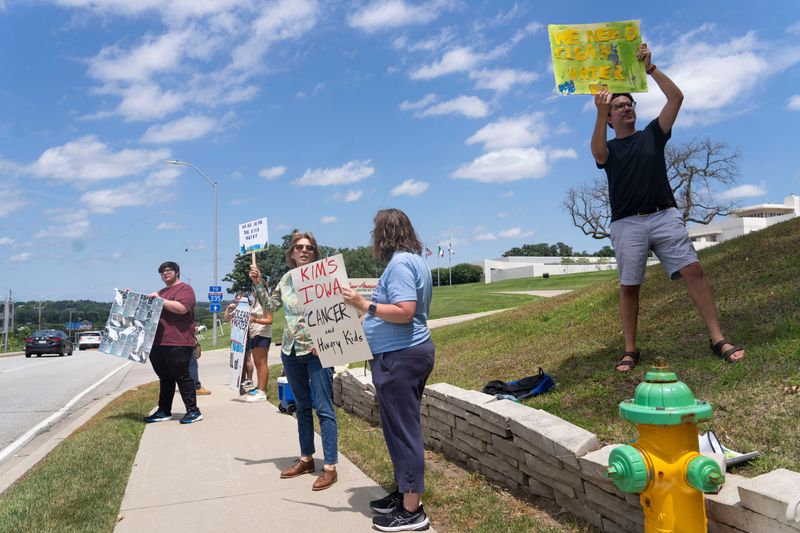
In a time when Iowans are more concerned than ever about water issues, EPA’s tone-deaf decision rings hollow. This summer, Central Iowa Water Works imposed a first-ever lawn watering ban because of high nitrate levels. Almost 900 Iowans showed up to learn from the scientists behind the Central Iowa Source Water Research Assessment. Over 700 Iowans requested Nitrate Watch monitoring kits just this summer. Iowans are paying attention. Our waterways need more protection, not less.
Removing waterways from the impaired list doesn’t make water quality issues disappear – it only hides them. Iowans must stay vigilant and continue to hold leaders and polluters accountable. Based on the concern we’ve seen this summer, it’s clear that Iowans will continue demanding clean water.
Terence Turnovsky, Cedar Rapids
This article originally appeared on Des Moines Register: Iowans’ anger about water pollution is not abating | Letters
Reporting by The Register’s readers / Des Moines Register
USA TODAY Network via Reuters Connect