Can artificial intelligence save Iowa taxpayers money?
Iowa House Republicans are considering spending $1.4 million to give it a try.

The money would pay a private technology company to study school and county government budgets across Iowa and find areas to potentially trim spending as lawmakers look to usher in property tax cuts.
While lawmakers aim to close in on legislation to cut property taxes in the legislative session’s final weeks, House Republican leaders said April 7 they are looking at a three-year contract with Texas-based Tyler Technologies to use AI to examine local budgets and recommend ways to make government operations more efficient.
The company’s analysis would look at all 99 county governments and 220 of Iowa’s highest-enrollment school districts, or about two-thirds of the total.
The $1.4 million would cover the first year, with $900,000 annually in subsequent years.
Lawmakers have not struck a deal with the firm but did receive a formal proposal from the company, said House Speaker Pat Grassley, R-New Hartford. He said this is the only company capable of using AI at the scale needed to analyze government budgets and provide line-item level spending data.
“If you’re going to reduce property taxes, we’ve been saying that there has to be efficiencies to be found at the local level,” Grassley said. “We feel us being able to have this tool that we can access that would be public facing, that if local governments would like to also access, this will revolutionize that conversation in a way that we’ve never been able to do before.”
Grassley said the House GOP caucus has indicated support for tapping Tyler Technologies since the company first approached legislative leadership about four months ago.
Mark Welch, with Tyler Technologies, pitched lawmakers on the partnership Tuesday morning during a House Government Oversight Committee meeting. He outlined how the company uses publicly accessible budget data and uses AI to sort it through “priority-based budgeting” to compare spending between local governments.
“… Most people say, ‘this is what we want to understand,’ right?” Welch said. “We want outcomes in our communities. We want to know that where we’re investing our money, we’re getting the outcome that we want, and we want to know that it’s aligned to our strategic plan, our goals or even what our function is.”
Gov. Kim Reynolds said she wasn’t ready to embrace the company, telling reporters she wants the state’s IT experts to take a look at the proposal to see if they believe the company can deliver on its pitch.
She said the state wants to find ways to help local governments make well-informed decisions about possible budget savings going forward.
“I commend them for looking at it and thinking about ways that we can help them,” she said. “We just need to make sure it’s a better way to do it.”
How would Tyler Technologies complete its analysis?
Welch said the company’s AI model has helped government entities across the U.S. cut millions of dollars in spending by flagging budget items where there appears to be outliers or overspending relative to peers. It has been developed over 12 years.
The state of Arizona and the Alabama Department of Corrections are among the agencies that have contracted with Tyler Technologies, as well as Collier County in Florida. Potential savings identified in Collier County include $1.3 million in energy rebates and $360,000 in electric bill reductions, the Fort Myers News-Press & Naples Daily News reported.
Welch assured lawmakers of the accuracy of the company’s AI model and said the company controls what it enters into its database, unlike large language AI models such as OpenAI’s ChatGPT.
He said the software also could take into account unique elements of counties and school districts, such as a school district’s geography and size when examining student transportation costs.
Analyzed data would be shared through a dashboard for counties and school districts to view.
How would lawmakers fund the contract?
In addition to the $1.4 million price tag for the initial analysis, Rep. Charley Thomson, R-Charles City, who chairs the House Government Oversight Committee, said it would cost $900,000 a year to continue analyzing local budgets.
He said the three-year contract term would allow lawmakers to “monitor how those changes carry through the system.”
Grassley said House Republicans could look to fund the contract through the chamber’s unlimited standing appropriation. If there is support from the Senate and governor, the measure could instead be added to a fiscal year 2027 budget bill.
Would this delay a resolution on property taxes?
While the Legislature would “love to have” this line-item level data on local spending before passing legislation cutting property taxes, Grassley said, this wouldn’t necessarily delay the other property tax proposals.
The Senate passed its property tax proposal Wednesday, April 8, but legislative leaders have not yet indicated there is consensus between the two chambers.
And Grassley said no one would be required to do anything with the information discovered through this tool. But he said the data could help officials pinpoint how school districts with high reading scores are spending their money and guide services that lawmakers invest in.
Grassley said there could be interest in expanding the company’s analysis to city and state agencies but felt this was a fair starting point given the cost.
Democrats urge ‘holistic’ approach to using data
Democratic lawmakers expressed skepticism over using AI to guide decisions about spending on social services and more broadly on whether the GOP-led Legislature would use the data to interfere with local priorities.
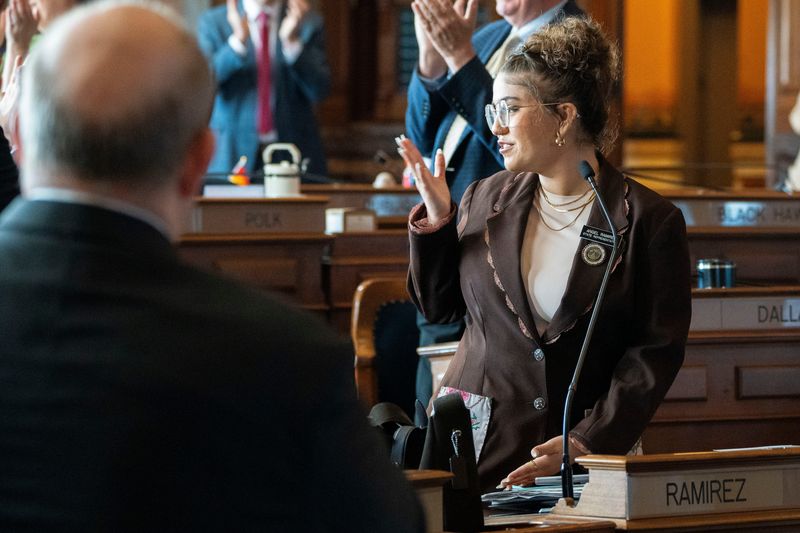
Rep. Angel Ramirez, D-Cedar Rapids, urged a “holistic” approach that uses qualitative data, like the more time-consuming process larger management firms undergo that combines quantitative data with interviews.
“When you start comparing how effective in terms of just money saving is this program versus this one in a different county, what we’re not getting into the full picture is the lives that were impacted of people who were helped,” Ramirez said.
Thomson did not commit to law changes to make private school spending data available for this sort of analysis when Democrats pressed him. Ramirez raised concerns about lawmakers “cherry picking” the budget data that gets analyzed and turning it into a “politicized resource.”
Rep. Steve Holt, R-Denison, said the partnership would enable the Legislature to look at how money has been spent in local entities, improve efficiency and increase services.
“There’s been no discussion about how we can impose priorities,” Holt said.
Des Moines Register Capitol Bureau Chief Stephen Gruber-Miller contributed to this article.
Marissa Payne covers the Iowa Statehouse and politics for the Register. Reach her by email at mjpayne@registermedia.com. Follow her on X at @marissajpayne.
This article originally appeared on Des Moines Register: Iowa House GOP may spend $1.4M on AI to identify local budget cuts
Reporting by Marissa Payne, Des Moines Register / Des Moines Register
USA TODAY Network via Reuters Connect