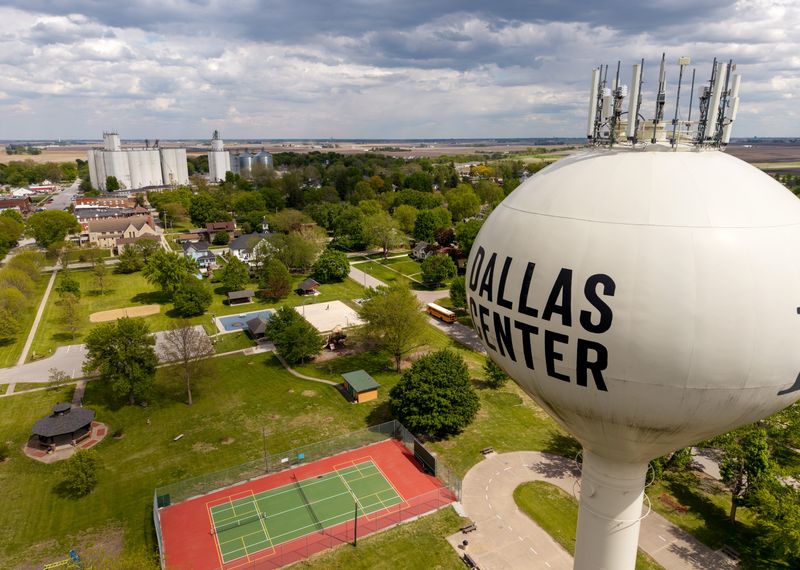
On the heels of its mayor’s abrupt resignation, Dallas Center leaders say the city is at a crossroads, grappling with internal conflict stymying progress and risking spiraling out of control — as it has in other central Iowa towns.
The issues center on a federal funding proposal that has drawn scrutiny over its claims, allegations against neighboring businesses, procedural missteps, and has fueled tensions between council members, staff and residents.

Millions of dollars and the future of critical infrastructure are at stake as the city of about 2,000 residents faces broader debates over water quality and science that have divided the country.
Dallas Center, a Dallas County community about 30 miles from downtown Des Moines, sits on the western edge of the metro area. It carries agricultural roots, but is increasingly shaped by the growth pressures spreading through one of the Midwest’s fastest-growing counties.
Now, a roughly $5 million Community Project Funding request through the office of U.S. Rep. Zach Nunn for a new water treatment plant has become a test of how Dallas Center handles those pressures.
The request is large by local standards, equaling a little more than half of the city’s projected 2027 annual budget and nearly five times its budgeted public works spending.
The push to assemble the strongest possible case for competitive federal money has generated a fight over the claims in the proposal and whether they reflected the city’s priorities and consensus.
A $5 million proposal drafted by one council member
The water proposal began with council member Shellie Flockhart, who took the lead on assembling the application.
By the time it reached public discussion at an April 21 council meeting, City Administrator John Cook had taken a yellow highlighter to several sections, flagging language he said had become a problem for the city.
“A lot of the questions are going to be directed to you, Councilwoman Flockhart, because you have been the driver and architect of the process,” Cook said at the meeting.
One of the issues, Cook said, was that the city had not yet decided whether to pursue a much more expensive reverse osmosis system or upgrade its existing zeolite softening system. The proposal, he said, read as though the decision to go with reverse osmosis had already been made.
Flockhart said she had four days to finish the application and did not get help from others.
“I was told to do it to the best of my ability right now,” Flockhart said. “No one said, ‘Hey, let me help you,’ or ‘Let’s review this together.’”
Cook said Flockhart never asked for help, and that he did not see the application until the day of the meeting, 20 days after it had been submitted.
“It would have been preferable to see the language before it was submitted,” Cook told the Register. “That would have allowed for review and correction before it was sent forward.”
He said the result was not just a rushed application, but a flawed one.
“When you ask the federal government for funds, your information should be accurate and up to date,” Cook said. “The materials that were provided were clearly inaccurate.”
He questioned how the proposal had been written, saying parts of it appeared to resemble artificial intelligence-generated text and even included prompts. Flockhart acknowledged using AI.
Mayor Pro Tem Angie Beaudet called for efforts to correct what had gone wrong.
“To be clear, we are not against water, and we are not against federal assistance,” Beaudet said at the meeting. “We are against a flawed process with inaccurate information.”
Flockhart, in a statement to the Register, said her focus remains on “delivering real, tangible results for the people of Dallas Center.” She did not respond to detailed questions about the proposal’s claims.
The fight is unfolding against the backdrop of Mayor Bret Van De Pol’s resignation in April, only a few months into his term, after a contentious April 14 City Council meeting.
Van De Pol did not cite the water proposal in his resignation letter, posted on the city’s Facebook page, but said “hostility, conflict, and escalation” tied to the mayor’s job had left him no longer confident in the safety of himself, his family or others serving in city government.
Dallas Center resident Jobe Hinders previously told the Register he was accused of threatening the mayor during public comment at the meeting, but said his comments were not a threat. Instead, he said they were a reminder “that it is our duty to stand up to corruption.” He said he was “not proud of my demeanor or the way I carried myself during the meeting.”
The Dallas County Sheriff’s Office said it opened an investigation into the incident and that reports could not yet be made public.
Draft proposal accuses local businesses of polluting Dallas Center water
The initial proposal did more than ask for money to replace and upgrade a water treatment plant.
It named two of Dallas Center’s largest local businesses — Stine Seed Company and Hy-Line International.
“Dallas Center is partially surrounded by experimental farmlands operated by two of the world’s largest farming innovators,” Flockhart wrote in the application, naming both companies.
The proposal stated that, although the city valued the companies’ work, their presence raised concerns.
The city recognizes “the potential risks associated with innovative practices, such as unknown impacts on water quality from experimental applications,” it read.
Another section tied those operations to the case for a reverse osmosis system.
“This proximity to experimental agriscience land heightens the need for an advanced RO system to effectively address potential emerging contaminants and ensure long-term water safety,” the proposal said.
At the April 21 council meeting, Cook called the claims “problematic.”
“There is no evidence to indicate that the activities of Stine Seed or Hy-Line have impacted the water quality,” Cook said. Including the claims could expose the city to lawsuits, he said.
Hy-Line International, which provided a letter of support for the project, was not aware of the proposal language until the Register shared it.
“Regarding the references from Councilwoman Flockhart, no, we were not aware that they had been added to the proposal,” Tom Dixon, head of global marketing for Hy-Line International, said in a statement. “We are investigating the matter with the Dallas Center city government to understand this issue better.”
Hy-Line has been a mainstay in Dallas Center for more than 60 years and many of its employees live in the community, Dixon wrote.
The company does not understand what those comments mean or how they apply to its Dallas Center operations, he said of the references to “experimental farmlands” and potential risks associated with “innovative practices.”
Stine Seed Company President Myron Stine said modern agriculture is regulated and monitored.
“Today’s farming operations, whether traditional or innovative, operate under strict testing, regulatory oversight, and ongoing improvement,” Stine said in a statement. “Protecting natural resources, including water quality, is not optional. It is a core part of how modern agriculture functions.”
Evidence doesn’t back claims on fluoride, water quality, expert says
The city’s proposal also raised concerns about fluoride and children.
“Our town includes two schools where children are at risk from fluoride levels that recent studies have associated with slower brain development,” Flockhart wrote in a letter of support.
Another support letter from state Sen. Jesse Green, R-Boone, said Dallas Center’s aging system faces “real challenges,” including “lingering public questions about long-term fluoridation effects.”
The claims about fluoride and nearby businesses do not match existing research or the city’s data, said Jerald Schnoor, a University of Iowa environmental engineering professor.
“Their level is around 0.4 or 0.5 milligrams per liter,” Schnoor said of city water fluoride levels. “That is actually close to what many cities target for preventing cavities.”
Cities across the United States have added fluoride to drinking water for decades to reduce tooth decay, and the Centers for Disease Control and Prevention named community water fluoridation one of the 10 great public health achievements of the 20th century.
Schnoor said no research indicates such fluoride levels pose any risk.
“At very high levels, fluoride can be a problem, but the reports of brain development impacts are at much higher levels than” those found in Dallas Center, he said. “I would not have any concerns about that level for children.”
Emerging contaminants in drinking water are a real concern, but tying them to specific local businesses requires evidence, Schnoor said.
“Unknown chemicals in drinking water are always a concern,” Schnoor said. The draft went further than the evidence allowed, he said.
“Until they really have data to show chemicals in the water coming from industry, it is speculation,” Schnoor said. “I would call it anecdotal until there is measurable proof.”
Dallas Center’s most recent water quality report, which was included in the April 21 council meeting packet, shows no reported violations and that regulated contaminants were below federal limits. Fluoride averaged about 0.47 parts per million in 2024, below the EPA limit of 4.0 ppm, while lead, copper and disinfection byproducts also measured below federal thresholds.
The report does show hard water characteristics, including naturally occurring minerals and sodium, which can affect taste, leave buildup in plumbing and wear down appliances, but those are not identified as safety violations.
National politics seep into Dallas Center’s water fight
The dispute landed as water quality, cancer rates and fluoride have become political flashpoints heading into the 2026 election cycle.
High nitrate levels in the Des Moines and Raccoon rivers last year prompted Central Iowa Water Works to impose its first mandatory lawn-watering ban across much of the Des Moines metro to reduce demand and preserve treatment capacity.
Those concerns reached Dallas Center, which draws water from an alluvial aquifer near the Raccoon River that naturally filters much of the nitrate. It is still considered susceptible to contamination.
Iowa continues to report the second-highest rate of new cancers in the country and is one of two states with a rising cancer incidence rate, according to the Iowa Cancer Registry.
The fluoride language in the Dallas Center proposal also echoed a renewed national fight over fluoridation.
Health Secretary Robert F. Kennedy Jr., a leading voice in the Make America Healthy Again movement, has made fluoride a target, saying in 2025 that he planned to tell the CDC to stop recommending fluoridation in drinking water. Dental and public health groups continue to defend fluoridation as a cavity-prevention measure.
Flockhart is vice chair of Moms for Liberty’s Dallas County chapter, part of a conservative political nonprofit that has pushed for book removals and “parental rights” legislation. She is an advocate of Kennedy’s MAHA movement.
Kina Clark, a Dallas Center resident, like others in the community, sees a connection between the proposal Flockhart submitted and Nunn’s 2026 reelection goals.
“He can claim a victory that he does care about water quality, and she can claim a victory that we’re removing fluoride from the water,” she said.
On the other side, local activist Julie Becker cast Flockhart as the person who “brought us to the dance” and accused Cook of trying to undercut her work.
“Dallas Center needs to FIRE its City Administrator!” Becker wrote on Facebook after the April 21 meeting.
Becker said Cook “interrogated” Flockhart about the process of getting the $5 million request and accused him of controlling a “scripted narrative ambush.”
“She deserves the City’s loyalty and support to see it through,” Becker wrote of Flockhart.
Nunn’s office rejected the idea that political considerations were involved and said the request was a straightforward infrastructure project.
“This is a clean water project for a small Iowa town with documented infrastructure needs and a bipartisan list of local backers,” Nunn’s office said in a statement to the Register. “Rep. Nunn requested federal funding because clean drinking water is a basic priority for Iowa families — and a priority reflected in 62 pages of letters of support from local businesses, officials, and residents submitted with the Dallas Center application.”
Nunn’s office, as part of the congressional process, receives proposals and letters of support from local governments before revising and repackaging them into formal funding requests. Dallas Center’s application was forwarded for consideration.
If approved, Dallas Center would still need to finalize the treatment system and secure more than $1.5 million in local funding if it chooses the more expensive reverse osmosis system.
A “corrected” version of the proposal obtained from the city through an open records request shows the earlier narrative-style draft had later been reformatted into a standardized application spreadsheet with structured tables and factual entries.
The revised version, prepared with Nunn’s office, no longer included the earlier references to fluoride concerns or allegations tying nearby businesses to possible water contamination.
Cook said he sees broader politics bleeding into local decision-making.
“It definitely feels that way,” Cook said. “There is a sense that broader political dynamics are influencing local decision-making.”
At the April 21 meeting, council member Kody Nielsen said the dispute had become too confrontational.
“There is a little bit of a ‘me versus you’ mentality right now,” he said. “That is not where we should be as a council.”
Cook said the city is trying to lower the temperature.
“We are just trying to run the city and get clean, safe water to people,” he said.
Nick El Hajj is a reporter at the Register. He can be reached at nelhajj@gannett.com. Follow him on X at @nick_el_hajj.
This article originally appeared on Des Moines Register: How a small Iowa town’s $5 million water proposal spilled into turmoil
Reporting by Nick El Hajj, Des Moines Register / Des Moines Register
USA TODAY Network via Reuters Connect