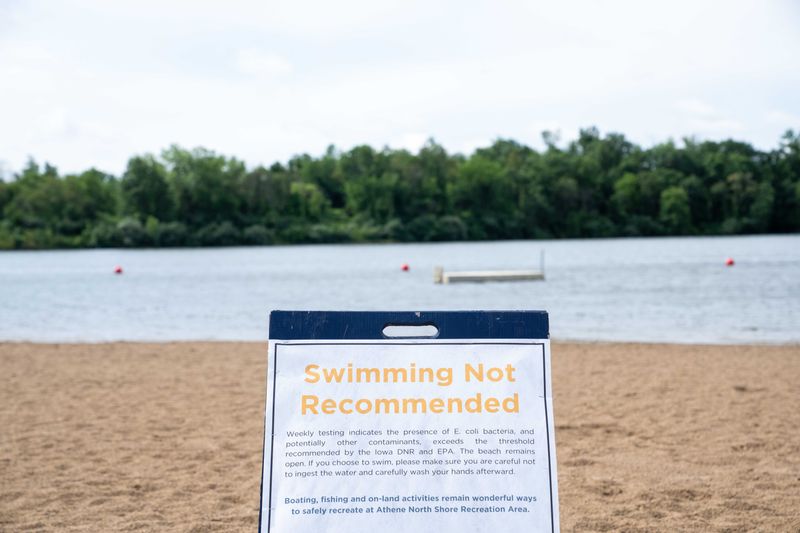
Iowa’s list of beaches not recommended for swimming dwindled week, but not by much. Twelve beaches monitored by the Iowa Department of Natural Resources had high test results for algae or high E. coli. A beach monitored by Polk County also reported high E. coli levels.
Wondering how can you check up on water monitoring, beach classifications and know what locations are open or closed? Iowa Department of Natural Resources tracks it all and updates the public weekly on its website and using a phone hotline at 515-725-3434.

The DNR collects weekly samples at 39 state-owned swimming beaches to determine the public’s risk of coming in contact with waterborne diseases. Testing starts a week prior to Memorial Day and runs through Labor Day.
What Iowa DNR beaches are not recommended for swimming?
Backbone Beach
Beeds Lake Beach
Black Hawk Lake Beach
Blue Lake Beach
Lake Ahquabi Beach
Lake Darling Beach
Lake Manawa Beach
Lake of Three Fires Beach
Nine Eagles Beach
Pine Lake South Beach
Pleasant Creek Beach
Union Grove Beach
What Polk County beach is not recommended for swimming?
What Iowa beaches have a special status?
What beaches have improved to ‘OK for swimming’?
Four beaches have seen improved water quality and have been removed from the not recommended for swimming list from week 8 data, posted on July 11, to week 9:
How does the Iowa DNR classify Iowa’s beaches based on their water quality?
DNR officials classify state park beaches into one of three categories annually based on their history of bacteria results in recent years:
Vulnerable: Beaches are considered vulnerable when the geometric mean standard is exceeded in three or more of the five most recent sampling seasons.
Transitional: The beach’s geometric mean standard is exceeded in two or fewer sampling seasons of the five most recent years of monitoring and was listed as “vulnerable” in the past monitoring seasons.
Less vulnerable: The beach’s geometric mean standard is exceeded in two or fewer sampling seasons of the five most recent years of monitoring and was listed as “transitional” or “less vulnerable” in past monitoring seasons.
Victoria Reyna-Rodriguez is a general assignment reporter for the Register. Reach her at vreynarodriguez@registermedia.com or follow her on Twitter @VictoriaReynaR.
This article originally appeared on Des Moines Register: Don’t swim at these 13 Iowa DNR, Polk County beaches with high E. coli and algae levels
Reporting by Victoria Reyna-Rodriguez, Des Moines Register / Des Moines Register
USA TODAY Network via Reuters Connect